Review date: 2026-11-18
Author: Zhongzhu Zhou
Paper reviewed: Phrase-Level Speculative Decoding on a Frozen Target
Paper author: Madhusudhana Naidu
arXiv: 2611.12464
Version and date: v1, 2026-11-09
1. What I take from the paper
I find the paper’s useful idea in a change of representation. The drafter need not use the vocabulary of the model whose output it accelerates. It can predict a compact symbol for a longer string, expand that symbol into ordinary target tokens, and let the unchanged target decide which tokens survive. This separates the unit that is cheap to predict from the unit that determines the served answer. The target’s tokenizer, weights, and greedy decision rule remain fixed.
This is attractive when several predictable characters or words occupy many target tokens. A vocabulary entry can represent mathematical formatting, a common reasoning fragment, or a word fragmented by the target tokenizer. One classification decision then offers several target tokens for verification. The head is small because it reads a hidden state already produced by the target, rather than running another substantial language model. The difficult part is choosing entries that are both long and predictable at the actual prefixes visited during generation.
I would describe the contribution as evidence for a useful design axis, with an informative account of its present limits. I would not infer that phrases generally beat well-trained token drafters. The main comparison uses Qwen3-4B, a single A5000, batch one, greedy output, and small prompt sets. The larger phrase head beats the paper’s EAGLE-3 tree-16 operating point on its two mathematical sets but loses to tree-60 on all three sets. The small head trades additional latency for a much smaller parameter budget. Those are different claims and deserve different axes in a comparison.

Figure 1. Original explanatory diagram based on the paper’s abstract and Sections 1 and 4. A phrase is expanded before the target sees it. The final authority is a target-token argmax, so proposal errors normally waste work rather than change output.
An especially useful observation is that the measured benefit is largely a formatting benefit. On the mathematical workloads, punctuation and LaTeX entries account for much more accepted work than ordinary English words. The term phrase therefore needs care: the paper’s units come from a regex in which standalone punctuation counts as a word. A three-word entry can be a short LaTeX fragment. I think this makes the paper more interesting, because it exposes the low-entropy structure the drafter can actually exploit.
I read the complete ten-page v1, including all nine tables and the references. There is no separate appendix in this version. Equations and algorithms below are my paper-level explanations unless explicitly identified as the paper’s equation. Numerical examples marked illustrative are not model experiments. I have not retrained a head or measured GPU inference. The review separates reported measurements, arithmetic I recomputed, and experiments I would want before deployment.
2. Prerequisites: tokens, proposals, and a target pass
2.1 Token IDs are the target’s interface
Let the target tokenizer be , its token vocabulary be , and its conditional distribution be . Given a target-token prefix , greedy decoding emits
A tokenizer determines how a byte string becomes IDs. A proposal vocabulary need only provide a deterministic map from its entries to valid sequences of those IDs. It does not need an embedding row inside the target. This is why a phrase vocabulary can change without modifying the target’s vocabulary or output projection. The proposal head’s last layer classifies its own entries; expansion supplies the IDs the verifier consumes.
For some tokenizers, pretokenization prevents merges across particular boundaries. The paper motivates its method with whitespace boundaries in the Qwen tokenizer. I would keep that statement local to the tokenizer under discussion. It is not a theorem about every BPE tokenizer: regular expressions, whitespace attachment, normalization, and special-token handling vary. The general argument needs only a mismatch between useful proposal units and the target’s atomic tokens.
The useful quantity is often fertility, such as target tokens per word. But fertility alone cannot predict acceleration. A long word split into many pieces is valuable only when the drafter can predict it at a visited prefix, and when enough of its expansion agrees with the target. Language-wide averages also conceal a request’s mixture of code, equations, names, and ordinary prose. A serving policy needs the distribution at decoding positions, rather than a single language label.
2.2 Why one pass can verify several tokens
A causal target can score a proposed sequence in parallel by teacher forcing. Logits at each position use the committed prefix and the proposal tokens before that position. As soon as a proposal token differs from the target argmax, later logits along that continuation are conditional on an uncommitted token and cannot justify accepting the suffix. Verification must stop at the first mismatch along a path.
Multiple candidate sequences can share prefixes. A prefix tree represents a shared target-token prefix once. A tree attention mask allows a node to attend to the committed context and its own ancestors; it must forbid attention to siblings. Position IDs encode depth along a candidate path, not arbitrary flattened row numbers. These are semantic conditions of a correct verifier, even though the paper does not provide an exhaustive mask or cache protocol.
A target pass can also supply one target-selected token after the accepted speculative prefix. If every candidate fails immediately, this fallback still advances greedy generation by one token. The arithmetic floor of one token per pass is useful for understanding the paper, but it is not a floor of one-times speed: a failed pass can be slower than an ordinary one-token target invocation.
2.3 Three different budgets
I distinguish proposal slots , unique verifier rows , and accepted tokens . The first counts proposed entries; the second counts their expanded and prefix-merged target positions; the third counts work that becomes part of the answer. Increasing can increase without increasing . Conversely, sharing prefixes can keep small even when many entries are proposed.
This matters because an entry’s nominal word count is neither its verifier cost nor its accepted reward. A long expansion may fail on its first token. A short entry can be useful as a prefix fallback. Reserving candidate slots for short entries is a way of retaining that option, but it consumes slots that could have held longer candidates. There is a resource allocation problem even before one considers the target’s GPU kernel.
3. Constructing and learning a useful proposal vocabulary
3.1 The representation contract comes first
Write the proposal vocabulary as . Each entry has an expansion into target IDs at prefix . I include because tokenization at a string boundary can depend on preceding bytes. An implementation may avoid this dependence by storing target-ID sequences at verified token boundaries, or may explicitly resolve boundary context. The paper does not settle every case, so I would not silently equate independently tokenizing a phrase with tokenizing that phrase inside a complete continuation.
For an entry represented as target IDs, expansion is simple concatenation. For a string entry, a robust representation contract must address leading spaces, Unicode normalization, byte fallback, partial words, special tokens, and whether decoding then re-encoding preserves the intended IDs. These are properties of the proposal-to-target interface. The greedy verifier can reject an unexpected expansion safely, but a wrong interface can erase all the intended speed advantage or mishandle a stop condition.
The paper builds entries from target-distilled mathematical completions and uses one- to three-unit spans. Half of the 8,000-entry vocabulary is reserved for single-unit entries: 4,003 such entries and 3,997 multi-unit entries are reported. The single-unit fraction is approximately one half rather than exactly 4,000 because the realized vocabulary follows its construction rule. I would preserve the reported counts rather than round them into a different training configuration.
3.2 Longest match resolves labels, not verification
At a supervised position, several entries can match the following string: a word, that word plus punctuation, or a longer phrase. Greedy longest match chooses a target label among these overlaps. That is a labeling convention. It does not mean that the inference system must accept the longest proposed phrase, or that a shorter matching prefix becomes invalid.
The head reads a target hidden state and produces a distribution over . A conventional explanatory objective is cross-entropy against the selected entry label,
where denotes the training positions included in the feature budget. This equation explains the classification task; v1 does not specify a complete loss and sampling protocol from which I could reconstruct all training decisions. In particular, positions omitted by the feature budget can change which continuations the head learns. The online experiment explicitly reports that many generated positions never entered training.
A longest-match classifier is also not automatically a banked-token optimizer. Cross-entropy rewards the selected label. Serving rewards accepted target tokens per unit time. These objectives align when a frequent long entry is predictable and cheap to verify, but they can disagree when overlapping short entries are under-ranked, when a rare long entry dominates a label, or when a candidate has a large expansion that almost always fails early.
Algorithm 1. A conceptual vocabulary and labeling procedure
This is my reconstruction of the paper’s vocabulary-level idea, not an assertion of an undocumented training recipe. Boundary validation is an explicit requirement of the target interface.
01  Collect target-generated completions from a training split.
02  Split each completion with the declared word/punctuation rule.
03  Count eligible spans of one, two, or three regex units.
04  Choose a vocabulary under V, retaining a single-unit quota.
05  Associate each entry with a boundary-valid target expansion.
06  For each retained hidden-state position in the feature budget:
07      Enumerate vocabulary entries matching its future suffix.
08      Use the longest eligible match as the supervised label.
09  Fit the small classification head on these labeled positions.
10  Validate candidate recall and accepted-token yield separately.
Steps 4 and 8 explain why short-prefix coverage deserves its own accounting. A phrase-only top- could evict short entries with high practical utility. Reserving short-entry slots can preserve a word-level alternative, but a proof of weak improvement requires a fixed comparator whose candidates really remain available. It does not by itself prove lower latency: preserving more candidates may enlarge the tree, and training a shared classifier may change their scores.
3.3 Why the small head is plausible
The target hidden state already encodes the full committed context. A shallow head can exploit it to classify a highly repetitive output pattern without independently reconstructing that context. The paper reports that deeper, attention-based, and convolutional alternatives did not improve its search, and that width was more useful than additional depth under the tested budgets. That evidence favors a simple design here, not a universal limit on more expressive drafters.
The alternatives remain useful in other regimes. Retrieval can provide rare exact strings when the relevant material is in a datastore. An autoregressive drafter can condition later guesses on earlier guesses. A larger neural head may help a varied domain if it has enough data. Changing the target tokenizer can improve all subsequent target computation, but also changes the model interface and usually training requirements. The phrase head’s appeal is that its proposal representation can change independently of the target.
4. Exact greedy verification, trees, and cache state
4.1 The mask must describe a path
Let the committed context be and a node’s path be . The logits used to test must be those conditioned on . Flattening candidates into one array is only a storage choice. If sibling paths can attend to one another, they no longer represent independent continuations of the same prefix. If position IDs increase with flattened row index instead of path depth, RoPE can encode a different sequence from ordinary decoding.
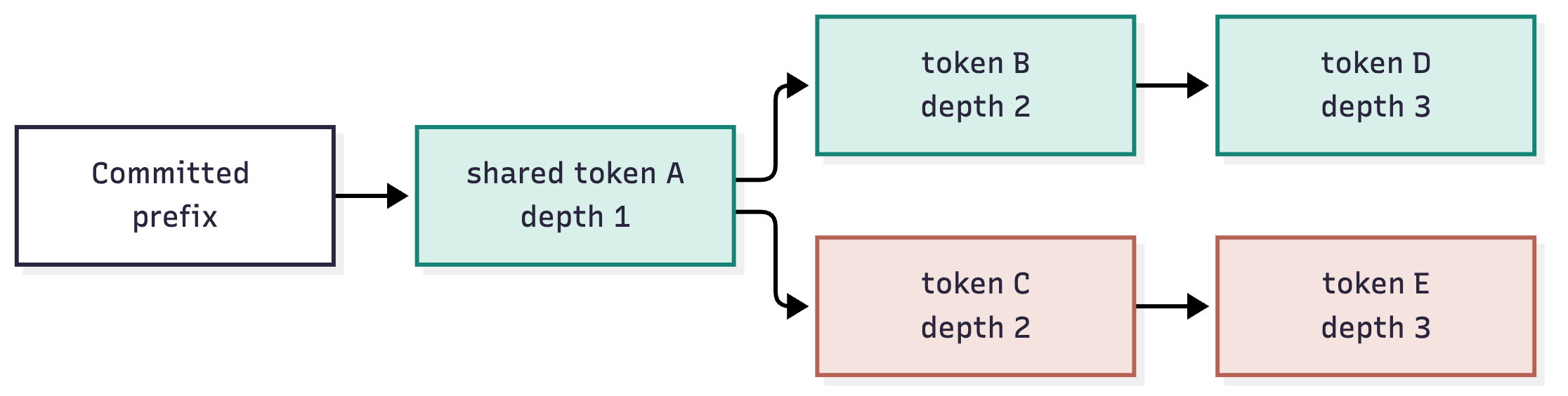
Figure 2. Original conceptual tree based on the paper’s prefix-tree description. The two continuations share their first target token. Their remaining rows are sibling branches, not consecutive text. Only the branch that matches the target can enter the committed cache.
There is a second state boundary after acceptance. A verifier may temporarily compute KV states for every candidate. Only KV states belonging to the accepted path can become part of the persistent context. The target-selected bonus token is part of the emitted output; its KV may need materialization on the next pass. Treating speculative branches as committed history is a semantic error, regardless of how accurately the head predicts phrases.
4.2 A short proof explains the guarantee
Assume deterministic target evaluation, the same causal context and positions as baseline, compatible numerical precision, and the same argmax tie rule. Suppose the committed prefix equals the baseline greedy prefix. At a candidate node whose ancestors have matched, the target conditions on exactly that prefix. Accepting its next token only when it equals the target argmax therefore preserves equality. Induction along the accepted path preserves the entire speculative block. Emitting the target’s own next argmax preserves equality for the bonus token too.
The guarantee does not require an accurate proposal distribution. A terrible head merely creates many rejected candidates. But it does require the verifier’s logits to represent the correct conditionals. Floating-point differences can arise because a tree pass and a one-token pass use different kernels or reduction shapes; a near tie may change the argmax. The paper accordingly qualifies identity by floating-point tie-breaking. I would report actual token equality with explicit numeric settings instead of turning that qualification into a blanket bitwise promise.
Algorithm 2. A conceptual greedy tree-verification pass
The bonus-logit and cache steps below state the required semantics. They do not prescribe a particular target API or storage layout.
01  Start from a committed prefix identical to greedy baseline.
02  Score proposal entries from the latest target hidden state.
03  Select N entries, including the declared short-entry quota.
04  Expand entries into target IDs; merge identical prefixes.
05  Assign path depths and an ancestor-only attention mask.
06  Evaluate the target on this tree and the committed context.
07  Follow a path only while each token equals target argmax.
08  Select the longest surviving prefix, using a fixed tie rule.
09  Emit that prefix and the next target-selected token, if allowed.
10  Retain only accepted-path KV; discard other speculative rows.
11  Apply EOS, output-length, and external stop rules in order.
12  Continue from the resulting committed state.
At line 9, EOS and the requested output cap can suppress the bonus. If a stop string begins inside a phrase expansion, the service must apply its normal stopping policy at the corresponding target-token boundary. One should not count the whole phrase merely because it came from one proposal entry. These conditions become important when comparing generated lengths or using aggregate seconds as the speed metric.
4.3 This is a greedy guarantee
Matching an argmax is not a distribution-preserving sampling algorithm. At nonzero temperature, exact speculative sampling requires acceptance and residual sampling rules that reconcile proposal and target distributions, including the probability mass of overlapping phrase paths. The paper’s evaluation uses temperature zero. It establishes neither that extension nor its latency. I would keep stochastic serving outside the demonstrated claim.
Even with correct greedy output, speed composition is not automatic. Combining a phrase head with deeper neural drafting may add serial work or alter candidate overlap. Combining it with quantized KV can alter target logits and thus the target being matched. The phrase representation is conceptually independent of tree shape; a realized system still has to measure the combined verifier, cache, and numerical behavior.
5. Deriving the useful-work and latency models
5.1 Accepted length is conditional
Let be the number of speculative target tokens accepted in a pass, the event that at least one speculative token lands, and . Ignoring terminal truncation, the pass emits tokens. Splitting on gives
This is a precise interpretation of the paper’s Equation 1. It requires the second factor to be the mean number of tokens actually banked conditional on landing. Replacing it with the mean expansion of arbitrary vocabulary entries changes the quantity. Expansion is measured before verification; banked length is measured after selecting and verifying candidates. Their distributions need not agree.
Using the main head’s reported tokens per pass and landing rates, I obtain approximately 2.23 banked tokens per landing for GSM8K, 2.19 for MATH-500, and 1.54 for MT-Bench. These are arithmetic diagnostics, not newly observed measurements. They show why a landing probability alone cannot explain the transfer gap: both landing and conditional accepted length fall.
For a single proposed path with token-level conditional match probabilities , the expected accepted prefix length is
The first equality is the tail-sum identity. The product uses probabilities conditioned on all preceding tokens matching; it is not an assumption that token matches are independent. Under the illustrative constant- case, the expression becomes . A longer proposal then has diminishing value, especially when the first token is difficult. A tree replaces the single-path event with the event that at least one represented path survives to a given depth.
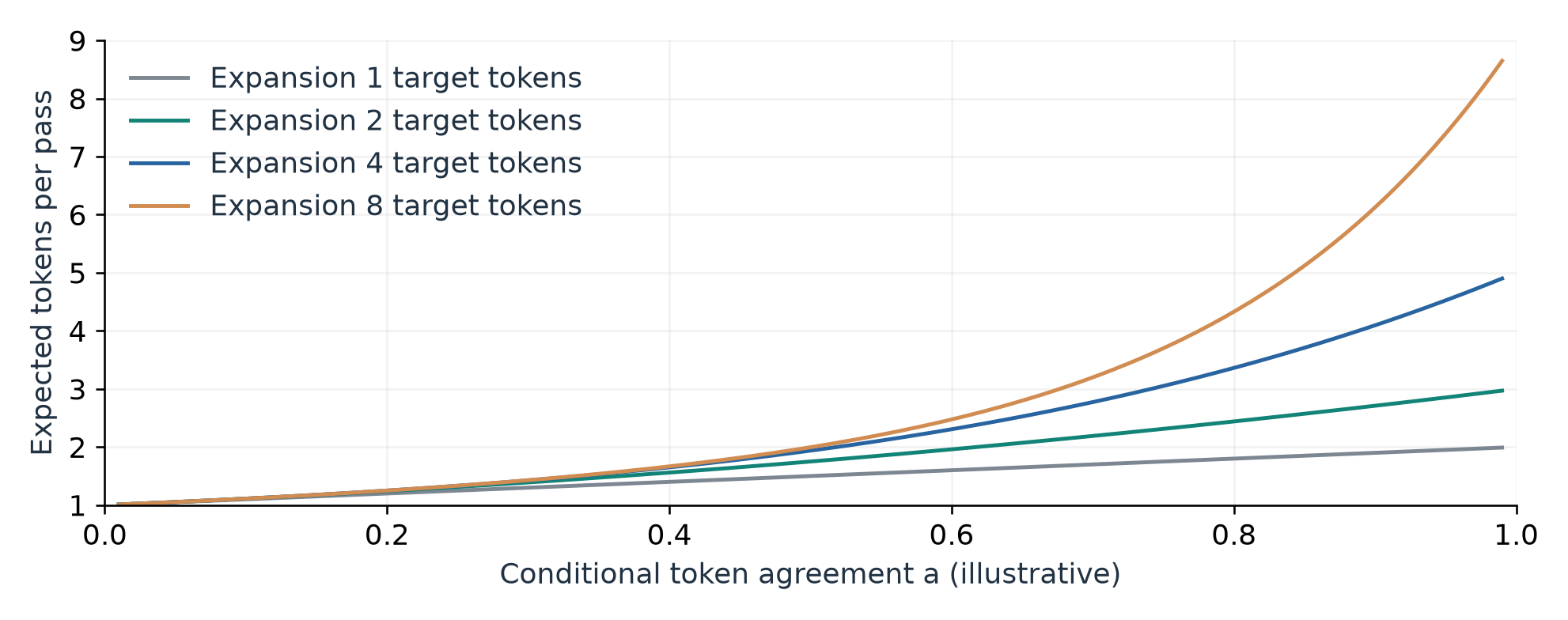
Figure 3. Original mathematical illustration of Equation 4, not a benchmark. A four-token candidate offers little extra yield at low conditional agreement. The chart assumes a single path and constant conditional agreement; it does not estimate the paper’s tree acceptance.
5.2 A pass is not free
Let be ordinary target decode time per emitted token and the complete proposal-and-verification pass time, including amortized expansion and cache work. For a long steady decode with comparable output, the useful approximation is
This is a ratio of aggregate work to aggregate time, not an average of per-pass speedups. If difficult prefixes cause both larger trees and lower acceptance, averaging ratios can distort the result. The break-even condition is . It explains why a small head can be useful even when it accepts fewer tokens than a large drafter: its pass overhead may be sufficiently lower.
For GSM8K, Table 5 reports 41.16 ms per phrase pass against a 36.06 ms ordinary pass. Their ratio is approximately 1.141. Dividing the reported 2.730 tokens per pass by that ratio gives about 2.392, consistent with Table 1’s 2.391 speedup after rounding. This is an internal arithmetic check. It does not independently validate the timing setup or establish that the same ratio holds at another batch size.
5.3 Output length belongs in the denominator
Suppose baseline and accelerated outputs contain and tokens, and their mean times per token are and . Defining , aggregate-time speedup is
The paper uses this kind of correction in its shared-baseline comparison. It matters because small numerical differences around argmax ties, EOS, or caps can alter total generated length. Time-per-token ratios and total-time ratios coincide only when lengths match. On MT-Bench, Table 1 lists 35.528 baseline ms/token and 22.27 accelerated ms/token: their direct ratio is approximately 1.595, while the reported speedup is 1.544. A length increase around 3.3% would reconcile those rounded aggregates, but the table does not provide all raw lengths. I treat this as a request for paired length data, not proof of an incorrect result.
The same principle applies to claims of output identity. A greedy-preserving algorithm can still exhibit numerical differences in an implementation. Reporting a length correction is good practice; publishing exact mismatch counts, differing token positions, and the size of the top-logit margin would explain what the correction is compensating for.
6. The parameter budget is mostly the vocabulary
6.1 Recomputing the head size
The paper states that at target width and hidden width , the fixed head cost is . Each output entry adds parameters. Therefore
At , this yields 3,433,792 parameters. At , it yields 21,937,792. Those counts agree with Table 3. The output layer contributes 2,056,000 and 20,560,000 parameters respectively, or about 59.9% and 93.7%. Reducing the vocabulary by ten therefore reduces total parameters by about 6.39 rather than ten, because the fixed head remains.
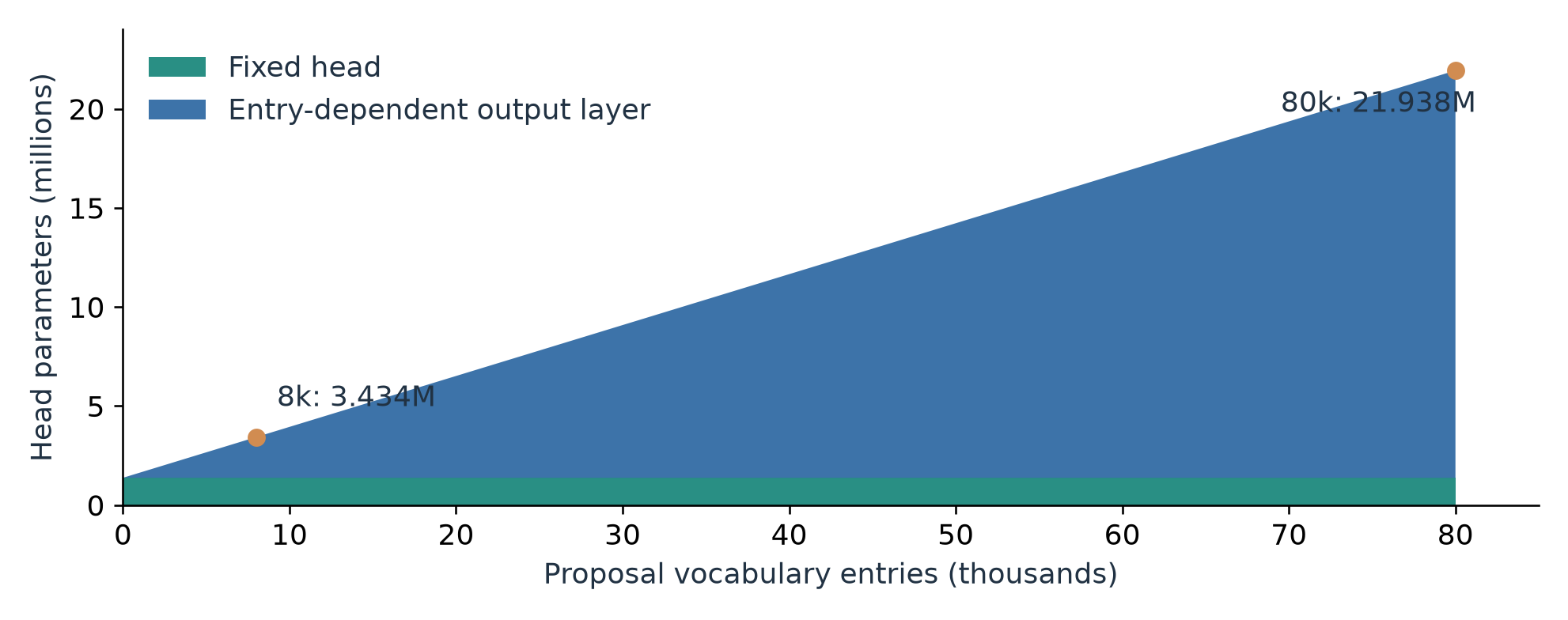
Figure 4. Original replot of the parameter formula in Table 3. Colored areas separate the fixed head from its entry-dependent output layer. Parameter counts measure weight storage; they do not include target KV, verifier rows, activations, or optimizer state.
A half-precision copy of the 8k head’s weights occupies about 6.87 decimal MB, compared with 43.88 MB for the 80k head, before alignment or framework overhead. This is my weight-only calculation. The paper’s 0.0854% and 0.5454% ratios refer to the target parameter count, not the fraction of a whole serving process’s memory. Neither ratio predicts training memory, because cached hidden features can dominate such a small head.
6.2 Parameter efficiency and speed efficiency differ
The 8k head retains of the large head’s GSM8K tokens per pass. But its reported accelerated time is 16.67 rather than 15.08 ms/token, about 10.5% higher. The retained speculative increment is different again:
Subtracting one removes the target’s guaranteed contribution. Reporting both quantities makes the tradeoff easier to interpret: the small head keeps about 92.3% of total output per pass, but about 87.9% of the speculative contribution. Neither should be called 92.3% of the speedup.
The vocabulary sweep also warns against a single size rule. Table 8 compares 40k, 16k, and 8k vocabularies on a T4 against the paper’s own drafting-off loop. The 8k version can improve MT-Bench relative to the 40k version, while the 80k version in the main experiment improves on the smaller heads. This is not a monotone smaller-is-better effect. Entry count interacts with supervision frequency, domain, and head fitting.
6.3 What should determine an entry’s value?
Frequency mining is simple, but frequency is only a proxy. A serving-oriented utility could combine how often entry is proposed, its expected accepted length, its extra verifier cost, and the weight row it occupies. For a candidate-set change, an illustrative net-time objective is
This is my proposed design objective, not the paper’s training loss. The delta notation is essential: overlapping entries share tree rows, so an entry’s cost depends on what is already selected. An entry with little standalone value can be cheap when its prefix is present, while a frequent long entry can be expensive if it creates many unique branches.
An alternative vocabulary experiment should therefore compare equal parameter budgets and equal unique-row budgets, not only equal numbers of entries. It should keep the labeling rule and training-position budget fixed. Otherwise a better result can come from more supervision or a different mix of easy prefixes rather than from a better unit of speculation.
7. Reading the experimental comparison at the right scale
7.1 The primary operating point
The main experiment uses Qwen3-4B in fp16 on one NVIDIA A5000. It uses batch one, temperature zero, EOS termination, and a 2,048-token cap. The head is trained on mathematical distillation. GSM8K and MATH-500 are treated as in-domain, while MT-Bench is a cross-domain transfer test. Prompt counts are 50, 50, and 40 respectively. Those counts describe the evaluated samples, not full-benchmark coverage.
Table 1 reports the large head’s best candidate count per set: 32 for GSM8K, 16 for MATH-500, and 32 for MT-Bench. Its reported speedups are 2.391, 2.444, and 1.544. These values use the paper’s HuggingFace generation baseline for that experiment. They should not be mixed with Table 8’s drafting-off loop or with another target’s multi-token prediction baseline.
I appreciate that the paper exposes its baseline instability. The two environments used in the EAGLE-3 comparison have different Transformers versions. Baseline generation latency differs by several percent, and repeated runs also move. The paper rescales the arms to a shared baseline in Table 2, but notes that environment and temporal drift cannot be separated from the measurements. A common numerical denominator improves presentation; it does not make separately executed environments a perfectly paired timing experiment.
7.2 A comparison with four useful operating points
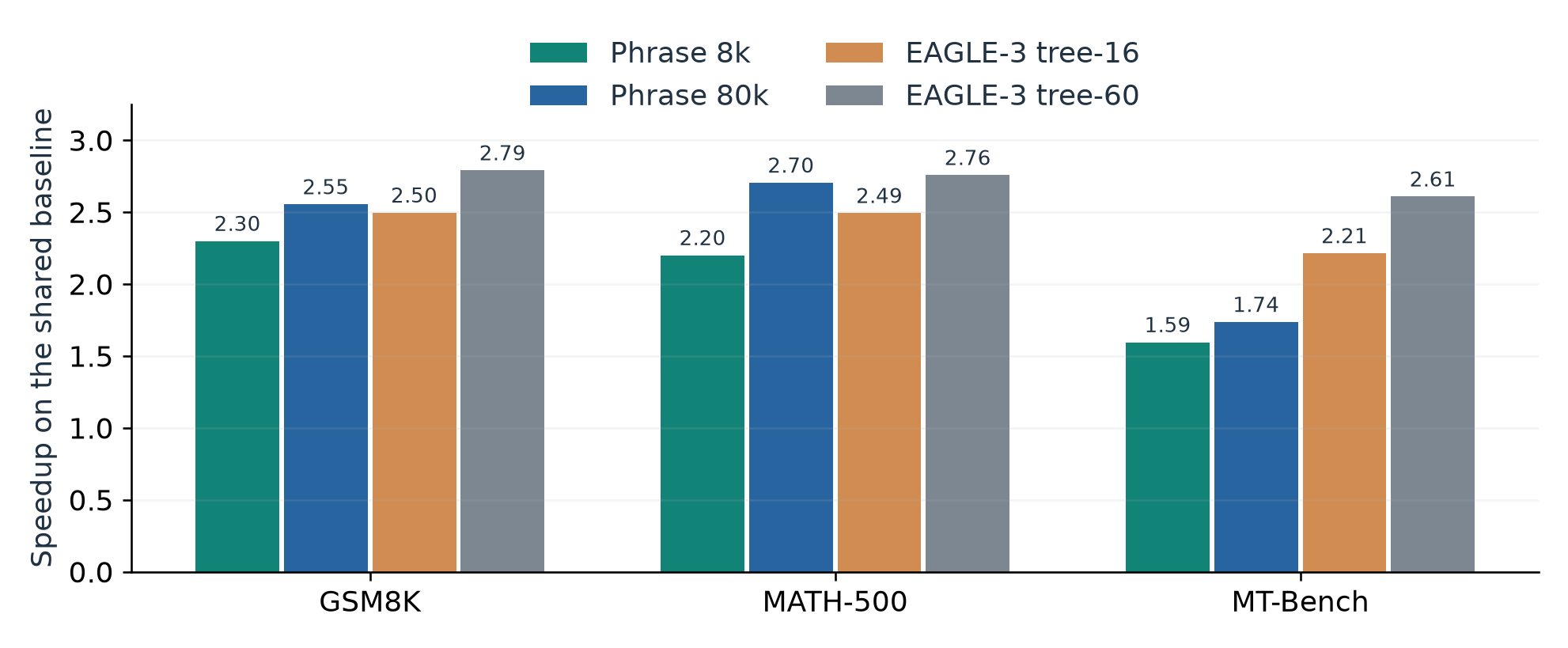
Figure 5. Replot of the paper’s Table 2, using its reported shared-baseline speedups and length correction. The phrase heads have approximately 3.434M and 21.938M parameters; the EAGLE-3 drafter has approximately 218M. These are author-reported measurements, not measurements from this review.
The large head’s shared-baseline MATH-500 result is 2.704 versus 2.493 for EAGLE-3 tree-16 and 2.757 for tree-60. Its GSM8K result is 2.554 versus 2.496 and 2.790. On MT-Bench, it is 1.736 versus 2.214 and 2.608. This is a meaningful parameter-efficiency comparison, but the faster wide EAGLE tree remains faster in every evaluated set.
| Workload | Phrase 8k | Phrase 80k | EAGLE-3 tree-16 | EAGLE-3 tree-60 |
|---|---|---|---|---|
| GSM8K | 2.299 | 2.554 | 2.496 | 2.790 |
| MATH-500 | 2.200 | 2.704 | 2.493 | 2.757 |
| MT-Bench transfer | 1.595 | 1.736 | 2.214 | 2.608 |
Table 1. Speedup factors transcribed from paper Table 2. All four columns use that table’s shared denominator. Candidate counts for the phrase arms are set-specific; tree-16 and tree-60 are the named EAGLE-3 operating points.
A decision about deployment needs a constraint. With a tight head-weight budget, the 8k head is attractive. With enough memory for the larger drafter and a throughput objective on these sets, tree-60 is the better measured choice. With a sustained mobile power limit, neither comparison settles the question, because the paper does not measure that platform. A large parameter ratio is not a substitute for a latency, energy, or capacity frontier.
7.3 The MTP comparison is a different experiment
Table 6 uses Gemma 4 E2B on a T4 and compares the phrase method with an in-family multi-token predictor at each method’s best . The phrase arm loses on all listed English tasks and wins on Hindi, Bengali, and Tamil, with Telugu slightly below MTP. The AIME row is explicitly unpaired. I would not merge these rows into an average improvement over MTP.
The paper decomposes speedup as tokens per pass times conversion efficiency. The phrase method can have better conversion while offering fewer accepted tokens. Its explanation is plausible: sequential draft passes add serial cost, whereas additional phrase candidates mainly add rows to one target pass. But the claim that the remaining gap is corpus rather than architecture is stronger than the experimental design isolates. Corpus, model capacity, vocabulary, and training procedure are not crossed in a controlled factorial experiment.
7.4 What the small prompt sets can establish
Small paired workloads can establish that a mechanism works and reveal large operating differences. They do not precisely establish a few-percent ranking. No confidence intervals are provided for the main comparisons, and the selected best can itself introduce selection optimism if it is chosen on the reported prompts. To assess a 2.704 versus 2.757 difference, I would want repeated paired runs, held-out selection of , and uncertainty over prompts as well as timing rounds.
An informative record would save each prompt’s baseline seconds, accelerated seconds, emitted token counts, pass count, accepted-token histogram, and numerical mismatch status. One can then bootstrap paired prompt-level totals. The statistic to resample is the ratio of summed baseline time to summed accelerated time, preserving the actual workload weighting. Averaging individual speedup ratios gives short prompts the same weight as long ones and answers a different question.
8. What the diagnostics reveal about the mechanism
8.1 Formatting is the dominant source of accepted work
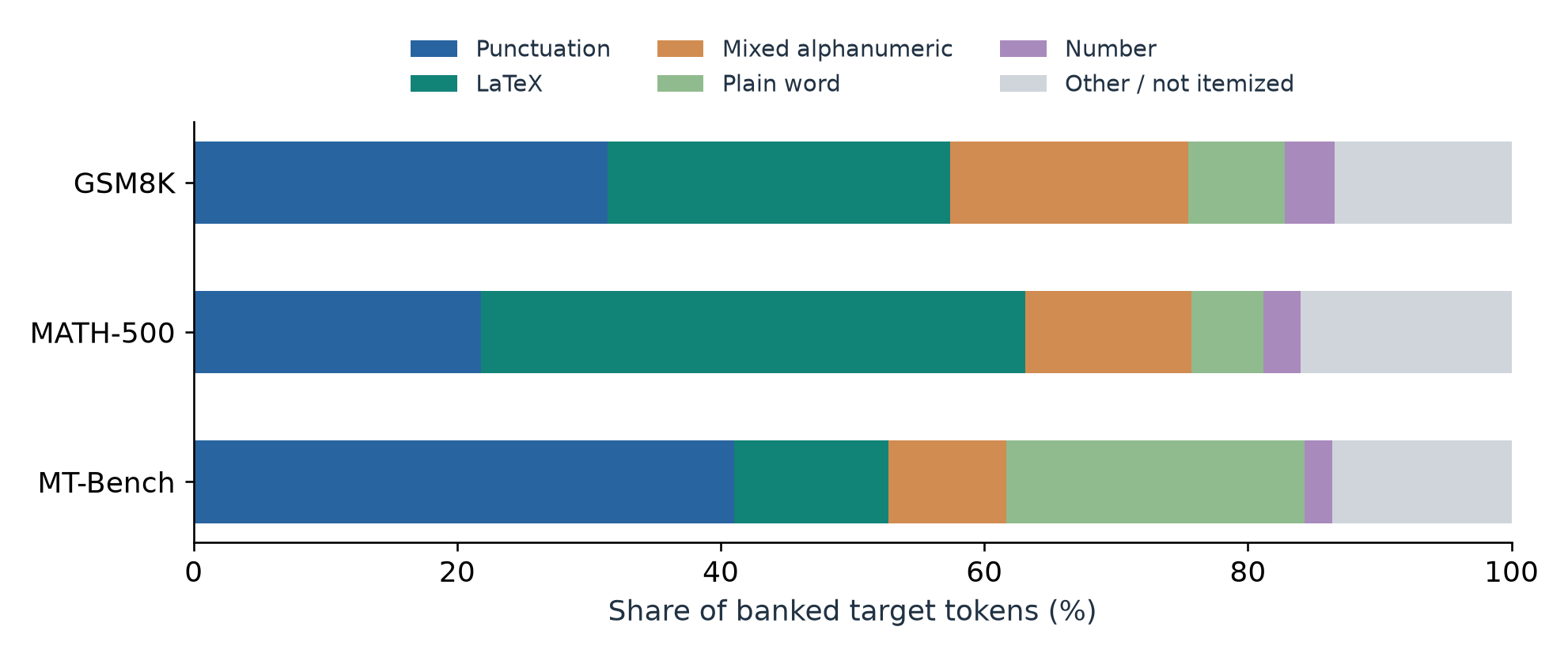
Figure 6. Replot of the entry-class percentages in paper Table 4. The residual is labeled Other / not itemized and computed as 100 minus the five displayed class shares. The separate three-word-entry statistic is not another disjoint category and is therefore not stacked here.
On GSM8K, punctuation and LaTeX sum to 57.4% of banked tokens; on MATH-500, they sum to 63.1%. Plain words contribute 7.3% and 5.5%. On MT-Bench, LaTeX falls to 11.7% while ordinary words rise to 22.6%. The drafter is exploiting a very specific kind of predictability. A small head is enough to identify frequent structural fragments from the target state.
The entry census uses overlapping properties. In the small vocabulary, 43.9% of multi-unit entries contain a LaTeX character, 55.0% contain a digit, and 24.7% contain a newline. An entry can satisfy several of these predicates. Adding those percentages would be invalid. Likewise, the share of work from three-word entries overlaps all the entry classes in Figure 6. I keep these distributions separate because confusing them would imply an artificial explanation of the speedup.
This evidence motivates a concrete alternative: compare a formatting-specialized vocabulary with a semantic-phrase vocabulary at equal row and parameter budgets. The former might recover most of the mathematical benefit with fewer entries. The latter might transfer better to dialogue. A hybrid vocabulary could reserve explicit budgets for formatting, common words, and domain terms. These are proposed experiments, not outcomes established by the current tables.
8.2 More verifier rows were cheap in this local regime
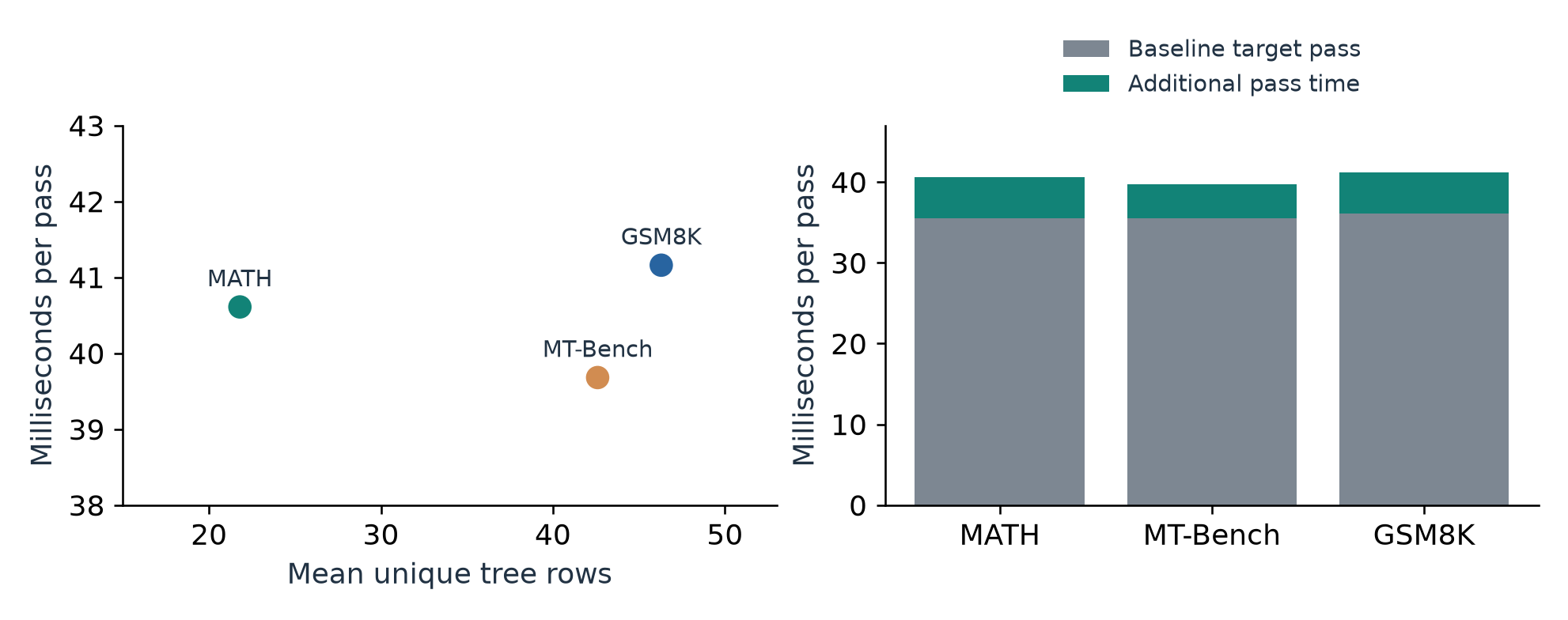
Figure 7. Replot of paper Table 5. Left: mean tree rows versus complete pass time. Right: the ordinary target-pass time and additional time. The three points come from different workloads and best- choices, so they are descriptive rather than a controlled scaling curve.
Mean rows range from 21.8 to 46.3, while pass time remains around 40 ms. This is consistent with a memory-bound decode regime in which more verifier rows reuse target weights. It does not prove that arbitrary width is nearly free. The comparison changes workload as well as width, and the current widths may sit within a flat region of the kernel’s capacity curve.
The table’s peak additional memory is also workload-dependent: 0.73, 0.72, and 0.26 GB. It is not monotone in tree rows. One should not fit a universal memory-per-row coefficient to these three values without knowing context length, allocator accounting, and temporary-buffer behavior. On an 8 GB device, a fraction of a GB can matter even when the head’s weights are tiny.
At high batch sizes, there may be much less idle matrix-multiplication capacity to exploit. Verifier rows compete with other requests’ decode tokens and with their KV memory. A method can reduce one request’s latency while lowering total system goodput under load. The paper’s batch-one measurements are therefore a low-load latency result, not a serving capacity result.
8.3 Online adaptation changes landing, not yet reliable speed
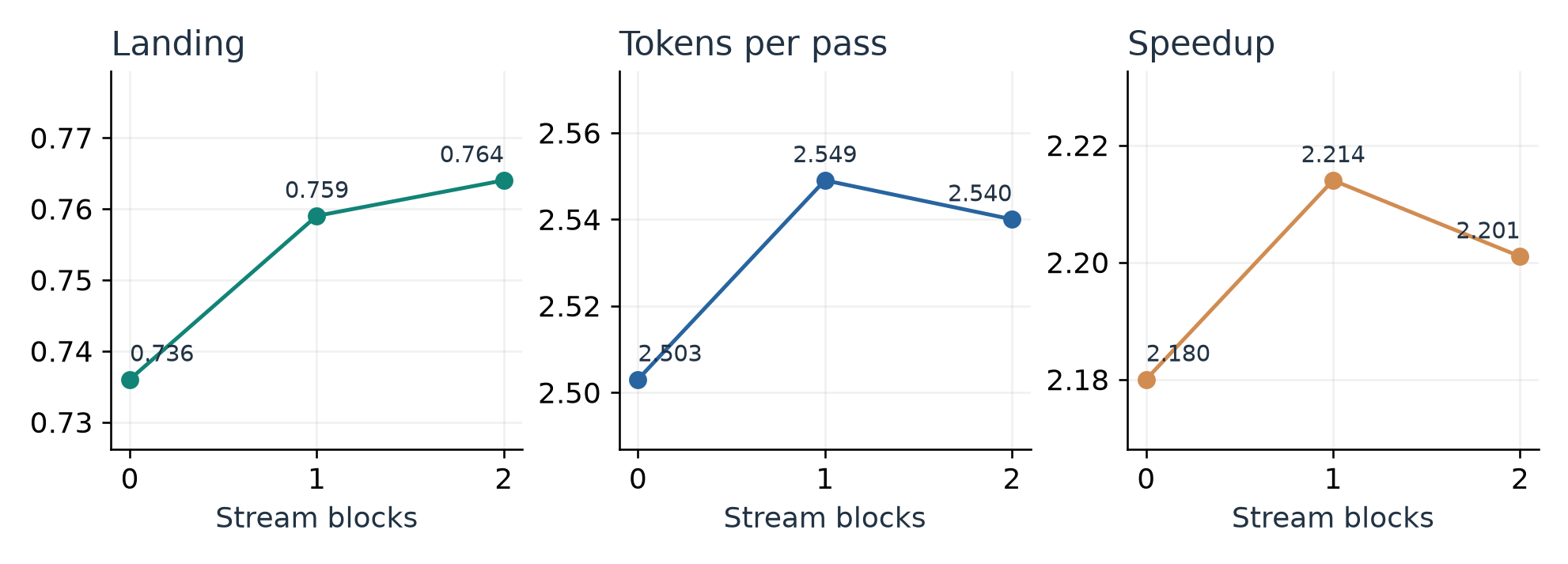
Figure 8. Replot of the first three checkpoints in paper Table 7. The panels have separate y scales to show each reported quantity; they should not be compared by visual slope. The head’s vocabulary also grows, so this is not a fixed-capacity adaptation experiment.
The vocabulary grows from 40,000 to 43,261 to 45,719. Landing rises from 0.736 to 0.759 to 0.764. Tokens per pass rise and then flatten; speedup goes from 2.180 to 2.214 to 2.201. These data do not establish a dependable speed gain. There is no frozen-head control, and the repeated held-out pool and one seed constrain interpretation. The author explicitly treats this as partial work.
Using Equation 7, the 5,719 added entries imply 1,469,783 more output-layer parameters, or about 12.6% of the initial 11.658M head. That is my calculation. It shows why rising landing cannot be attributed to online learning alone: the model also gains capacity and a changed vocabulary. A fixed-size replacement policy with a frozen comparison arm is the cleaner next experiment.
The reported update cost is roughly five minutes plus a few seconds per block, against about 2.4 hours of streaming. If those updates are fully additional serial work, the rough time fraction is , before details of the measurement boundary. The largest listed speed change, 2.214 relative to 2.180, is only about 1.6%. Thus a faster decode segment can still fail to repay adaptation overhead over that stream. Idle-time or overlapping updates change this accounting, and should be measured explicitly.
8.4 Hardware portability is encouraging but narrow
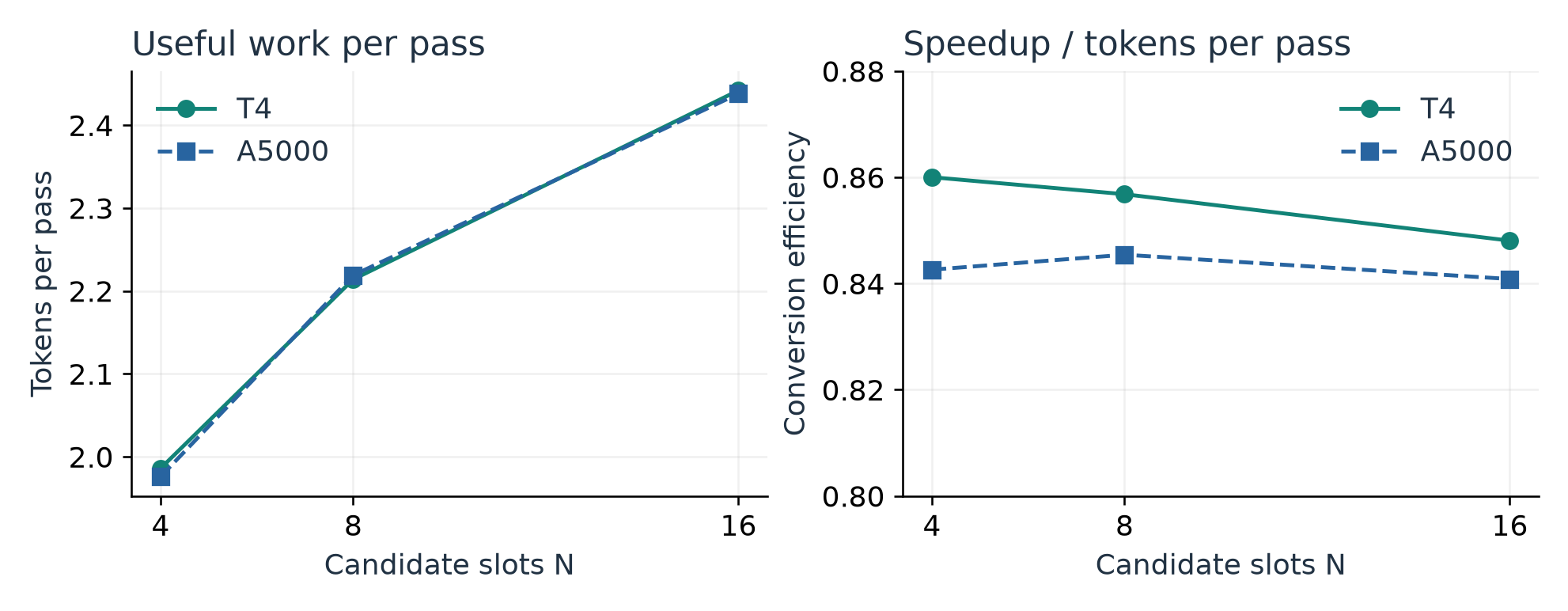
Figure 9. Replot of paper Table 9. Left uses its measured tokens per pass; right is my division of reported speedup by tokens per pass. The comparison holds the head and prompt file fixed for GSM8K and tests three candidate counts.
The T4 and A5000 preserve similar useful work per pass, and their latency changes largely track the baseline card ratio. At , the ordinary latency ratio is , while the accelerated ratio is . That is a helpful check that the result is not confined to exactly one GPU.
It does not establish performance on mobile accelerators, sustained thermal limits, or a target kernel unable to express an arbitrary tree mask. The table’s three values also leave wide trees and high concurrency untested. I read it as portability within two discrete GPU settings, with a particularly stable acceptance trace, rather than general hardware independence.
9. Limitations and failure boundaries
The strongest empirical boundary is distribution. A head trained on mathematical completions does not inherit a general ability to predict dialogue, code, or an individual’s writing style. The vocabulary analysis explains the observed mathematical advantage but does not establish the proposed personal-assistant use case. A low-entropy formatting skeleton may be absent, change with the prompt template, or be diluted by a mixed workload. A domain-specialized head should have a cheap drafting-off fallback.
The statistical boundary is equally concrete. One seed and 50/50/40 prompts cannot support precise claims about a small advantage over an already competitive system. The paper exposes several-percent baseline variation. Its small differences should therefore be read as operating points, not stable rankings. The unpaired AIME row and separately normalized timing environments need to remain visible when describing the comparison.
The algorithmic boundary is greedy decoding. Exactness follows from verifying the correct target conditionals and accepting only their argmax. It does not follow merely from keeping model weights frozen. Attention masks, positions, cache commitment, stop behavior, and numerical settings all enter the proof. The paper provides the high-level mechanism but leaves details that an independent implementation would have to state explicitly.
The multilingual boundary is a prediction problem, not just a tokenizer statistic. The paper reports large target-token expansion with low landing for Telugu and notes that its strongest fertility motivation is not evaluated on the most fragmented target. A large fertility ratio creates potential reward, but does not ensure that a small classifier can predict those strings from the hidden state. Nor does it ensure a suitable target kernel. The suggested 4–5-times outcome belongs to future work, not the measured results.
Finally, low parameter count is only one part of resource use. Tree verification, target weights, KV state, feature collection, head training, memory alignment, and sustained energy all matter. The adaptive experiment stores only part of the generated feature positions and has no fixed-size replacement. Its evidence cannot yet justify a claim of on-device continual acceleration. These limitations leave the basic mechanism useful while keeping the deployment claim bounded.
10. Critical analysis: what I would change and test
10.1 Replace unconditional expansion with accepted-work accounting
My first change would be to publish an accepted-prefix histogram for each entry class, alongside landing and raw expansion. For a maximum represented depth , the general identity is
This avoids treating vocabulary length as accepted length. It also accommodates overlapping tree candidates without adding their individual rewards twice. A tree with many entries sharing the same first two target tokens has only one opportunity to bank those two tokens. Summing expected rewards per entry would exaggerate its useful work.
I would record, per pass, the number of candidate entries, unique target rows, deepest surviving path, proposed expansion lengths, and accepted length. The same record can explain whether a larger vocabulary improves the first token, adds longer tails, or merely adds redundant branches. It would turn a verbal claim that a certain unit is the bottleneck into a measurable attribution.
A small illustrative example makes the distinction concrete. Suppose one candidate has length six but matches its first token with probability 0.2; conditional later matches are 0.9. Equation 4 gives about 0.937 expected accepted tokens. A two-token candidate with conditional agreement 0.8 at each position yields 1.44. The long candidate has three times the nominal expansion but less expected accepted work. This example is synthetic; it explains why candidate utility must involve prediction, not just compression.
10.2 Qualify the claim that the remaining gap is data
The paper makes a strong case that the current vocabulary reflects its mathematical corpus. It makes a weaker causal case that more corpus alone will close the gap to larger drafters. Capacity, class imbalance, representation, and conditional prediction depth can all limit the head. A single hidden-state classifier cannot update a later proposal based on its own earlier speculative choice in the way a sequential drafter can.
I would use a crossed design: fixed head geometry with increasing unique training positions; fixed data with changing vocabulary; and fixed vocabulary with changing head width. Keep candidate-row budgets matched and select on a separate split. An additional comparison could provide the same formatting-oriented entries to a retrieval baseline. If retrieval captures the benefit, the learned head may be serving mainly as a low-latency selector. If the neural head keeps improving on unseen contexts, that supports the representation-learning argument.
The main reported architecture search is still useful negative evidence. But a failed architecture under one corpus and budget is not proof that its capacity axis is finished. A more precise claim would be that the present simple head converts its accepted work efficiently, while the cause of insufficient accepted work remains to be isolated.
10.3 Make the verifier’s numerical contract measurable
A deterministic token-equality test should be a reported outcome, not just an intuitive consequence of frozen weights. Compare complete emitted token sequences for paired prompts, state the target dtype and kernel settings, and report how often argmax margins are near numerical noise. The length-corrected timing table gives a reason to request these records. The theoretical guarantee and the observed equality rate should be adjacent in a final result table.
My suggested protocol first fixes one target backend and precision, then runs drafting off and on with identical stopping rules. For every mismatch, record the first differing token and the logit gap between the top two target choices. A tie-sensitive difference can then be distinguished from a wrong path mask or an extra emitted token. This is a proposed behavioral experiment; I did not run a model to claim those cases have been separated.
The same protocol should include Unicode and token-boundary cases. Multi-unit strings with leading whitespace, combining marks, numeric punctuation, and special-token-like text can exercise the expansion contract. The objective is not to alter the target’s tokenizer but to show that its interface is preserved. A failed proposal should reduce acceleration, while the verifier must still produce the target-selected fallback.
10.4 Use an end-to-end adaptation break-even calculation
Let be baseline-equivalent seconds of future decoding, the frozen-head speedup, the adapted-head speedup, and the additional serial adaptation cost. Adaptation is beneficial only if
For illustration, taking seconds and the table’s 2.180 and 2.214 speedups gives a threshold of roughly 42,600 baseline-equivalent seconds, or 11.8 hours. This is my arithmetic using reported point estimates, not a validated production forecast. The second adapted checkpoint has a smaller advantage, so its corresponding threshold is longer. If the update overlaps idle time, the effective serial can be lower, but energy and memory still need accounting.
This reframes the online claim. An increase in landing can be useful scientific evidence even when the current stream does not amortize its update. The next evaluation should report both decode-only speed and total elapsed time including feature extraction, vocabulary maintenance, and head fitting. It should also hold the vocabulary size fixed to test replacement rather than unlimited growth.
10.5 Add an entry replacement policy with a stability budget
An additive vocabulary grows the output matrix and changes the competition among logits. A persistent on-device head needs a replacement rule. One possible policy assigns each entry a decayed estimate of saved target time, discounts training and verifier costs, and evicts entries with low utility. This should be compared with frequency-only and least-recently-used policies. The measured objective is saved time under a fixed memory budget, not a monotone count of entries.
Changing the vocabulary introduces a stability question. A new entry can split probability from an older prefix even when the older prefix remains valuable. Reserving short-entry slots helps only if score calibration remains adequate. I would track accepted work by entry age and by domain, and run a frozen vocabulary with head-only adaptation as a separate arm. That distinguishes better prediction from better coverage.
Privacy and lifecycle also become practical model choices. An individualized vocabulary may retain sensitive substrings from a user’s output. A local deployment can choose to avoid particular classes of strings, age entries out, or keep updates entirely on device. These are proposed product constraints rather than measured shortcomings of the paper. They matter only when moving from the current research setting to persistent personal use.
10.6 Compare scheduling choices at a fixed verifier budget
The paper often selects the best per set. A mixed request stream needs a policy before the set label is known. A cheap gate could estimate expected accepted length from head confidence and recent acceptance, then choose among drafting off and a few widths. The theoretical decision is to draft when the expected extra useful work exceeds its time cost. An illustrative rule is
where is a margin for estimation error. This is my proposed controller, not part of the evaluated method. Confidence must be calibrated on the actual request mix; a math-trained head can be confidently wrong on unfamiliar text. A recent-acceptance signal can help but may react slowly at domain changes.
A better controlled comparison fixes unique verifier rows rather than proposal slots. A phrase can expand into many rows, while shared prefixes can make another phrase nearly free. A row budget exposes that difference. Under concurrency, one should additionally hold offered load and latency targets fixed, measure completed-request goodput, and include the extra KV occupancy. Those measurements would connect the promising local pass model to a serving decision.
10.7 A concrete paper-based evaluation plan
I would prioritize four experiments in order. First, establish token equality and a complete time boundary on the current Qwen workload, with repeated interleaved timing rounds. Second, compare formatting and semantic entries under equal parameter, row, and training-position budgets. Third, test fixed-size online replacement against frozen-head, head-only update, and additive-growth controls. Fourth, measure the full pipeline on the intended mobile backend, including sustained power and memory.
The paired timing statistic would be
with prompt-level paired resampling and repeated timing rounds reported separately. I would preserve lengths, EOS status, and exact-match flags in every resampled unit. Selection of vocabulary size and belongs on a different validation set. Confidence intervals should not hide a systematic environment difference; that difference needs its own controlled run.
These experiments do not require a claim that the current paper has solved general-purpose drafting. They ask a narrower and more useful question: at a given head, data, memory, and target-kernel budget, when does changing the proposal unit increase accepted target work enough to pay for itself? The paper has already supplied a persuasive positive example. The remaining work is to map its boundary without confusing potential expansion with demonstrated speed.
11. Conclusion
I would keep this paper as a useful example of separating a proposal representation from an execution interface. A phrase entry can be cheap for a small head to predict while expanding into several target tokens that the frozen target verifies. The main mathematical workload shows that such a representation can be effective with very few additional parameters.
My main caution is about what the measured unit means. A three-word entry is often punctuation or mathematical formatting, raw expansion is not accepted length, and retained tokens per pass are not retained speedup. The wider EAGLE-3 comparison remains faster on all three main sets. Online adaptation increases landing but has not yet established an end-to-end gain, and mobile serving remains future work.
For my own research, the most useful next step is a vocabulary-and-verifier co-design experiment: choose entries by marginal accepted work and actual row cost, validate exact greedy behavior, and measure total time under the intended load. That is a concrete route from an appealing representation idea to a reproducible systems result.
References and reading scope
[1] Madhusudhana Naidu. Phrase-Level Speculative Decoding on a Frozen Target, v1, 2026-11-09. Primary source for all reported model measurements in this review; complete PDF pages 1–10, Sections 1–6, Tables 1–9, and references read. Equations 1–13 here are explanatory notation and derivations; Equation 3 interprets the paper’s Equation 1. Figures 1–3 are original explanations; Figures 4–9 replot or calculate from the identified tables. No independent model training, inference benchmark, or energy measurement is claimed.