Review date: 2026-11-17
Author: Zhongzhu Zhou
Paper reviewed: Experience-Handoff Reinforcement Learning for Recursive Self-Improvement
Paper authors: Doyoung Kim, Byeongguk Jeon, Kailin Zhang, Sherry Yang
arXiv: 2611.16409v1, 2026-11-12
1. The unit of training is a handoff
Consider an agent that fails an API task because it looked at the wrong collection of transactions. Its final reward is zero. The trace contains the query, the empty result, and the action it took after seeing that result. Starting from scratch, a new rollout can repeat the same search with different wording. With a playbook, it can start from a specific premise that the earlier attempt already tested. The learning problem is making the premise faithful enough to survive compression and concrete enough to change the next action.
Kim et al. put a single set of model weights behind three fixed role prompts. The actor interacts with the environment. The reflector distills a trajectory into a diagnosis. The curator turns the diagnosis into operations on a small task-local playbook. The causal sequence is interesting because the output of one call becomes part of the prompt distribution for a later call from the same model. The supervised target for the reflector is absent. A candidate playbook is scored by resetting the episode, letting the actor read it, and taking the verifier’s result. The evaluator episode also trains the actor.
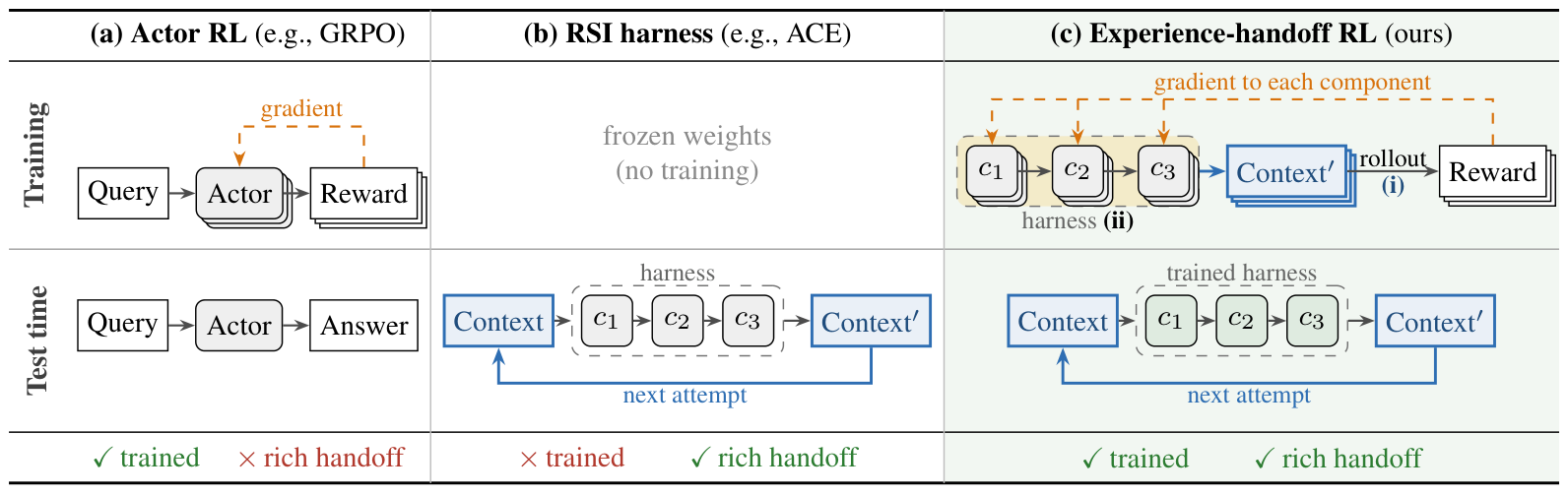
Figure 1. Cropped from Kim et al., Fig. 1. The extra rollout is where edits acquire a task reward in training. At inference the next normal visit consumes the edit directly.
The paper’s meaning of recursive self-improvement is deliberately operational. A model revises the text it sees on the next visit while the test-time weights and control program stay fixed. A new task starts with an empty playbook. This narrows the scientific claim to a form of adaptation with visible state and a controlled reset. It also means the experiments leave open whether memorized task details can become reusable skills or whether edits remain helpful across environments. The original Agentic Context Engineering paper is the scaffold reference. Here the actor and both text-writing behaviors are trained together.
2. Prerequisites
Episodes, policy inputs, and verifiers
Let denote a task instance. An episode starts by initializing its environment and may contain many turns. The model emits action tokens, receives observations, and eventually obtains a verifier reward from the trajectory . A visit is one such episode together with the surrounding handoff calls. A second visit can repeat the task from the same initial condition while reading an updated playbook. Environment state, prior tool output, and the old transcript do not become the next actor’s interactive state. The formatted playbook is the channel through which earlier discoveries reach that actor.
A probability over a trajectory includes policy action probabilities and environment transition factors. With parameter-independent dynamics, differentiating the log probability leaves only the sum of the scores of generated actions. To see why a tool reply belongs in the conditioning context but contributes no score, write one turn as . Its logarithm is the sum of model log probability and a transition term whose derivative in is zero. The same rule applies when the reflector sees that reply. Ordinary language tokens in the reflector or curator’s generated answer do have a score.
Outcome-relative policy updates
For actor-only GRPO, one collects siblings sharing a task prompt. A scalar score above the group mean yields a positive advantage. The training signal of each generated token in that sample inherits the same group-level advantage. If all sampled outcomes are identical, the centered comparison supplies zero signal. In the harness, both the task input and the playbook can influence the reward. Grouping reflections of a single trajectory controls the evidence they read. Grouping edits of a single reflection controls the proposed strategic change. The actor group deliberately trades away this same-input property, pooling incumbent and candidate prompts to reuse expensive episodes.
Why task-local memory matters
The playbook can retain facts as specific as what one guess established about a hidden code or which endpoint exposes a relationship in AppWorld. This makes a reset-and-retry protocol measurable and separates actions from stored text. It also changes what “generalization” can mean. A model can generalize the process of writing useful task-specific notes to held-out tasks while storing particular facts that apply to just one instance. To establish reusable procedural knowledge, the test would need a separate transfer step that removes identifiers and other instance-specific state.
3. The four-call objective and its gradient
Write for the incumbent playbook, for a reflection, for an edit sequence, and for the resulting playbook. Write for the evaluator’s fresh attempt and . For a fixed input distribution over , Eq. 5 of the paper asks for the expected future outcome after one sampled handoff. With role prompts suppressed and environment factors implicit, the chain distribution is
The realized handoff uses the actual formatter and role inputs. The compact notation permits task information attached to the role prompt. The edit operation is deterministic given its inputs. The text may be discrete, so there is no need to differentiate through the parser or verifier. With parameter-independent rewards and dynamics, and regularity to exchange expectation and differentiation, expand , differentiate each probability, and substitute . Taking the logarithm of the product yields four score terms , one for each call.
From the perspective of the reflector, the subsequent randomness is the edit and fresh rollout. Define . Since is measurable given that prefix, . Conditioning one call earlier gives , and one call later gives . The evaluator’s own score stays paired with its realized reward. This proves the paper’s Eq. 12 and explains how an actor’s unsuccessful attempt can nevertheless carry useful evidence.
A full comparison tree estimates each conditional value with averages of its descendant rewards. Unconditional dependence through shared ancestors is compatible with the tower property. The estimator averages the seed term over seeds, the reflector term over reflections, the curator term over edits, and the evaluator term over returns for evaluator draws per edit. Giving an inadmissible branch terminal value zero and no evaluator score specifies one objective. The sparse recipe’s admission and averaging rules matter whenever candidates fail validation.
The online update trains the seed for its own outcome
The seed actor actually receives . Omitting filtering, normalization, and unequal role weights, the difference between the exact local gradient and this idealized training direction is
With a frozen distribution for the initial trajectory, fixing the seed is legitimate for a conditional objective. That interpretation leaves the other three score terms intact. Freezing the behavior model during batch collection still allows a seed score in the gradient of the all-policy objective. Consider an early exploratory action that lowers immediate score because it uses a scarce turn, yet reliably exposes a parameter required on the next visit. Its seed reward pushes against this action. A reflector may learn to extract the parameter when it appears, while the actor learns to expose it less frequently. A direct way to measure that tradeoff is to pair seeds that solve locally with exploratory seeds that reveal verifiable constraints, then compare the subsequent rewards under the same reader.
Appendix D.1 also reindexes rewards along a trajectory of retained playbooks. For visit rewards in , the difference between current and one-step-shifted averages is , by cancellation of the interior terms. The same identity applies to direct reader terms , with a bounded expected endpoint norm needed for the expected boundary to vanish. These identities refer to the realized incumbent sequence at a fixed policy. Selection, resets, changing checkpoints, and the omitted influence of present actions on future evidence each delimit that interpretation. A finite sequential objective credits the seed with its immediate reward and the expected returns it helps cause at later visits.
4. Sparse branching under the actor budget
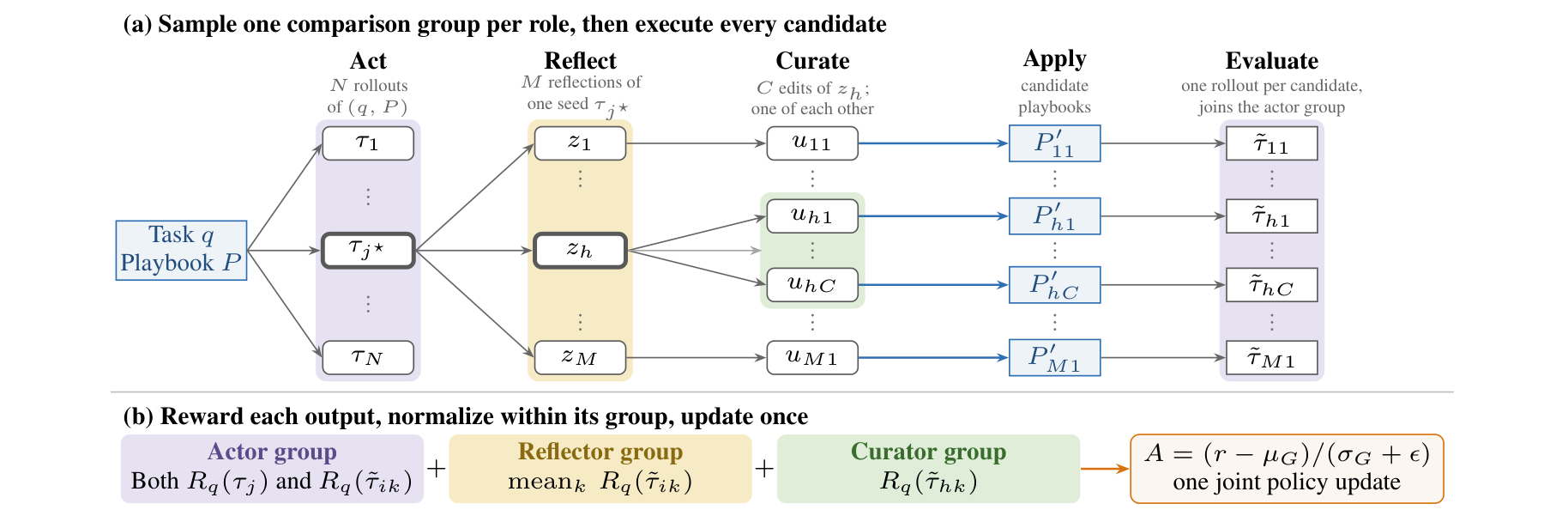
Figure 2. Cropped from Kim et al., Fig. 3. Branching among reflections holds the seed fixed. Branching among edits holds one reflection fixed. All admitted evaluation episodes return to the actor training group.
At the main setting , four episodes sample the incumbent and one is picked uniformly for reflection. Two interpretations of that trajectory are generated. One usable interpretation is chosen uniformly to receive three curator samples, while the other usable interpretation supplies one. Each edit uses a copy of the same incumbent. An admissible edit must parse, apply, change the text, and stay within 2,048 tokens. The paper describes ordered ADD, UPDATE, and REMOVE operations, followed by deduplication and renumbering. With both reflections usable and every edit admitted, four evaluator episodes replace the remaining four actor-only episodes in the nominal GRPO budget. Actual accepted groups can be smaller.
Algorithm 1. One ACE-RL training collection and update
This pseudocode follows paper Algorithm 1 and Appendix D. “Usable” applies to the reflection. “Admissible” applies to a curator output after validation. The selected playbook and the training batch have separate lifecycles.
01  Freeze the collection policy; start an empty update batch.
02  For each task, increment its encounter counter.
03  Before each reset encounter, restore the empty playbook.
04  Sample four seed episodes from the incumbent and score them.
05  Pick one seed uniformly; sample two reflections of that seed.
06  Pick one usable reflection uniformly for three curator samples.
07  Draw one edit for each other usable reflection.
08  Validate each edit against a copy of the incumbent.
09  For each admitted edit, reset the environment and score one retry.
10  Credit actors by own reward and editors by candidate reward.
11  Credit reflections by mean admitted values (zero if empty).
12  Retain a maximum-scoring candidate if it matches or beats the seed.
13  Keep group identifiers for actor, reflector and curator outputs.
14  Filter groups, normalize within groups, and update shared weights.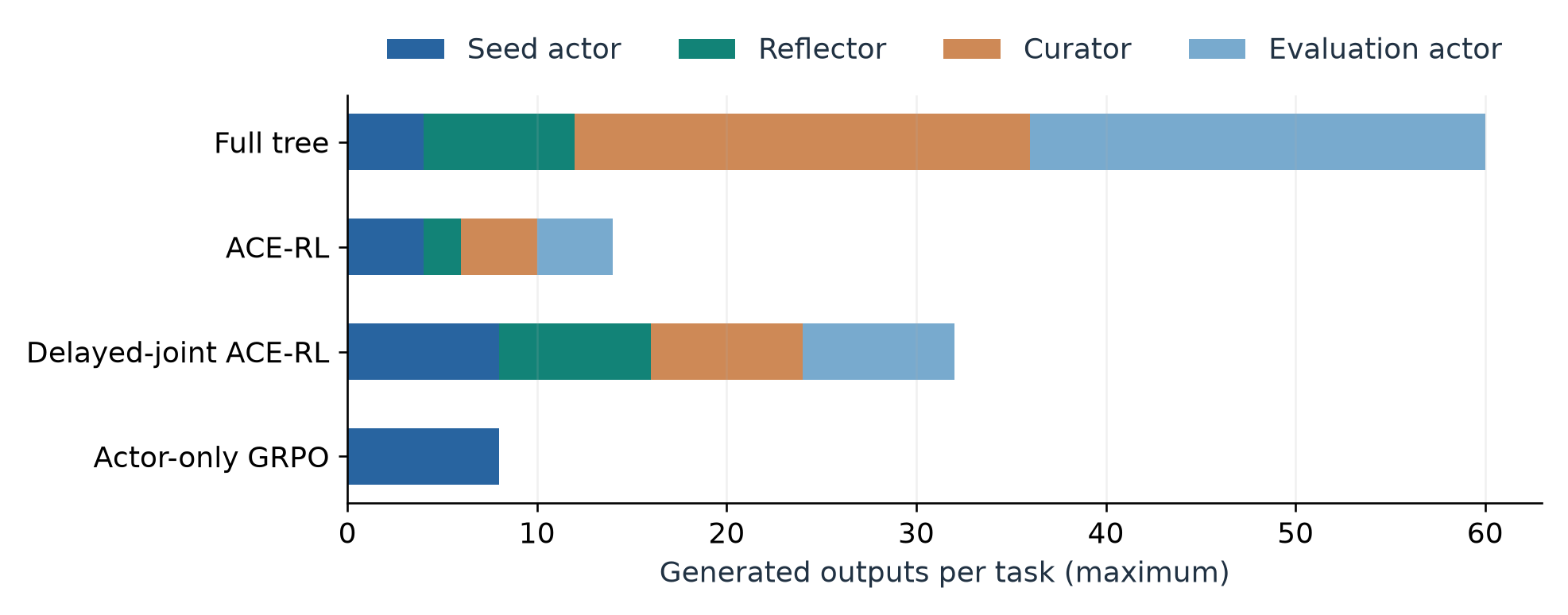
Figure 3. Redrawn from paper Table 3 and Appendix D.1. The 60-call full tree uses one evaluation per candidate. The highlighted practical resource is the number of environment episodes, while short text calls still consume generation capacity.
For a single reflection family, a conditional group baseline removes between-seed differences from the comparison. In a chain-wise design, the reflector reward of a weak seed competes with the reward of a strong seed. Let be a leaf score, its conditional mean given the reflection and seed, and the mean given the seed. With leave-one-out baseline across chains, add and subtract the two conditional means:
The first term is descendant noise. The second measures variation attributable to which reflection was sampled at that seed. The last term has zero expected product with the reflection score when the other chains are independent conditional on the task and the score has zero mean given its prefix. Sharing the seed removes the analogous between-seed term from the difference. With multiple evaluations of a fixed candidate and independent episode randomness, has mean and variance . A single evaluator preserves the mean of the value estimate. Its cost is the noisy feedback carried into filtering, scaling, and selection.
Algorithm 2. Run the trained harness on a new task
The additional playbook-ranking rollouts are confined to training. The test protocol applies the sampled edit and uses its effect when the next scheduled attempt arrives. This distinction matters when a candidate is cheap to author and slow to verify.
01  Initialize a task-local empty playbook and best reward zero.
02  For each of K visits, start a fresh episode of this task.
03  Give the actor the task and current playbook; record its reward.
04  Update best reward with the maximum observed so far.
05  Give the reflector the formatted trace and verifier feedback.
06  Ask the curator for edit operations using the current playbook.
07  Apply the edit using the harness rules for the next visit.
08  Return best reward and retain the visit-level trace for analysis.
5. Reward means, normalization, and selection
A finite-group correction
With independent siblings and conditional score mean zero, compare each value with a leave-one-out mean . Its expected product with the sample’s score is unchanged because the term involving other siblings vanishes conditional on the input. Now use the full sample mean , which includes the current reward. Since ,
The corresponding raw score estimate shrinks by for a two-reflection group and by for a three-curator group, assuming the raw independent-sibling setup. Dividing by the sampled standard deviation changes more than that scalar. For two non-tied samples, normalization substantially converts a magnitude comparison into a sign comparison. A change in the noise of a descendant value changes the chance of reversing that sign. The real actor group mixes playbook inputs, so the most direct same-input correction applies to the idealized groups, with additional qualifications for admission and mixed actor prompts.
Admission changes the expected reflector credit
The paper gives a useful example in Appendix D.1. Suppose edits are independently admitted with probability and each admitted edit has expected value . Conditional on a nonempty admitted set, the expected valid-only mean is . With zero credited to an empty set, it follows that
Counting invalids as zero in a denominator of gives for all . For and , the valid-only expectation is for one draw and for three. The comparison can therefore reflect unequal branch budgets even when the two reflections are equally informative on average. Random assignment of the larger branch protects exchangeability across draws under suitable conditions, yet a realized update rewards a particular reflection under its assigned budget. Balancing edit counts per reflection would remove this variance source at fixed total branching only by reallocating the curator budget.
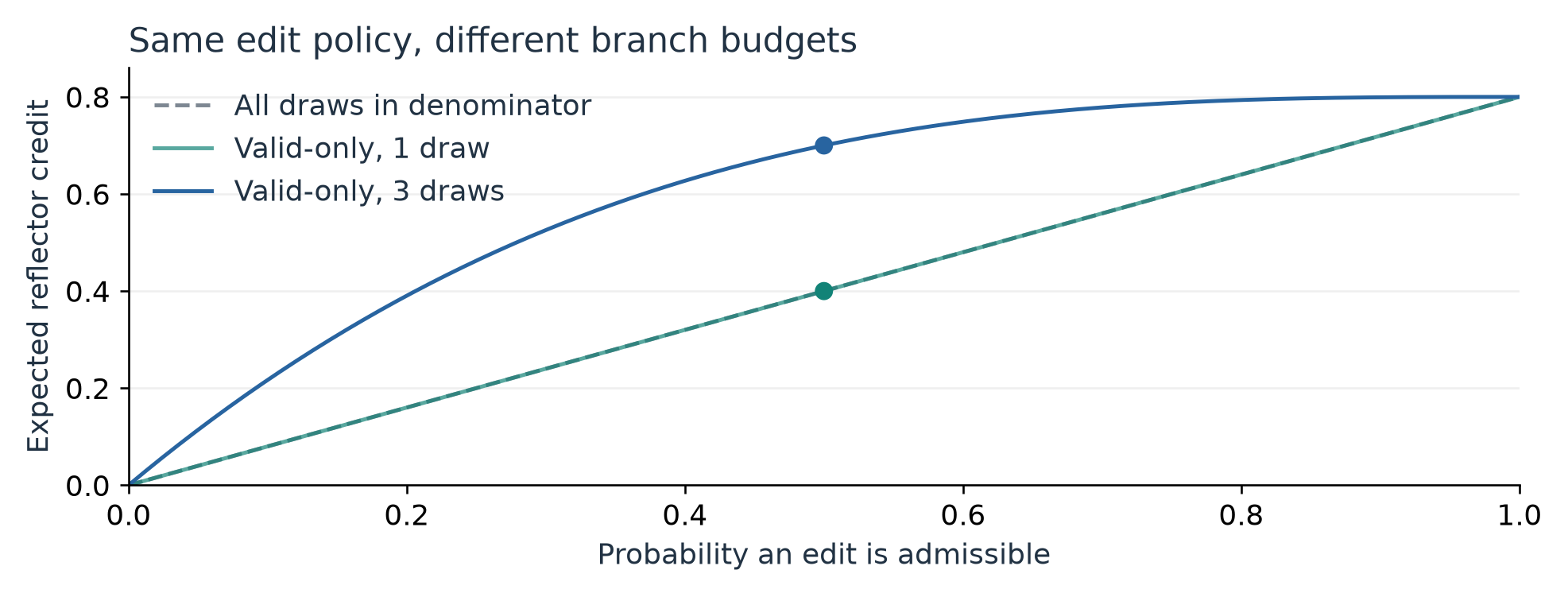
Figure 4. Original illustration of the Appendix D.1 identity at admitted value 0.8. For one draw, the valid-only and all-draw curves coincide. The larger branch has an advantage whenever admissibility is uncertain.
Filtering, clipping, and memory selection
Per Appendix D.3, the comparison batch drops groups whose rewards are all zero or all one under the threshold rule. MiniSWEBench instead uses a nonzero range check for shaped rewards. A singleton with a fractional outcome can survive threshold filtering and receive an outcome-weighted update under the reported mean-zero, scale-one convention. Constant interior-reward groups with multiple outputs have zero centered advantage. These details qualify the main-text shorthand about dropping constant groups. No-op edits produce no candidate and carry zero edit reward. Some curator prompts permit valid no-ops when evidence supplies no improvement. Their structural validity as responses and their eligibility for downstream credit are distinct.
For an advantage and token ratio between the current policy and collection policy, paper Eq. 24 uses
For , dual clipping uses . This caps the negative term for an outsized ratio. The batch averages masked token losses over generated tokens from all retained roles. If an actor output and a reflector output have equal scalar advantages but different lengths, their token counts differ in the loss. When branches are filtered, both the numerator and denominator change. The paper reports one PPO epoch per batch, a learning rate of , and no KL or entropy bonus for ACE-RL. Those design choices belong to the empirical surrogate. Uniformly thinning an ideal unnormalized tree does not prove equivalence after these operations.
The playbook-selection threshold compares the best observed candidate with the chosen seed’s own reward and retains the candidate on ties. Training resets before encounters 3, 6, and onward for each task. Group rewards remain eligible even if the incumbent is retained. Under an illustrative binary verifier, four independent candidates each with true success probability supply a positive observed maximum with probability . If the incumbent has a true success probability of , its single observed outcome cannot reliably distinguish it from that best observed candidate. All four candidates can be objectively worse than the incumbent under this scenario. A count of retained changes alone would conflate that selection effect with true improvement.
Work through a complete mixed-reward batch
Consider a synthetic bounded-reward task. The four incumbent episodes score , and the uniformly chosen seed scores . Two reflections of this same seed advance to editing. The three draws for the first reflection give an admitted improvement scoring , an invalid operation, and an admitted change scoring . The other reflection gives one admitted change scoring . Then the first reflector gets and the other gets . The invalid edit receives zero but is outside its reflector’s averaging denominator. Under all-draw averaging the first reflector would get . The ordering of the two reflectors reverses even though all observed episode rewards are unchanged.
The actor group now contains seven outcomes: the four incumbent episodes and three candidate evaluations. Its mean is . The curator group attached to the first reflection has values , with mean . The evaluation at reward is below both of those means. It still generates useful evidence that a syntactically correct edit can make an inferior candidate. The singleton from the second reflection would use its outcome as its advantage if the fractional-reward threshold filter and singleton convention admit it. The seed’s comparison and reflection’s comparison consequently answer different questions even when both are charged against the same task budget.
The stored candidate is the one with observed reward . Substituting a stronger seed score of as an illustration would keep the incumbent if the candidate scores were unchanged. The editor’s and reflector’s would still exist for optimization, subject to filtering. In real data the seed also changes the evidence, so that hypothetical holds downstream samples fixed solely to explain the distinction between persistence and credit. An implementation-independent report should keep reward, advantage, and retention as distinct columns in its episode ledger.
Value maximization and a capacity decision
The sparse algorithm has three independently meaningful allocations. One can increase the number of distinct seed rollouts , the number of reflections , or the number of edits under a chosen reflection. Within the all-valid regime, the actor cap is . Increasing at fixed requires reducing seed rollouts or reflector breadth. If the verifier is noisy, spending a second evaluation on the same candidate reduces that leaf’s variance, but a fixed then buys fewer candidates and fewer chances to obtain an admitted edit. With and , replacing four single evaluations with two double evaluations would preserve the cap and reduce coverage of edits. It could also train the actor on duplicate playbook inputs, which changes its input diversity.
A simple cost model makes the trade explicit. Let denote average end-to-end cost of one evaluation episode and the costs of a reflection and an edit. Ignoring reset failures and scheduling overlap, the maximal collection cost at the main configuration is . GRPO spends eight seed costs. A budget comparison needs measured and separately, since a good candidate may terminate faster than a poor incumbent or cause the actor to inspect more evidence. The same actor-count cap gives a useful systems invariant for batching, but neither assumes equal duration nor predicts cost on a task mix.
6. Evidence from four benchmarks
The 0.6B non-thinking Qwen3 is used for Mastermind and MBPP. Mastermind gives partial credit for positional and value matches and takes the best guess within 20 turns. MBPP takes the best fraction of three visible unit tests passed within six submissions. The 4B Instruct checkpoint is used for AppWorld and MiniSWEBench. AppWorld evaluates the final application state on 57 development tasks. MiniSWEBench trains on 100 SWE-Gym issues with shaped reward and reports binary resolution on the first 100 SWE-bench Verified issues. An episode that is comparable in count can consume different tokens, tool calls, or environment time on each benchmark.
The baseline grid distinguishes actor-only PPO with a critic, actor-only GRPO, ERL’s retry and internalization, and delayed-joint PPO that applies a critic to a complete handoff chain. Appendix B separately studies delayed-joint ACE-RL, which uses group-relative comparisons across complete chains. The two “delayed-joint” variants should be kept distinct. The PPO variant collapses on some tasks at the reported checkpoints. A critic with high explained variance on its late training batch can still be predicting returns from a poor behavior distribution. This comparison cannot isolate the effect of critic-based credit from chain sampling and the rest of its training recipe.
The following rows extract the GRPO and ACE-RL comparisons from Table 2. Entries are means of best reward after three actor episodes. The final column uses the paper’s reported paired estimate and one task SEM. Rounded marginal means can yield a difference one unit in the last digit away from the paired estimate.
| Benchmark | GRPO pass@3 | GRPO RSI@3 | ACE-RL RSI@3 | Paired gain vs GRPO RSI@3 |
|---|---|---|---|---|
| Mastermind | 0.686 | 0.739 | 0.775 | 0.037 ± 0.018 |
| MBPP | 0.867 | 0.820 | 0.987 | 0.167 ± 0.032 |
| AppWorld | 0.624 | 0.597 | 0.667 | 0.070 ± 0.055 |
| MiniSWEBench | 0.245 | 0.260 | 0.340 | 0.080 ± 0.039 |
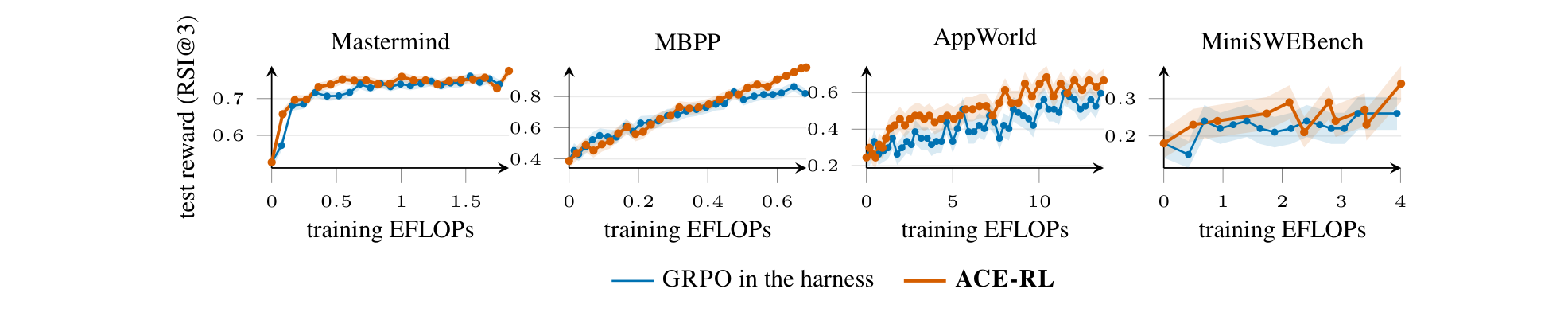
Figure 5. Cropped from Kim et al., Fig. 5. The common role prompts improve comparability. The horizontal axis counts cumulative update FLOPs, omitting generation and environment time.
The matched-harness comparison closes much of GRPO’s Mastermind gap. On MBPP, wrapping GRPO in ACE actually lowers its mean from 0.867 to 0.820 at the checkpoints in Table 2. A new interface can change the sampling distribution enough to erase some gains from repeated independent attempts. An approximate task-conditional 95% interval for the paired AppWorld gap against harnessed GRPO, formed as , is . The same rough calculation gives on MBPP. These are illustrative normal approximations from reported SEMs, with neither multiplicity correction nor between-run uncertainty. Both matter when evaluating the four positive point estimates. A pairing across tasks removes variation in their average difficulty from the difference, while replicating training seeds is required to learn how stable the difference is under retraining.
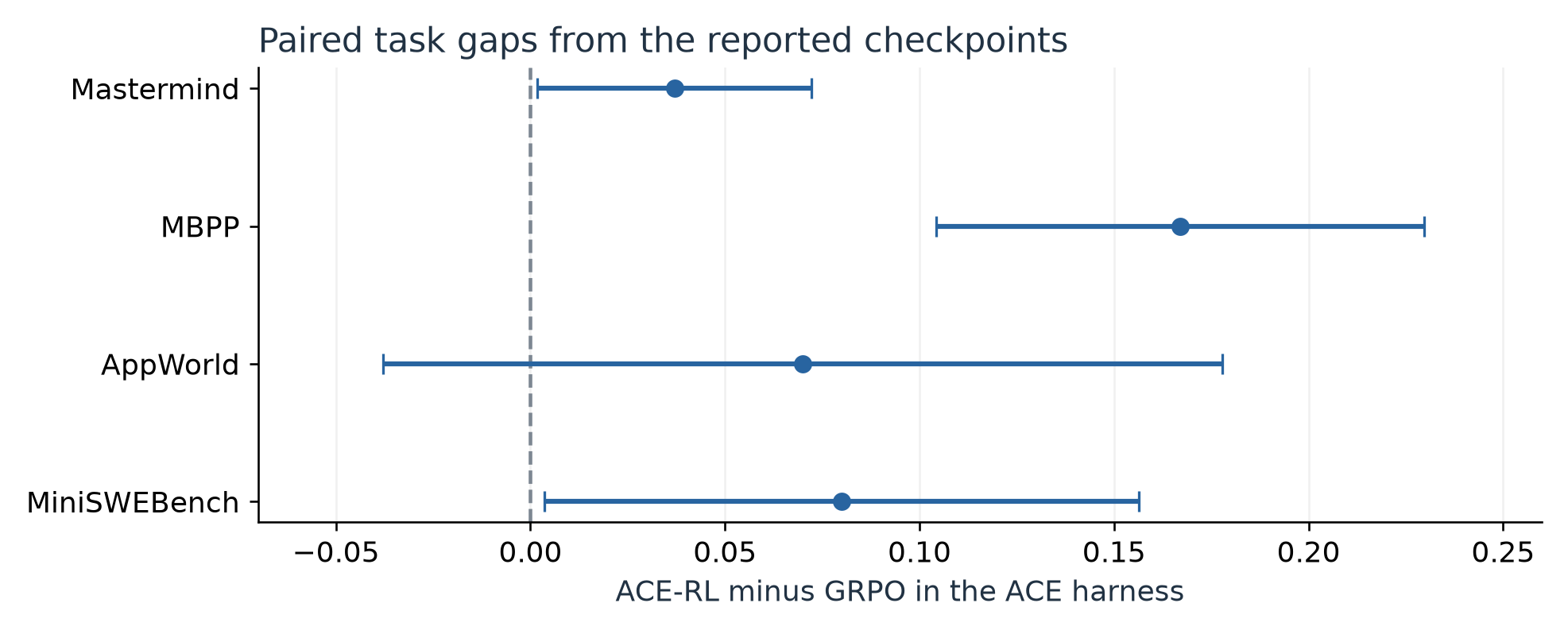
Figure 6. Recalculated from Section 5.2. Bars are 1.96 times the reported paired task SEM in either direction. The intervals do not incorporate variation between training runs.
The pairing matters in both directions. A difficult task that defeats both models can contribute a difference close to zero even if its two outcomes have volatile individual rewards. A task where a helpful edit unlocks the solve can contribute a large positive difference. Resampling all individual attempts as if independent would miss both the dependency within a task and the fact that the two checkpoints saw the same task suite. Training-sample variability is at a higher level. With multiple training seeds, the appropriate comparison would first pair within task and training seed when the design supports it, then examine variability across seed-level effects. On binary tasks, counts of tasks solved only by one model are also informative, especially when the absolute evaluation set is as small as AppWorld’s.
Appendix F.1 reports average update FLOPs per step of 1.14, 1.01, 1.17, and 1.21 times GRPO for the four benchmarks in table order. Matching cumulative update FLOPs thus selects checkpoints that can differ in optimizer steps and exposure. Over-generation, variable branch admission, extra role prompts, environment resets, and long-lived rollout requests remain relevant for end-to-end cost. A MiniSWEBench episode can time out after two hours in training, making the contribution of a slow candidate potentially much larger than the cost of its short curator call. The paper does not provide a cost conversion for that tail.
7. Adaptation, repeated sampling, and the missing counterfactual
For a binary verifier, write for the conditional probability of success on visit given no previous success. Chain the conditional failure probabilities to obtain
With an independent policy and success probability , all hazards are . For a dependent playbook sequence, each hazard integrates over the memories seen on still-unsolved tasks. Best reward is mechanically nondecreasing as more attempts are included. A dependence diagnostic therefore needs a matched empty or frozen playbook run. In the paper, pass@K for graded tasks is the expected best reward of subsets of independent draws. RSI@K takes the realized best reward among the first dependent visits. Binary hazard interpretation applies directly to AppWorld and the held-out MiniSWEBench evaluation, while partial-credit tasks can be analyzed at a given reward threshold.
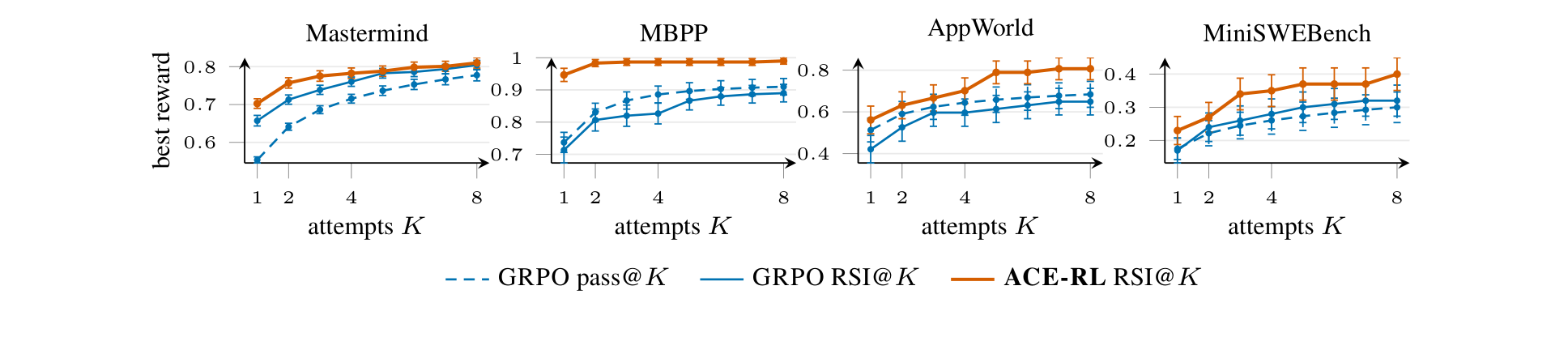
Figure 7. Cropped from Kim et al., Fig. 6. The trained harness leads GRPO independent sampling in the plotted range. The gain past three visits is largest on AppWorld and nearly absent on ceiling-limited MBPP.
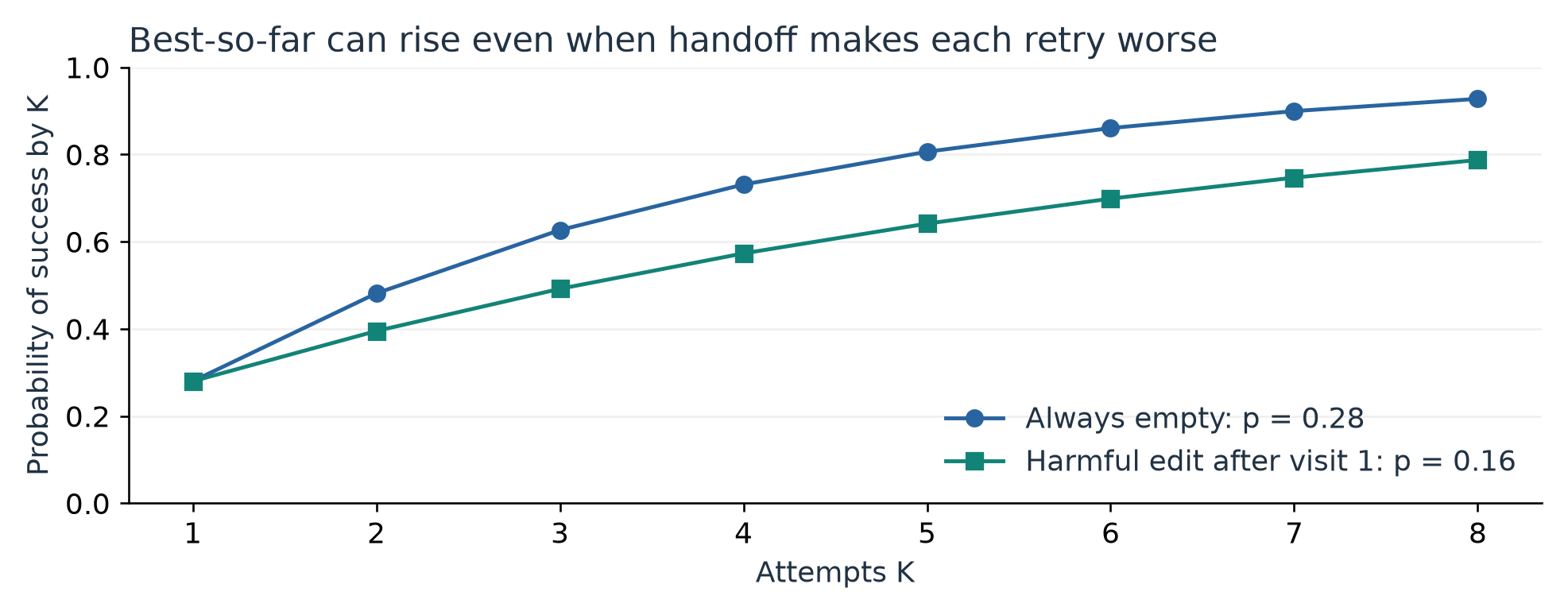
Figure 8. Original probability example. The green series has the same first-visit chance and a worse chance thereafter. Both curves rise because a best-so-far metric keeps past successes.
The edits-discarded experiment supplies a closer counterfactual. It freezes the ACE-RL checkpoint and starts each attempt from the empty playbook rather than carrying edits. Applying edits yields reported paired improvements of on the second AppWorld visit and by the third MiniSWEBench visit. MBPP’s 0.987 versus 0.977 at the third visit is consistent with a ceiling limiting the room for improvement. The Mastermind curve crosses below its edit-discarded counterpart later, with a deficit of about at eight visits and equal task SEM. Some additional attempts improve results on average even if their carried state makes the process less effective than an empty restart.

Figure 9. Cropped from Kim et al., Fig. 7. Panels use different vertical scales. The AppWorld edit-discarded test uses a checkpoint beyond its matched compute budget, as Appendix H notes.
Appendix B tests a chain-based credit design that gives each seed a reflection, edit, and optional evaluator, with evaluators excluded from actor training. Its maximum of 16 environment episodes per task includes eight scoring episodes. Even with a comparison at equal update FLOPs, the appendix uses older handoff prompts for the chain design and different actor data. On MBPP, its main deficit appears at the first attempt, before the playbook can mediate a gain. The chain experiment supports the feasibility of both routes and exposes the sampling cost of the alternative.
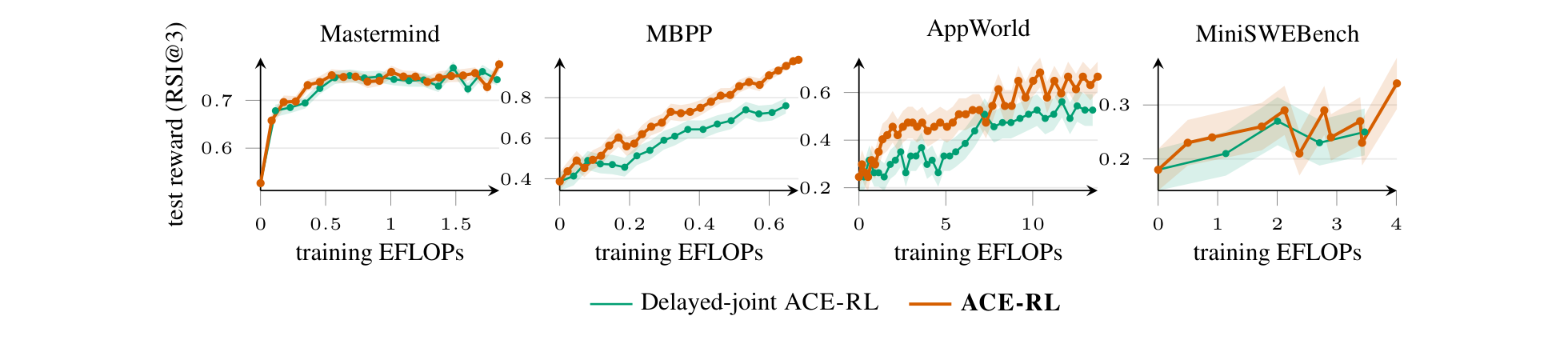
Figure 10. Cropped from Kim et al., Fig. 8. These are comparisons of training recipes. Using them as a controlled estimate of grouping alone would require matching prompt versions, which actor episodes train, and total generation.
8. Protocol details for an independent evaluation
The training and evaluation distributions should be written down before collecting any numbers. At collection, record each task ID, encounter number, incumbent and candidate identity, source seed and reflection, group admission, realized external reward, and whether a candidate became the stored incumbent. Store the role messages and generated-token masks alongside these transitions. The classifier for usable reflections and the parser for admissible edits affect how many updates each role sees. Logging counts by benchmark makes it possible to distinguish low adaptation from the absence of a learning signal after filtering.
A cost ledger should record attempted and completed environment episodes, actual prompt and generation tokens by role, actor and critic update FLOPs, and end-to-end elapsed times. Record reset, timeout, and failed evaluation costs. The paper’s generic test temperature of 0.7 has a MiniSWEBench evaluation exception of 0.6 in Table 5. The per-task reset before visits 3 and 6 is a training rule, while the eight-visit test store persists. Compare checkpoints by cumulative consumed compute with the matching tolerance reported explicitly, and evaluate all comparison arms on the same initial task states and verifier version.
Appendix C shows why “same task” by itself does not specify the handoff input. The AppWorld reflector inspects entity scope and asks for a pre-submission check. The MiniSWEBench reflector uses an abbreviated interaction record with patch and grading summaries, and its actor prompt pushes toward a successful edit by a turn budget. The Mastermind reflector sees a structured guess history and aims to preserve facts and deductions without printing a secret answer. The MBPP reflector receives failing assertions. The reported formatter can truncate history to 20k tokens and preserves the final environment reply. The renderer and prompts therefore contribute to which evidence enters the reward attribution path.
9. Limitations
The paper tests one training run per compared method and two Qwen model sizes, with the two suites confounded with model size. The evidence does not establish how the method scales when the actor already writes reliable playbooks, when verifier signal is scarce, or when restarting an environment is expensive or impossible. Sharing a model means gains in one prompt distribution can coexist with regressions in another. Task-local storage supports same-instance reuse, and cross-task transfer remains open.
MBPP shows a verifier-specific vulnerability. The failing assertions shown to the actor are also the scored ones. Appendix E reports an early delayed-joint PPO run that exited the test process before a failing assertion could run. The authors changed the grader to require a marker after the assertion and excluded that run. Most reported MBPP evaluations predate this repair, and the stated spot checks for ACE-RL and PPO inspected trajectories from selected steps for exit calls. Appendix G also notes solutions hardcoding visible assertions. The improvement on the reported verifier can be genuine while giving much weaker evidence of program correctness on hidden tests.
Appendix D.1 makes the estimator limitations unusually inspectable. Training drops all-invalid groups, normalizes noisy samples, and learns the current seed outcome. Test time applies an edit without the training-time best-of-candidates gate. The first AppWorld handoff example and the qualitative examples in Appendix G show plausible grounded behaviors. They identify mechanisms to investigate rather than the causal contribution of each individual tip.
10. Critical analysis
Separate the writer from its reader
The discard control establishes the value of letting the trained system retain edits under its given reader. It does not locate the gain in the reflector, curator, or reader individually. To locate it, form a crossed evaluation with two writers and two readers. Generate each playbook from an identical frozen bank of seeds. Use the same reflector-curator pair from ACE-RL or actor-only GRPO as the writer and evaluate both writers’ outputs under both actor checkpoints. Include empty memory and length-matched unrelated memory under each reader. The latter tests whether changes are trace-specific or act as generic priming. Hold environment seeds fixed where feasible, run several independent actor continuations per playbook, and analyze differences paired by task before aggregating over separately trained checkpoints.
Let be the mean reward when writer produces the playbook for actor . The crossed interaction
tests whether the writer improvement depends on the reader. The same experiment can swap just the curator while holding the reflection fixed. Report both the effect among admitted edits and an intention-to-treat result that scores the incumbent when an output is inadmissible. Those two estimands answer different questions because training may improve syntax or admission separately from the quality of accepted notes.
Measure credit variance without changing the actor examples
Collect a shared budget of fully scored handoff branches on a modest subset of tasks. Compute same-input and across-seed advantages from the same leaves, retaining identical actor examples, role prompts, loss masks, and collection checkpoint. Measure the per-role variance of raw score estimates before scaling and the rate of sign reversals after standardization. Randomize which reflection receives the larger edit budget. Compare fixed-denominator and valid-only mean credit and log the admission frequency with outcome by role. This isolates the mechanism in Appendix B.2 and exposes an asymmetry that raw means can conceal.
A downstream training ablation should then equalize environment episodes and total generation as well as update FLOPs. Comparing two samplers at a single compute budget is informative but can miss a setting in which many cheap descendants beat a few expensive episodes. A frontier coding agent and a small Mastermind agent are likely to occupy different points on that frontier. The data needed to tell them apart are measured costs and paired outcomes.
Put the no-op back in the experimental choice set
The selection rule has a one-draw maximum and rewards changing the playbook, even though the safest response to redundant or contradictory evidence may be to retain the old text. Evaluate a real no-op alongside edits on the same environment seeds. Use additional paired retries only when the value gap is within a preset uncertainty band. At test time, cap playbook age or include an explicit rollback when the failing evidence conflicts with its premise. Compare the conditional hazard of first success after each visit, the rate of harmful edits on previously unsolved tasks, and the cost paid per successful task. A stale tip may lose to an empty restart on Mastermind while a precise repository path remains useful on MiniSWEBench. The experiment should preserve that distinction by reporting per-domain error profiles.
A hidden-verifier variant of MBPP would further separate storing test literals from learning to write useful guidance. Train using the same visible failures, evaluate both visible and hidden assertions on the same candidate program, and preserve the sandbox and timeout across arms. For AppWorld, vary harmless entity identifiers across a transfer subset to test whether tips preserve rules or just names. For software tasks, measure the value and rate of edits that report genuinely new diagnostics, including those that followed a failed seed. Each is a controlled follow-up to the reported evidence, rather than a result from this review.
Make wall-clock credit assignment visible
The seed, reflector, and edit paths add serial dependencies before an evaluator can launch. Parallel GPUs can overlap different tasks, but work at one task’s evaluator leaves waits on completion of earlier calls. For one always-admitted branch, the critical path includes one seed, one reflector, one curator, and one evaluator. For a seed pool that is fully synchronized before selection, it also includes the slowest seed; the detached actor-only update can instead consume all seed rewards directly. At fixed compute this creates a different latency distribution even when average GPU utilization appears similar.
A measured comparison would group tasks by environment latency, then log the time from collection-policy snapshot to first and last admitted evaluation. The difference between those times is useful for quantifying update starvation or policy-age variation. Slow tasks can become underrepresented if collectors stop at a timeout and keep only faster admitted branches. Track reject reason and episode time together for this reason. A policy trained with playbooks that mostly survived a fast environment may lose its edge when new tasks require longer exploration. No runtime conclusions follow from update FLOPs alone.
For deployment, most additional work arises after an actor that failed could simply retry independently. A low-variance decision experiment can compare adaptive handoff only on unsolved tasks with an independent retry under the same invocation cost. Given a previously unsuccessful task, let be the next-visit solve probability under a handoff and under an empty restart. If both have equal actor cost and writing the handoff adds , solving per expected cost in a one-retry comparison favors writing only when . This implies . If and writing adds 20% to cost, the handoff needs . These assumptions are illustrative, and a real scheduler should use conditional estimates by task and account for different episode lengths. The calculation clarifies what extra evidence a same-episode comparison leaves unresolved.
Hold the environment state fixed as well as the actor
The reset assumption is part of what makes an ACE-RL handoff evaluable. A candidate and the incumbent can be tested on the same initial world state. An agent continuing in a partially modified production environment faces a different query. If a seed action has already created a record, a memo telling the next actor to begin by creating it can be an effective reminder from a clean start and a harmful instruction from the modified state. With the initial state, the seed’s terminal state, and the value of a memo under a state, the two relevant differences are
The signs need not agree. Continuing from one seed also changes how credit ought to be shared between the physical effect of the seed’s actions and the text handed onward. For a snapshot-capable benchmark, fork the seed’s terminal state for a within-state comparison, and separately fork the clean initial state. Run the same two playbooks in each fork, preserving verifier rules and actor weights. Record wrong-stage actions, repeated state changes, and the time to complete remaining work. This isolates the value of a handoff in each initial condition. Applying the result to an irreversible service depends on an appropriate sandbox or replay model.
A typed playbook could separate observations, inferred constraints, and actions to verify. Compare typed tips, free-form tips, and raw evidence at a fixed token budget. Measure both the information the actor can use and what the schema excludes. An easier format may raise admission without raising reward.
Stratify those trials by seed outcome. Evaluate whether a failed seed’s evidence helps recovery, and whether an edit after success introduces regression. Best-so-far scoring retains an earlier success even if all later attempts fail. Report post-success rewards and time to first solve alongside the headline measure.
11. Conclusion
ACE-RL turns the usefulness of an editable, model-written artifact into a trainable verifier signal. Sparse branching gives each writing role comparisons under shared parents while reusing costly candidate evaluations as actor experience. The practical estimator conditions on available evidence, trains the seed actor with current reward, and changes weighting through admission, normalization, and clipping. The exact four-call gradient is a reference for these choices. The matched harness and edit-discarded controls show why training the handoff is worth studying. The next empirical target is the benefit of each learned role under an all-in cost budget and a verifier that tests general behavior beyond the evidence shown to the actor.
References
- Doyoung Kim, Byeongguk Jeon, Kailin Zhang, and Sherry Yang, Experience-Handoff Reinforcement Learning for Recursive Self-Improvement, especially Algorithm 1 and Appendices B, C, D, E, F, G, and H.
- Qizheng Zhang et al., Agentic Context Engineering, for the editable playbook scaffold.
- Zhihong Shao et al., DeepSeekMath, for GRPO. John Schulman et al., Proximal Policy Optimization Algorithms, for the clipped objective.