Review date: 2026-11-02 · Author: Zhongzhu Zhou
Paper reviewed: InfraDev: Can Coding Agents Develop AI Infrastructure, and How Can We Tell?
Paper authors: Yangshen Deng, Jiaqi Ruan, Yeqi Huang, Nick Lau, Guangming Sheng, Luo Mai
arXiv: 2610.36589 · Version: v1, 2026-10-27
1. The important result is a change in the judge
A coding agent can return a tensor with the correct shape, satisfy the tests supplied by a repository, and still fail to implement the requested optimization. It can send an entire parameter buffer when only changed entries should travel. It can produce the right first output while leaving a cache in a state that breaks the second call. It can implement an eager execution path that silently stops updating state when CUDA graphs are enabled. These are not exotic edge cases for infrastructure software: they are part of what the software is supposed to do.
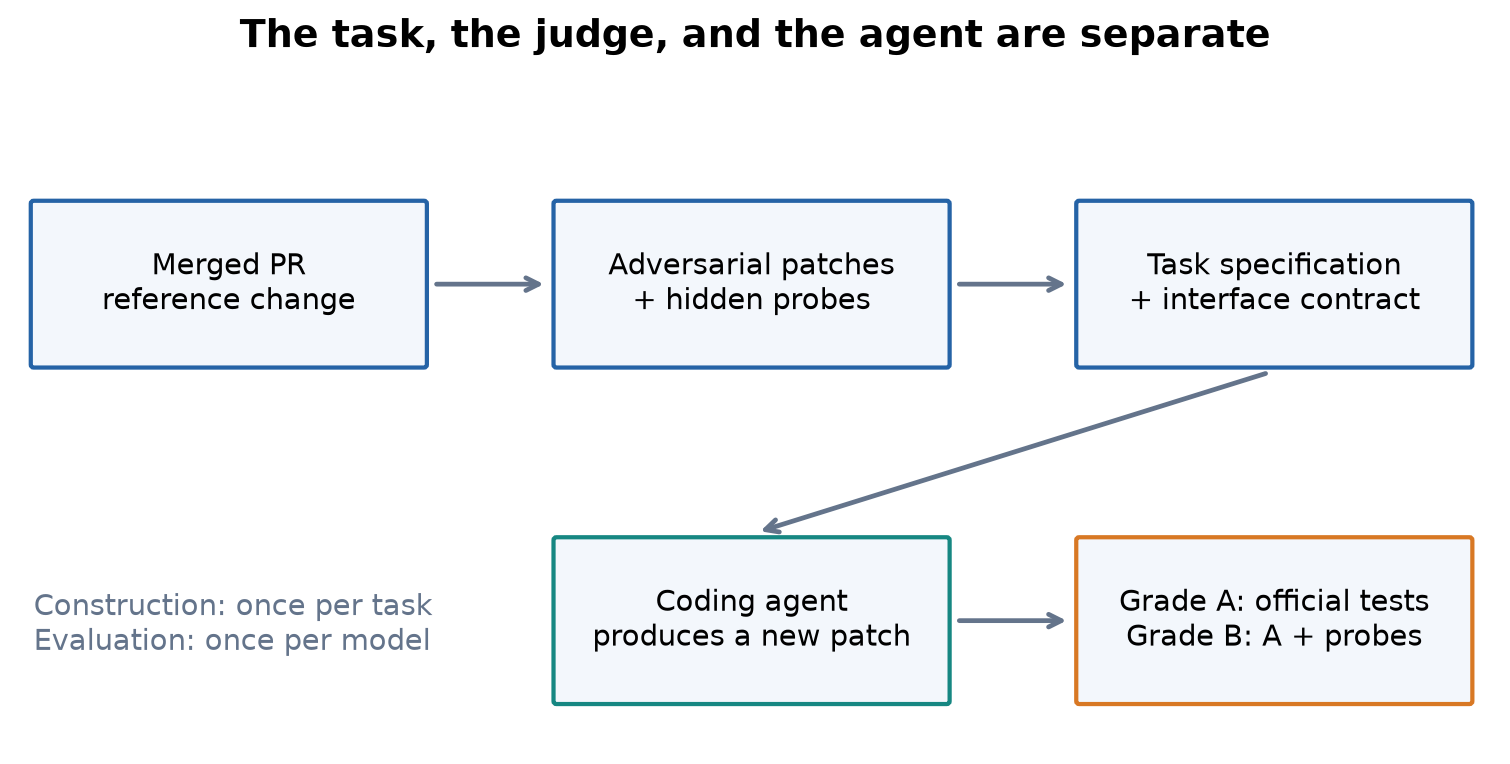
InfraDev turns that observation into a benchmark of 36 substantial changes to Megatron-LM, verl, and vLLM. Its central contribution is not simply a harder list of programming problems. It jointly constructs additional tests and a task specification. Hidden probes enforce requirements that the original tests miss; a rewritten prompt states the required interfaces and behaviors so that the stronger tests do not become a guessing game. A reusable execution environment makes running this evaluation less expensive in storage and setup time.
The most useful headline is that 102 of 216 model submissions pass the official tests, while only 69 of those submissions survive the additional probes. The difference is 33 accepted submissions whose success depended on a weaker judge. This does not establish that every remaining patch is correct, nor that all rejected patches are useless. It establishes that the choice of tests materially changes the measured result on these tasks.
The best measured configuration resolves 14 of 36 tasks, or 38.9%. That number belongs to a particular collection of large changes, a particular time budget, particular model-and-harness combinations, and a particular scoring procedure. It is not a universal probability that a coding assistant will succeed at an infrastructure request. The review below uses the complete 20-page paper, including Appendices A–D, and separates the paper’s observations from my analytical examples and proposed evaluation improvements.
2. Prerequisites: a program has values, state, and resource behavior
2.1 Functional correctness is only one observable
It is useful to model an infrastructure operation as a state transition. Let be the current input, the persistent state, an execution mode, and the environment. My notation is
A conventional unit test may observe only . A stateful test also observes the next state or a later output. A performance test constrains one or more components of . A mode-sensitive test repeats the experiment under another , such as eager execution versus graph replay. Equation 1 is an explanatory model, not a formula introduced by the paper.
This distinction explains why “correctness versus speed” is sometimes misleading. If the task explicitly asks to reduce communication, sending unchanged entries is a task failure even if the final weights match. The resource requirement is part of the specification. Conversely, a program can be a valid slower alternative when the task never promised a particular saving. Evaluation should not invent a performance obligation after seeing the solution.
The environment variable also matters. Different GPU types, compiler builds, collective implementations, and available memory can change which cases execute and how long they take. InfraDev calibrates the golden patch and evaluates submissions in the same task environment and on the same GPU type. This controls one source of mismatch; it does not make the benchmark independent of hardware.
2.2 Distributed arithmetic creates hidden scale errors
Consider data-parallel training with ranks and an equally weighted local objective . The intended global objective and gradient are
An all-reduce that sums gradients produces the numerator. If no later stage divides by , the update uses instead of . A single-rank test cannot distinguish the two because . Shape checks cannot distinguish them either. With two scalar local gradients, 2 and 6, the required average is 4 while the sum is 8. This is an illustrative arithmetic example, not a new experiment from InfraDev.
The error can resemble a change in learning rate in a simple optimizer, but it need not remain equivalent once clipping, optimizer state, mixed precision, or per-group policies intervene. The correct test therefore starts from the intended mathematical contract rather than accepting a plausible loss curve. Appendix D explicitly lists summing instead of averaging data-parallel gradients as an algorithm error.
Unequal local batch sizes require a different weighting. Equation 2 assumes equal rank contribution; blindly adding an average is not a general repair. This is exactly why the prompt should identify the objective and relevant behavior, while leaving the implementation to the agent.
2.3 Golden, adversarial, and hollow patches play different roles
The golden patch is the actual merged change. It supplies a reference implementation and calibration outcome. An adversarial patch deliberately violates a requirement while passing the official tests. It is a witness that those tests are insufficient. A hollow patch preserves the new interfaces but makes the new functions raise exceptions. It tests whether a purported probe actually executes the behavior rather than merely importing the right name.
None of these objects is a proof of specification completeness. The golden implementation may contain an undiscovered defect. The adversarial collection is finite. A hollow patch exposes interface-only checking but cannot expose every semantic shortcut. Their value comes from creating explicit positive and negative controls for a judge that would otherwise be accepted without challenge.
3. What the task collection covers—and what selection removes
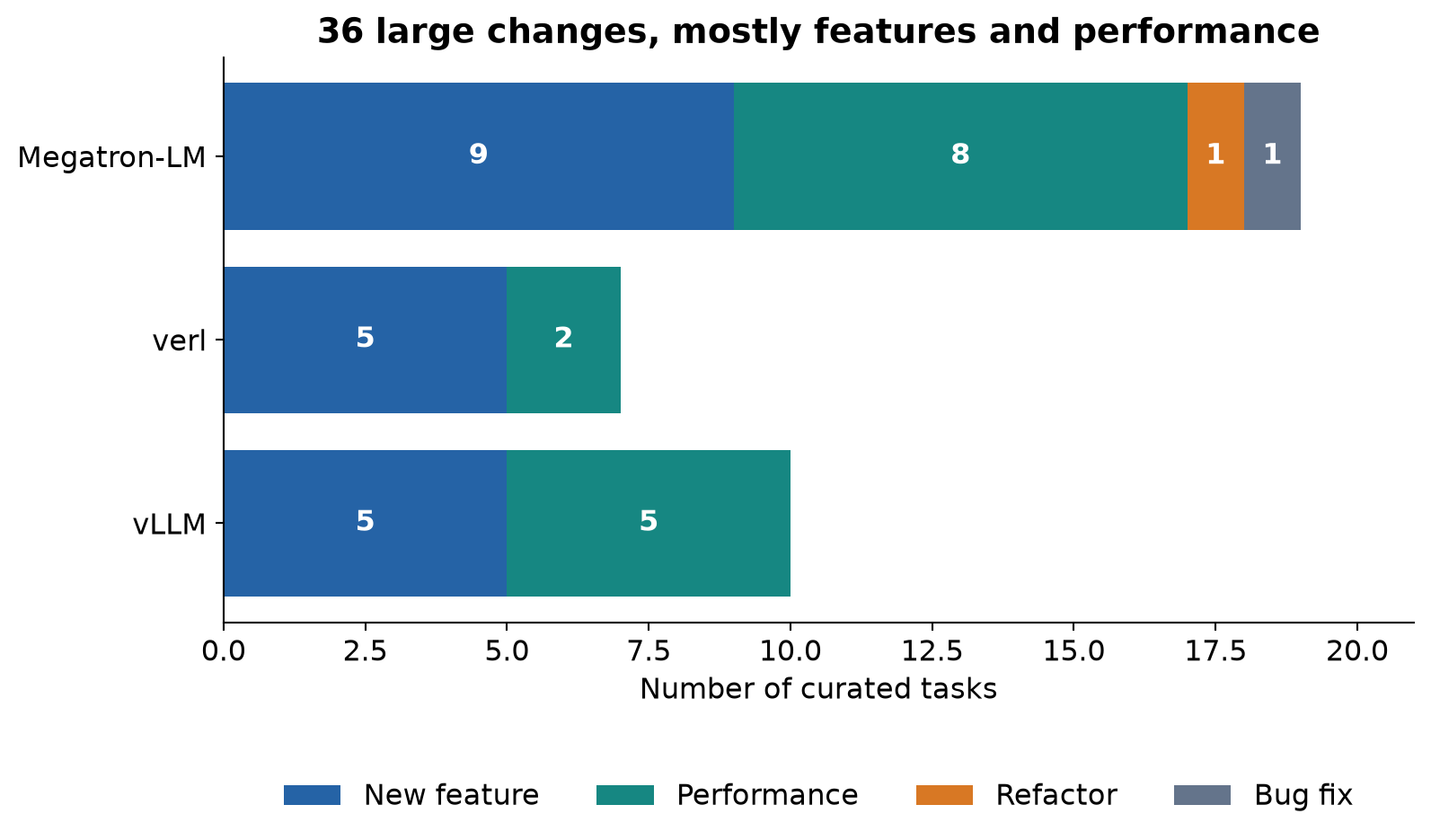
InfraDev starts from 21,389 merged pull requests dated January 2025 through September 2026. The selection requires a merged, non-reverted change of at least 1,000 lines with new tests; experts then select changes to core functionality. The resulting tasks average 17.4 files and 1,818 changed lines, and 20 of 36 require multiple GPUs. This is a deliberate stress test of changes that cross module boundaries.
The task distribution is 19 training changes from Megatron-LM, seven RL changes from verl, and ten inference changes from vLLM. There are 19 feature additions, 15 performance changes, one refactor, and one bug fix. Thus this benchmark is not primarily measuring the small issue-repair workload associated with many repository benchmarks. It asks the agent to reconstruct a substantial change in a production framework from its pre-change state.
The selection criteria improve interpretability: there is a real change, a before/after boundary, and an existing test suite. They also change the population being measured. A line-count threshold excludes many small but delicate numerical fixes. Restricting to merged and non-reverted changes favors work whose intended endpoint is already known. Expert selection can favor problems that are easier to package into a stable environment. These are reasonable construction choices, but results should be generalized to similarly scoped work rather than to every infrastructure activity.
The paper reports that 24 of 36 official suites have no assertion checking a numerical result, and 13 of 15 performance changes have no assertion checking the promised saving. These observations concern the selected changed tests and benchmark tasks. They should not be expanded into a claim that these projects have no numerical or performance validation anywhere. A production repository may rely on broader integration tests, release testing, or human review outside the task’s grading suite.
For an agent researcher, the collection is especially valuable because it joins concerns often studied separately: editing a large repository, reasoning about distributed numerical operations, maintaining state, and observing actual resource behavior. A benchmark of one kernel can isolate arithmetic and speed but hide integration. A task that uses a training framework can evaluate scientific workflow competence without requiring the agent to change the framework itself. InfraDev explicitly targets the latter boundary.
4. Joint synthesis: challenge the tests, then make the challenge fair
4.1 Hidden probes have an acceptance procedure
The construction agent first summarizes the claims of the pull request. It creates incorrect patches that the official suite accepts, writes probes for the missing requirements, and iterates. Appendix A adds important detail to the short main-text algorithm: each probe must accept the golden patch in three consecutive runs without skipped cases, reject the pre-change state, reject the hollow patch, and reject the adversarial patches. The adversarial patches must also score no worse than the golden patch on the official tests.
Using for the golden patch, for the base snapshot, for the hollow patch, and for adversarial patches, the intended discrimination can be summarized as
The repetition on is a stability check. Three successful runs can catch obvious instability but do not establish a low false-rejection probability for all machines or workloads. If a flaky test fails independently with probability , the probability of seeing three successful calibration runs is . A hypothetical still gives 0.729. Independence is only an illustrative assumption; correlated resource noise makes that simple model incomplete.
Algorithm 1. Construct and accept the hidden probes
The following numbered pseudocode restates paper Algorithms 1–2, including the bounded-round failure behavior described in Appendix A.
1. Read the PR claims, golden patch, base snapshot, and official tests.
2. Build adversarial patches that violate claims but pass official tests.
3. Write numerical and behavioral probes for the missing requirements.
4. Build a hollow patch with the new interfaces but failing function bodies.
5. Run every probe on the golden patch three times; require no skips.
6. Require every probe to reject the base, hollow, and adversarial patches.
7. Require adversarial patches to score no worse than gold on official tests.
8. If checks fail, revise probes and adversarial patches and repeat.
9. At the round limit, leave this PR without probes if acceptance still fails.
10. Otherwise retain the accepted probes and record their requirements.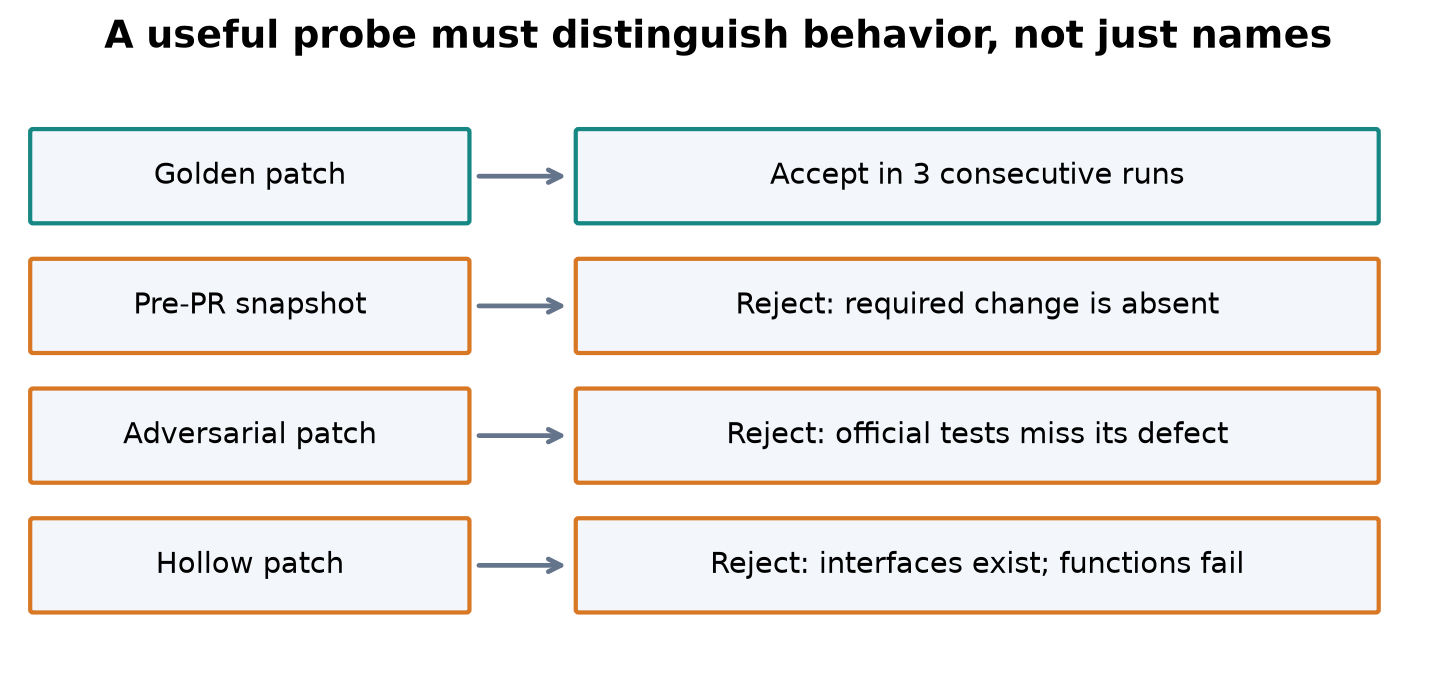
The round-limit case matters. A reader should not silently assume that every task receives equally strong probes. The paper explains what happens when acceptance fails, but does not provide a compact task-by-task coverage table showing which promises were probed and how many adversarial variants were attempted. Such a table would help distinguish a difficult task from a task with a particularly thorough judge.
4.2 Four ways to obtain a numerical oracle
Appendix A describes references from an existing path, an invariance, a manually computed result, or a mathematical property. These sources have different failure modes. Comparing against an existing path is useful when an optimization should preserve outputs, but shared defects can survive. An invariance can reject inconsistent behavior without identifying a unique correct output. A direct high-precision calculation is stronger for a small mathematical case but may not cover stateful execution. A property such as zero self-divergence is cheap and meaningful, yet many incorrect functions can satisfy one property.
For example, if a normalized probability vector has positive entries on its support, then
This derivation explains an invariant mentioned in the paper. It also exposes the limit: an implementation returning zero for every pair of distributions would pass this case. A useful oracle set combines self-consistency with nontrivial reference inputs. A robust benchmark should seek disagreement among plausible wrong implementations rather than merely accumulate many checks of the same easy property.
4.3 Why the prompt must change with the tests
Stronger tests can introduce unfair failures if they call a symbol or demand behavior that the agent was never told to provide. InfraDev therefore extracts an interface contract and passes a record of required behaviors and symbols to a prompt-authoring agent. That record does not include probe code. The author has additional construction inputs, including the golden patch, while the evaluated agent receives the resulting task description.
The prompt states the names, signatures, tensor shapes, types, configuration knobs, required behavior, and execution rules. It withholds solution algorithms, formulas, numerical constants, tolerances, and validation strategies. A linter checks required symbols; another agent checks whether the description leaks solution information. Ambiguous items are omitted. The distinction is sensible, but its boundary deserves scrutiny: an interface can constrain an algorithm strongly, and a numerical requirement can be part of the specification rather than an answer.
Algorithm 2. Build a sufficient, solution-free task contract
This is a reviewer organization of the procedure in Section 3.1.2, not an additional algorithm evaluated by the authors.
1. Extract every interface the official tests or hidden probes call.
2. Record each required behavior, its scope, and relevant execution modes.
3. Separate externally required behavior from implementation choices.
4. Draft the task from the PR, reference change, tests, and handoff record.
5. State required names, signatures, types, shapes, and configuration knobs.
6. Do not provide the hidden probe code or the solution procedure.
7. Lint the draft for missing contract symbols.
8. Have a checker flag leaked solution information; revise until accepted.
9. Give the final specification and pre-change repository to the coding agent.
Appendix B’s prompt template is part of the evaluated method, not an instruction to the reader. It insists on autonomous work, import and collection checks, runtime sanity, distributed checks, and regression protection. Those instructions reduce accidental early termination and make the expected operating conditions explicit. They also mean the rewritten prompt changes more than symbol names: it changes process guidance. That distinction becomes important when interpreting the prompt ablation.
5. Scoring: the denominator and the success rule both matter
5.1 Test pass rate is averaged over tasks
For task , the paper defines as the number of collected cases when the golden patch runs, including cases that the golden patch fails or skips on the available hardware. If a submission passes cases, its score and the reported task-macro average are
This is not the same as pooling all passing tests across the benchmark. Consider an illustrative two-task benchmark: one task has ten cases and all pass, while another has 100 cases and 50 pass. The task-macro score is . The pooled score is . Neither number is inherently wrong, but they weight the workload differently. InfraDev’s choice prevents a task with many parametrized cases from dominating the overall percentage.
Missing, empty, or inapplicable patches receive zero rather than disappearing from the denominator. Harness faults are excluded and counted separately. This separation avoids rewarding an agent for giving up and avoids assigning a system failure to the model. It creates a reporting obligation, however: readers need the excluded-run counts and their distribution to understand whether failures of the evaluation machinery are concentrated in particular tasks or configurations.
5.2 “Resolved” has an important qualification in the methods
Section 3.2 says a task is resolved when a submission passes at least as many cases as the golden patch. If is the number of cases passed by gold, the stated rule is
Several captions and prose passages simplify this to “every test passes.” These statements agree when gold passes all collected cases. They can differ when gold fails or skips some cases, which the methods explicitly allow in the denominator. This review therefore treats the methods’ calibrated rule as the precise definition and flags the shorthand rather than rewriting it into a stronger guarantee.
There is a second distinction between a count threshold and a set-based criterion. Let be the set of cases gold passes, and the set the agent passes. The stronger condition would be
but the reverse implication need not hold. For instance, gold might pass cases 1, 2, and 3 while the agent passes 1, 2, and 4. Equal counts do not show that the reference-success cases remain correct. This is a logical concern about the written metric, not evidence that a particular InfraDev score was inflated. Clarifying whether grading enforces case identity would resolve it without changing the benchmark’s central idea.
5.3 Quantifying the weaker judge’s acceptance gap
Across six models and 36 tasks there are 216 submissions. The official suite accepts 102; the stronger suite accepts 69. The conditional rejection fraction is
That is the source of the paper’s 32% headline. The corresponding difference across all submissions is percentage points. The denominators answer different questions: how often an official success is overturned, versus how much the overall acceptance rate changes. Calling this “32% lower accuracy” would obscure both the conditioning and the fact that benchmark acceptance is not an independently measured ground-truth accuracy.
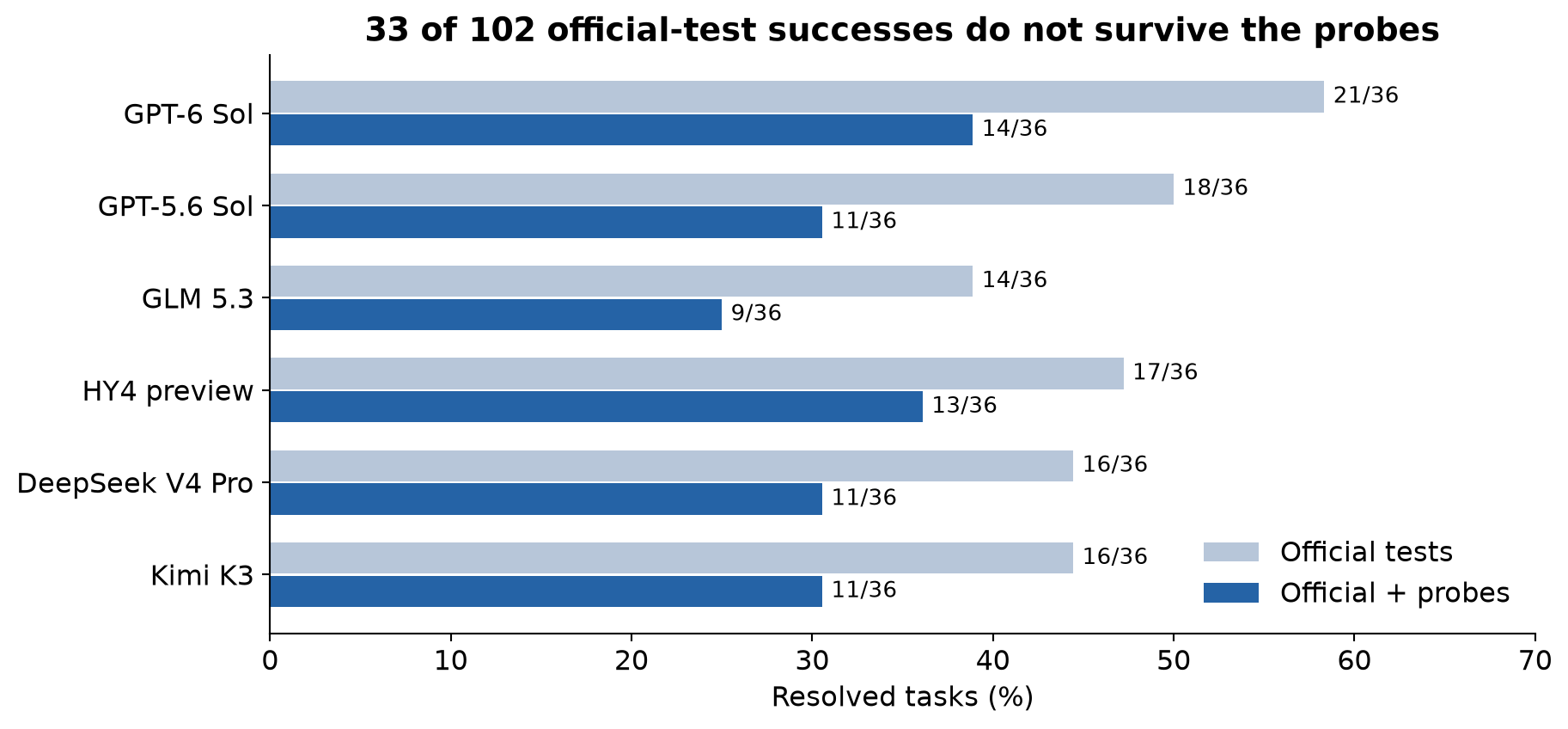
For GPT-6 Sol the change is 21 to 14 solved tasks: a 19.4-point reduction and a one-third reduction relative to official successes. For HY4 preview it is 17 to 13, or 11.1 points. Stronger tests therefore affect every measured configuration, but not equally. The added tests are not merely shifting a fixed score scale; they change which capabilities matter.
6. What the six-model comparison establishes
6.1 Aggregate success, test coverage, and cost
The following table reproduces the principal results from Table 2. Runtime and estimated API cost are per-task means from the paper’s experiments, not current price quotations.
| Configuration | Resolved | Tests passed | Minutes | Estimated USD |
|---|---|---|---|---|
| GPT-6 Sol | 38.9% | 78.8% | 43.9 | 5.37 |
| GPT-5.6 Sol | 30.6% | 78.6% | 73.9 | 17.98 |
| GLM 5.3 | 25.0% | 76.7% | 136.9 | 13.89 |
| HY4 preview | 36.1% | 83.3% | 118.1 | 2.09 |
| DeepSeek V4 Pro | 30.6% | 74.3% | 94.1 | 1.89 |
| Kimi K3 | 30.6% | 75.8% | 136.4 | 13.48 |
High test pass rates coexist with modest task resolution. Many easy or unchanged cases can pass while a few precise requirements remain unmet. HY4 has the highest test pass percentage, but GPT-6 resolves one more complete task. Optimizing the average number of passing tests is therefore not equivalent to optimizing successful delivery.
The comparison is between complete configurations. GPT-6 Sol and GPT-5.6 Sol use Codex; the other four use OpenCode. Reasoning effort is xhigh or a comparable setting, and each configuration runs once per task. A model’s observed result is mediated by its harness, tools, recovery behavior, context handling, and serving conditions. The paper additionally notes possible served-model degradation during the GPT-5.6 measurement window. Treating these results as cleanly isolated model-weight effects would go beyond the experiment.
The token totals in Appendix C are also easy to misread. Table 6 splits non-cached input, cache reads, output, and reasoning. The large totals are dominated by cache reads. They are not millions of newly generated answer tokens, and token totals alone are not a reliable cost comparison when providers price cached and uncached usage differently. The table describes parent-session accounting; readers should keep that scope rather than silently treating it as every resource consumed by an entire evaluation campaign.
6.2 Repository slices are essential
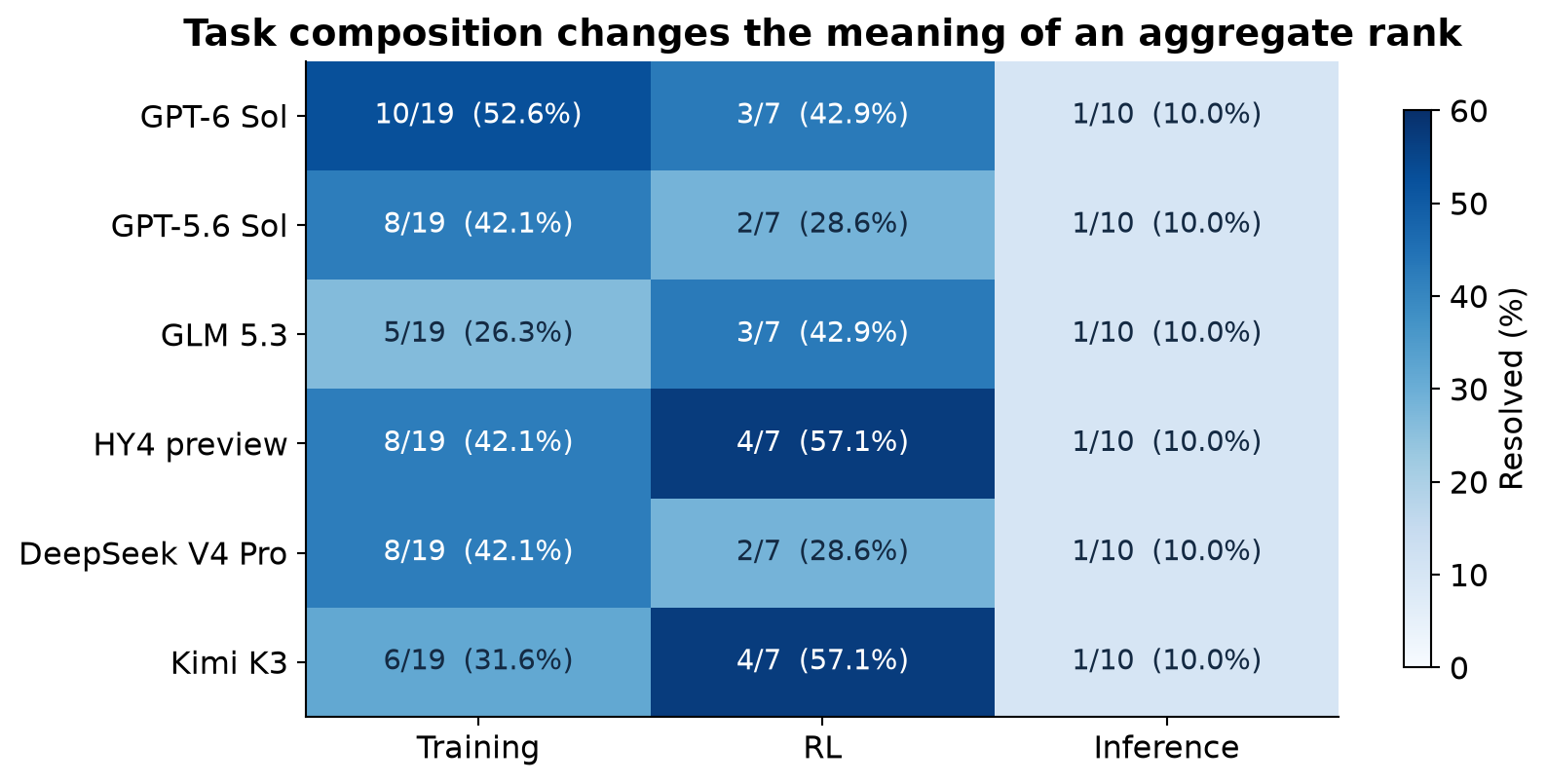
All six models resolve one of ten inference tasks. Training results span five to ten of 19 tasks, and RL results span two to four of seven. An aggregate advantage can therefore come from one portion of the workload. On this sample, GPT-6 is strongest on training, while HY4 and Kimi tie on RL. The inference slice remains difficult for every configuration.
With fixed task composition, the aggregate resolution rate can be reconstructed from the category rates:
Changing those weights can change the ranking without changing any model behavior. A deployment team mostly working on inference should not select a configuration only from the benchmark-wide headline. It needs the relevant slice, uncertainty over repeated runs, and an understanding of which failures overlap.
Appendix Table 4 shows a particularly large official-test gap in verl. GPT-6 goes from seven of seven official successes to three of seven with probes. By contrast, its inference count remains one of ten under both judges. A zero gap in that slice does not prove the original inference tests are complete: agents may already fail earlier structural requirements, leaving little additional accepted behavior for probes to reject.
6.3 The original-description ablation has a narrow scope
The prompt ablation tests GPT-6 Sol and DeepSeek V4 Pro on the 19 Megatron-LM tasks. Under the original PR descriptions, each resolves 5.3% with official tests and 0% with probes. Under synthesized prompts, their stronger-suite rates become 52.6% and 42.1%. The abstract’s broad wording should be read in light of this actual experimental scope; it is not a six-model, all-repository ablation.
The result strongly suggests that an underspecified request can prevent the benchmark from measuring the intended implementation capability. It does not show that specification repair alone causes the entire gain. The rewritten template also gives execution guidance and explicit completion criteria. A cleaner decomposition would compare the original description, interface-only enrichment, behavior-only enrichment, process-only guidance, and the full combined prompt. This is a proposed follow-up, not an experiment reported by the authors.
7. The execution environment saves preparation resources
Each run receives an exclusive node with eight H800 or H20 GPUs and a 2.5-hour agent time limit, excluding environment preparation. The submission is applied to a clean pre-change snapshot in a separate grading container. The test directory is replaced with the post-change tests, preventing an agent from gaining credit by modifying the tests it will later be graded against. Calibration and grading share the same hardware type and task environment.
Ordinary per-task Docker images reuse build steps as a prefix. Changing a dependency early in the build can invalidate the reuse of later steps. InfraDev instead puts locked dependencies into shared-volume virtual environments installed with uv, reuses environments with the same dependency hash, and hard-links cached packages for new environments. Model weights and datasets use a shared cache. Lightweight base images retain common components such as CUDA and the interpreter.
A conceptual storage decomposition makes the distinction clear. Suppose is common base storage, the dependencies needed by task , and its artifacts. Ignoring filesystem metadata and the image-layer sharing already available to Docker, the two idealized accounting expressions are
This is an explanatory model, not a claim that the measured baseline duplicates every byte. The potential saving depends on overlap. If tasks need unrelated packages and artifacts, union size approaches the sum and reuse helps little. If they share large immutable weights, the storage benefit can be substantial even when package builds remain slow.
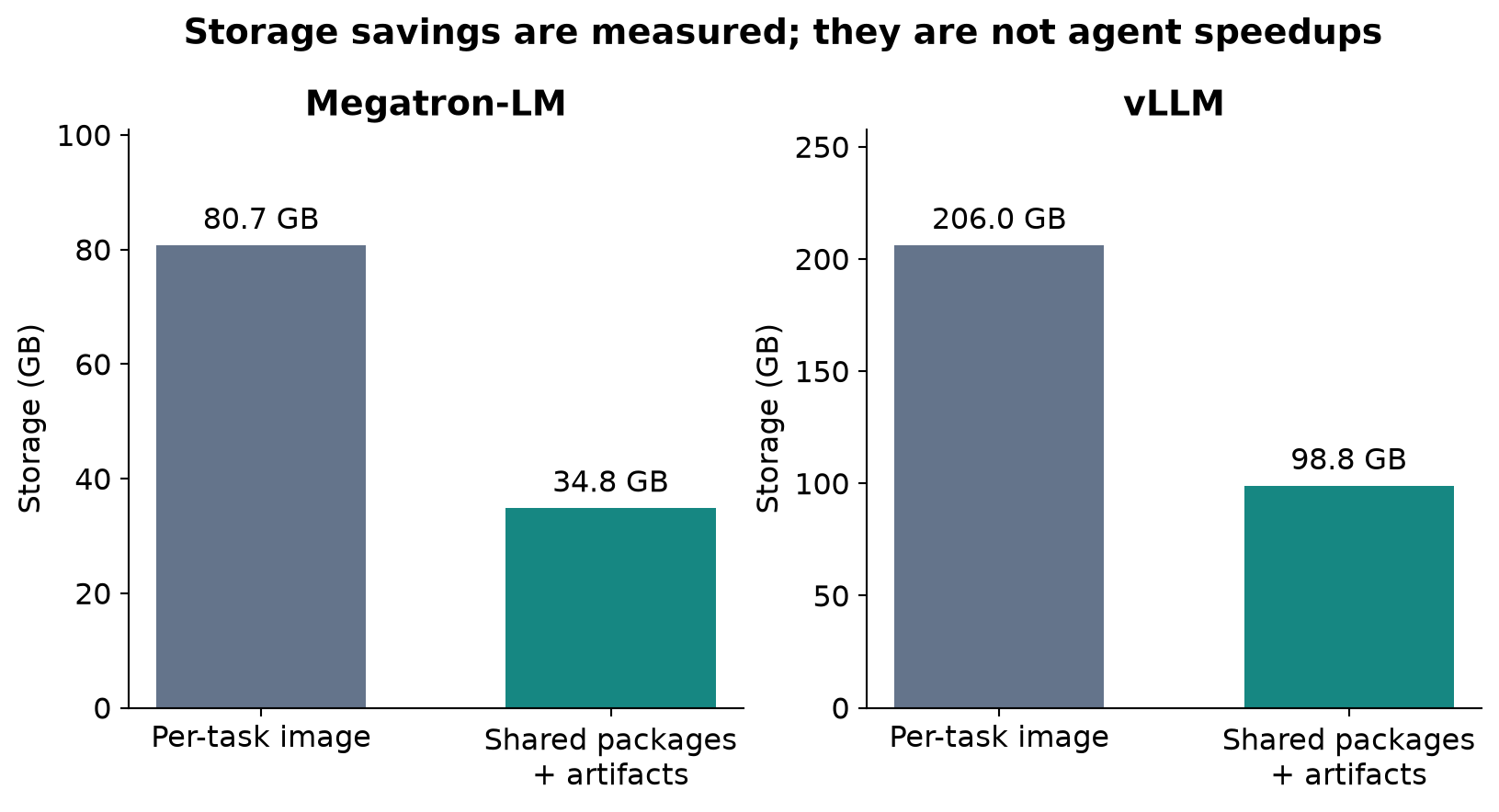
The paper reports 80.7 to 34.8 GB for Megatron-LM and 206.0 to 98.8 GB for vLLM. Direct arithmetic gives storage reductions of about 56.9% and 52.0%. Build time drops by 14% and 13%. These are preparation improvements, not a 52–57% reduction in coding latency or GPU execution cost. If preparation is fraction of a complete workflow and is reduced by fraction , the ideal end-to-end speedup is
For a purely illustrative and , this is about 1.029×. The paper does not report that end-to-end example. It illustrates why a useful preparation improvement can coexist with a high total GPU bill. At the full time limit, 36 tasks on eight GPUs would allocate GPU-hours for agent runs alone, before grading and excluding preparation. Actual runtime varies; this is a budget ceiling from the stated protocol, not a measured usage total.
Shared environments introduce their own design obligations. Cached artifacts should remain immutable to evaluated tasks, and mutable work directories should be isolated. Dependency reuse should not leak task-specific solutions or test artifacts between runs. The paper explains the reuse design, but storage reduction by itself is not evidence about all of those isolation properties. The practical contribution is credible within its measured scope without extending it into a complete reproducibility guarantee.
8. Failure analysis: fit the surrounding program before optimizing it
8.1 Keep the analysis population distinct
The failure study covers 180 submissions from the five models other than GPT-6 Sol and analyzes 1,754 failing test cases. A failing case here is one that the golden patch passes and the agent patch does not. The labels are assigned using the failing assertion, task prompt, and submitted code, then grouped by task and error signature. These counts should not be mixed with the 216-submission headline or treated as 1,754 independent agent attempts.
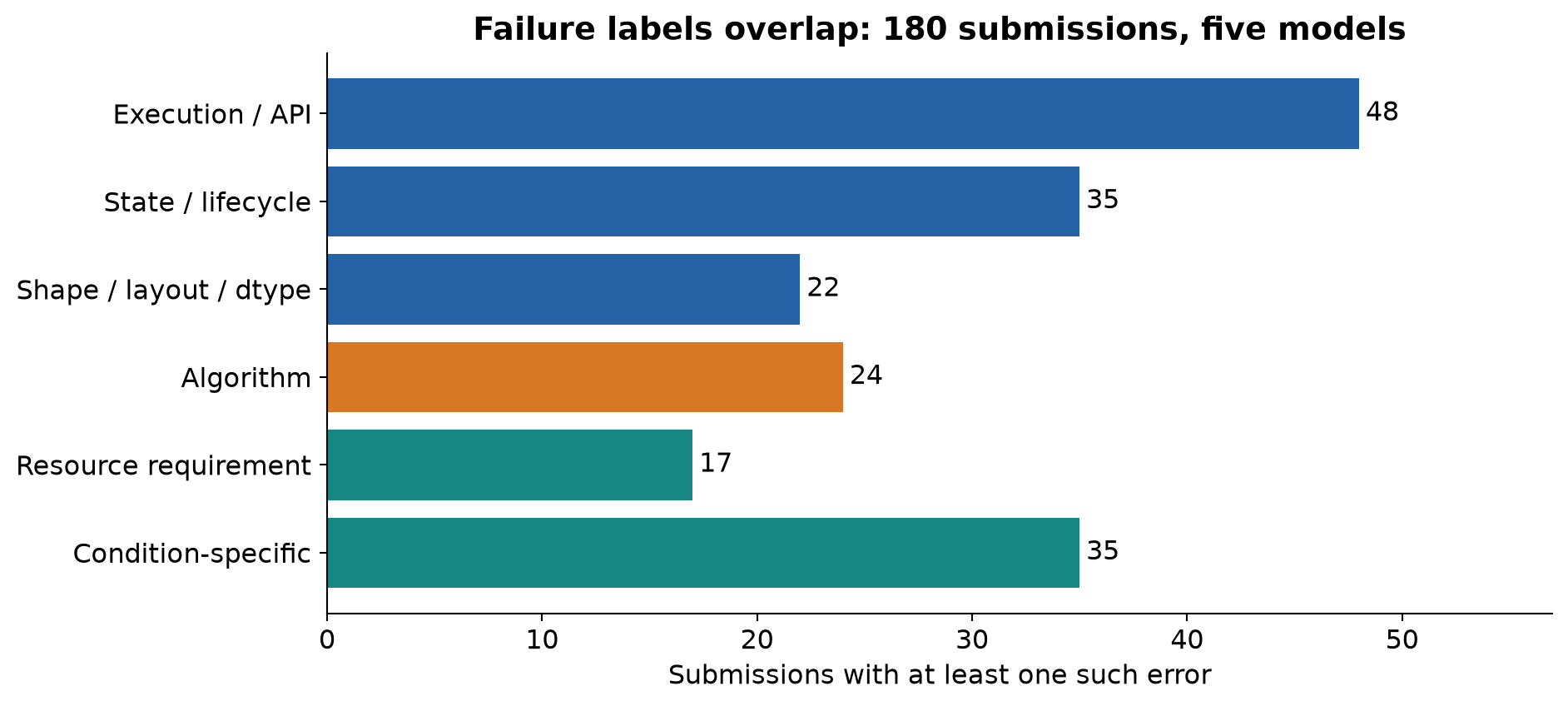
Table 7 counts 85 submissions with any structural error, 51 with any behavioral error, and 24 with any numerical error. Structural subtypes include 48 execution/API, 22 shape/layout/dtype, and 35 state/lifecycle cases. The categories overlap: 48+22+35 does not equal 85 because a single submission can contribute to more than one subtype. Likewise, 17 resource and 35 condition-specific incidences combine into 51 behavioral submissions.
The main figure labels broad-class percentages as 48%, 14%, and 29%. Dividing the appendix’s exact class counts by the stated 180 submissions gives approximately 47.2%, 13.3%, and 28.3%. The difference is small but not explained by ordinary nearest-integer rounding. I therefore use the appendix’s explicit integer counts in the redraw and leave the figure’s percentage denominator as a reporting ambiguity. It does not change the qualitative result that structural problems are common.
8.2 State and execution modes defeat one-call tests
Of the 35 submissions with state/lifecycle errors, 15 are caught only by generated probes. A cache can contain the right value after initialization but fail after reuse, invalidation, or a mode transition. A counter can advance correctly once and then be reset accidentally. A tensor can retain the right shape while ownership or lifetime is wrong. The appropriate test sequence therefore needs more than a fresh object and a single call.
CUDA graphs make this particularly concrete. Capture records GPU work; replay does not rerun the Python control flow that originally launched it. If a patch expects a Python branch or counter update to execute on every replay, eager behavior may look correct while graph behavior freezes a decision. The paper reports condition-specific errors in 60% of submissions on four CUDA-graph tasks versus 15% on other tasks. That association motivates mode-aware testing; it does not isolate CUDA graphs as the sole causal source of the difficulty.
8.3 Numerical failure is not necessarily floating-point noise
All 24 numerical-error submissions contain algorithm errors, and none is labeled precision-only. Appendix D’s labeling rule is strict: precision-only is assigned only when the same patch passes an exact-logic check. A numerical discrepancy arising only under a particular execution condition is instead labeled condition-specific. Thus zero precision-only cases does not establish that numerical precision never matters in infrastructure software. It describes the taxonomy and failure population of this study.
One paper example produces an indexer loss of 19.95 where the required value is zero. That is a warning against explaining a large discrepancy as routine floating-point variation before checking the mathematical operation. A tiny reference computation and a structural invariant can be more diagnostic than a large end-to-end run whose loss merely looks plausible.
8.4 Agents’ self-tests emphasize the easiest observables
Of 103 traced runs, agents write their own tests in 94. The 5,532 assertions in those tests are 56.3% functional, 27.9% structural, 12.0% numerical, 2.0% error-path, and 1.8% resource-oriented. Among 11 traced runs that fail a resource check, only one writes any resource assertion. These are assertion-level and traced-run statistics; neither is a random sample of all possible tasks or all production agent use.
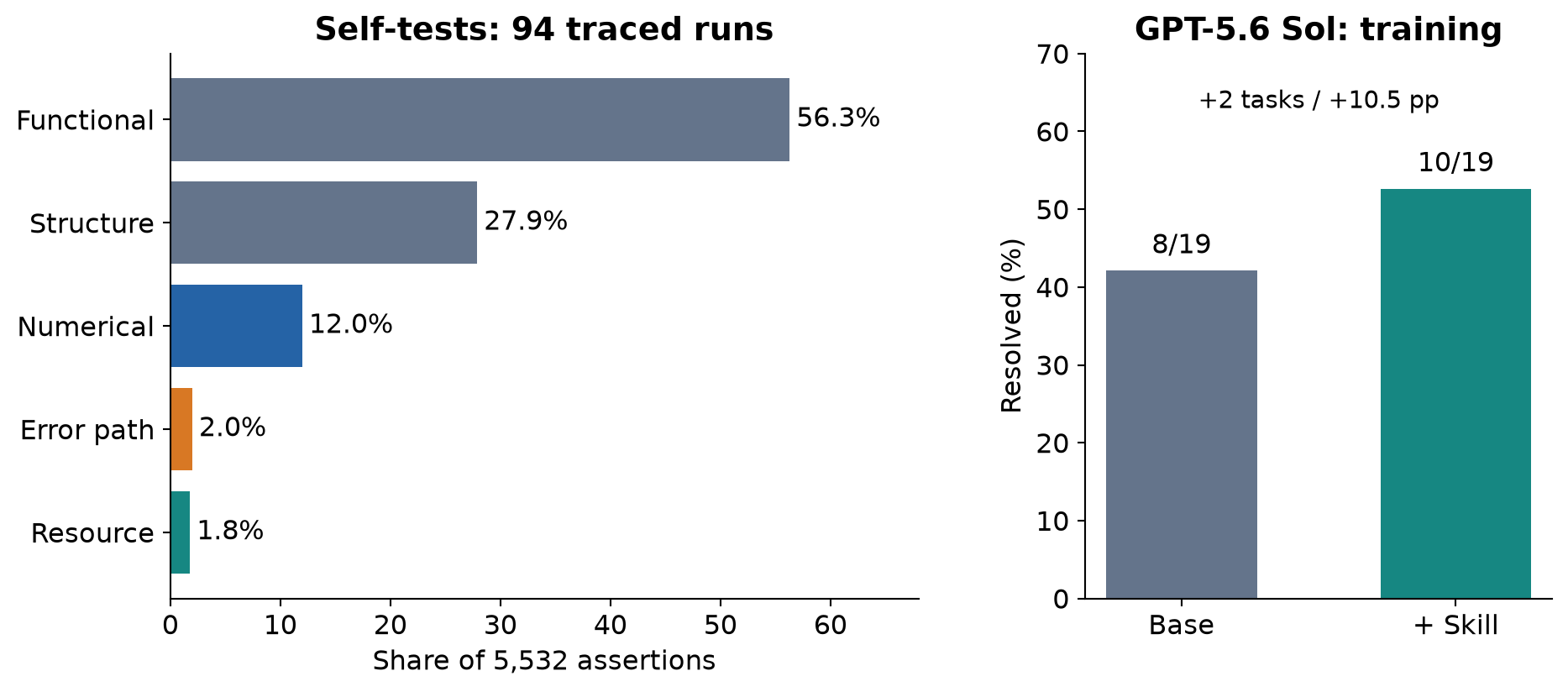
The authors turn the failure patterns into a reusable skill: inspect callers and persistent state, compare new computations with a simple reference, and measure required resources and graph behavior. GPT-5.6 Sol improves from eight to ten solved Megatron-LM tasks. The absolute gain is
The instruction skill is a change to the agent’s operating guidance. This experiment does not train model weights. It is promising evidence that test selection and workflow can improve outcomes, but one model on one repository with one run per task does not establish broad transfer. The targeted failure analysis and skill evaluation share the benchmark family; an independent task collection would be a stronger test of generality.
9. Worked examples: converting a promise into an observable
9.1 Incremental synchronization needs a traffic measurement
The paper’s verl example distinguishes sending 655 changed entries from sending all 65,536 entries. If each value uses bytes and each sparse index uses bytes, a simplified payload comparison is
The entry-count ratio is about 100.05, but the byte ratio can be smaller because sparse communication carries indices. With an illustrative two-byte value and four-byte index, the payload ratio is about 33.35. These byte widths are an example chosen for explanation, not settings reported for that PR. Protocol headers, packing, collective schedules, and fixed launch costs add further overhead.
A correct final weight tensor cannot distinguish sparse synchronization from full synchronization. The probe must observe entries, bytes, or another resource tied to the actual promise. Conversely, a low traffic counter alone cannot prove correct synchronization: a patch could send nothing. The informative judge combines the resource observable with a numerical comparison of the resulting weights and a sequence of updates that exercises persistent state.
9.2 Offloading requires peak accounting, not just a transfer call
For activation offloading, the visible presence of a host transfer is weak evidence. The intended benefit is often a lower GPU-memory peak during a training schedule. My simple accounting model is
Moving an activation after the original peak has already occurred may not reduce the maximum. Allocating an extra staging buffer can cancel the nominal saving. Keeping a stale reference can prevent storage from being released. The probe should therefore align its observation window with the promised lifetime change and compare equivalent workloads. A small numerical test can validate the copied values, while a separate memory observation checks whether the schedule achieves the requirement.
This does not mean one should impose a universal memory threshold across GPU types. Warm-up, allocator behavior, synchronization, and workload dimensions affect measurements. A useful test uses a justified threshold or relative comparison under controlled conditions, records the measurement method, and avoids converting resource noise into an arbitrary semantic failure. InfraDev motivates this discipline but does not establish a universal threshold policy for every resource probe.
9.3 A stateful probe should observe transitions
A useful conceptual sequence is initialize, operate, operate again, reset, and operate once more. The first repeated operation can reveal unintended reuse; the reset tests invalidation; the final operation checks whether the object remains usable. For a graph-enabled path, the same input sequence should be exercised under capture/replay with expected semantics defined in advance.
One must choose the comparison carefully. If a graph mode is intended to reuse fixed tensor addresses, reallocating inputs during the test may violate the supported contract. If an optimization permits a bounded numerical discrepancy, exact bitwise equality may reject a valid implementation. The challenge is not maximizing test strictness; it is observing the right property under the right preconditions. More assertions can make a judge less fair if they encode accidental details of the golden implementation.
10. Limitations of the evidence
The sample contains 36 expert-selected, large changes from three repositories. It supports a focused conclusion about substantial AI-infrastructure development, not a prevalence estimate for all programming work. Each configuration gets one run per task, so the paper does not estimate run-to-run variance. A one-task difference changes the overall rate by about 2.78 percentage points; in the seven-task RL slice, one task changes the rate by about 14.29 points.
The positive and negative controls are stronger than trusting the official tests, but they remain finite examples. Appendix A says the claim broken by each adversarial patch is recorded by its authoring agent and is not itself checked by execution. The judge can therefore inherit an incorrect understanding of the requirement. A probe that rejects the wrong patch for an unrelated crash may look discriminative without measuring the promised optimization.
The prompt-authoring stage sees the golden solution. A checker tries to remove solution information, but the paper does not prove that all algorithmic hints are absent. Conversely, withholding formulas, constants, or tolerances can remove information that belongs in a legitimate task specification. Both leakage and under-specification are possible; avoiding one does not automatically avoid the other.
The shared runtime reduces preparation overhead but leaves multi-GPU execution expensive. The authors identify simulation and automatic task curation as future directions. Simulation may increase accessibility while changing the failure modes being measured: collectives, device memory lifetime, graph capture, and real resource contention are precisely where infrastructure software becomes difficult. A simulated result should be validated against hardware before replacing the hardware-based judge.
Finally, model cost and latency depend on providers, caching, serving speed, and harness behavior. The paper’s cost table is useful for its experiment, but it is not a procurement recommendation or an enduring ranking. Likewise, the skill improvement has a narrow experimental scope. Neither the benchmark nor the skill should be presented as a completed solution to autonomous infrastructure engineering.
11. Independent critical analysis: evaluate the evaluator
11.1 The strongest contribution is paired falsification
InfraDev treats a benchmark as two coupled artifacts: a specification and a judge. This is the right level of analysis for agent evaluation. If a test checks an unstated interface, failure does not cleanly measure capability. If a specification promises a resource improvement that no test measures, success does not cleanly measure delivery. The paper’s joint procedure attacks both asymmetries.
Its most convincing evidence comes from grading the same submissions under two judges. Because the code is held fixed, the 102-to-69 change directly demonstrates a measurement effect. This is stronger evidence for the need to improve tests than merely reporting low scores on a newly difficult task set. The result does not require assuming that the new judge is perfect; it requires showing concrete behaviors that the old judge failed to distinguish.
I would nevertheless replace the broad claim that grading becomes reliable with a narrower claim: grading becomes more discriminating against specified failure modes. Reliability additionally needs stable measurements, correct oracles, coverage of relevant behavior, and fairness to alternative implementations. The acceptance loop improves several of these properties but does not establish them all.
11.2 Golden agreement should not become implementation conformity
A benchmark should accept a different correct algorithm, not only a patch that resembles the merged one. The golden patch is a useful source of examples and interfaces, but its internal design choices should not silently become obligations. The critical question for every probe is whether its failure witnesses a violated requirement or merely a departure from the reference implementation.
A stronger evaluation package would include deliberately different correct solutions where feasible. Positive controls drawn from multiple designs would test whether a probe is too restrictive. Negative controls should isolate one violated promise at a time where possible, so rejection can be attributed to the intended property. Independent expert review of the requirement-to-probe mapping would complement an automated checker that shares the same construction context.
A useful coverage record would link each declared promise to its observable, oracle, supported modes, hardware assumptions, and known blind spots. This is a proposed reporting artifact, not a demand to inspect authors’ repositories. It would make the benchmark’s evidential boundary understandable from the released task descriptions and outcomes alone.
11.3 Small counts need uncertainty and paired outcomes
Using a binomial model only as a rough illustration, an estimated rate over independent trials has standard error
For , this is about 0.081, or 8.1 percentage points. The benchmark tasks are heterogeneous and curated, so that quantity is not a validated confidence interval for arbitrary real-world work. It simply shows why a 2.8-point lead, corresponding to one task, should not be treated as decisive evidence of a general capability advantage.
The skill ablation is naturally paired: the same tasks are evaluated with and without guidance. A net gain of two successes can result from two fixes and no regressions, or from more fixes offset by regressions. The aggregate 8-to-10 count does not reveal which. Publishing the task-level transition matrix and repeating the runs would distinguish a consistent workflow improvement from a fragile reshuffling of successes.
11.4 Resource promises should determine the evaluation budget
An agent given a large task but no affordable way to observe its key behavior may rationally focus on import checks and easy unit tests. InfraDev gives real hardware, which removes a major excuse, yet agents still rarely test resource usage. This suggests that capability includes selecting the right experiment, not merely generating code or receiving more runtime.
The appropriate response is not to require every agent to run every expensive benchmark after every edit. A better policy would progress from low-cost structural gates to a small numerical reference, a minimal distributed case, a state-transition sequence, and finally the resource measurement that the task actually requires. Such a policy balances diagnostic value and execution cost. The paper’s skill moves in this direction, but the optimal allocation of test effort remains an open research question.
For my own interpretation, the key research opportunity is therefore a verifier-aware agent that reasons about observability. It should ask internally which incorrect solutions would pass its current self-tests, then choose a new test that separates them. That is the development-side analogue of InfraDev’s adversarial benchmark construction. It is a hypothesis motivated by the paper, not a demonstrated result.
12. Conclusion
InfraDev shows that passing a repository’s supplied tests can substantially overstate completion of large AI-infrastructure changes. Its joint construction of hidden probes and explicit task contracts is a useful way to improve that measurement. The multi-GPU setting and the attention to state, numerical behavior, and resources make the benchmark more relevant to real framework development than a purely syntactic or single-call judge.
The measured lesson is precise: 33 of 102 official-test successes disappear under the stronger judge; the best configuration resolves 14 of 36 curated tasks; and a failure-informed skill adds two solved training tasks for one evaluated model. The broader lesson is methodological: a successful patch needs an observable connection to the promise it was asked to fulfill. More tests, more detailed prompts, and higher scores are only useful when that connection is justified.
References and reading scope
- Deng, Ruan, Huang, Lau, Sheng, and Mai. InfraDev: Can Coding Agents Develop AI Infrastructure, and How Can We Tell?, v1, 2026-10-27. Full PDF, 20 pages. Sections 3–4 and Appendices A–D are the primary sources for this review.
- Figures 1–3 here are conceptual redraws of the paper’s workflow, task table, and acceptance procedure. Figures 4–8 redraw reported counts or measurements with source locations in their captions. No figure presents a new model experiment.
- Equations 1–4, 7, and 9–15 formalize or derive explanatory consequences; Equations 5–6 restate the stated scoring rules, and Equation 8 recomputes the reported acceptance gap. Illustrative assumptions and proposed follow-up studies are explicitly identified in the text.