Review date: October 25, 2026. Paper: VERSE: Verified Self-Evolving Optimizer for Agent Harnesses. Authors: Zekai Wang, Yingqiang Ge, Zekun Wang, Hai Wang, Yuhui Xu, Joshua Frandsen, Shancong Fu, Ashia C. Wilson, and Chandan K. Reddy. Version: arXiv:2610.02616v1, October 2, 2026. Paper and PDF · Authors’ resource entry.
This review covers the 45-page paper, including Appendices A–L. Numerical results below are the authors’ measurements. Explanatory calculations and suggested experiments are explicitly identified; none is a new agent benchmark run.
1. The question: can the improver learn a better way to improve?
An agent can fail despite understanding the task. It may select the wrong interpreter, repeatedly try an unavailable network connection, exhaust its turns before testing, or corrupt a patch while passing it through a shell. Changing the surrounding prompts, tools, and control flow can therefore change performance without changing model weights. The difficult part is deciding which change deserves to survive.
VERSE puts that decision process under scrutiny. It separates the executor harness, which helps an agent solve tasks, from the optimizer harness, which helps another agent diagnose failures and propose executor changes. The optimizer can modify its own prompts, skills, tools, hooks, and notes. But permission to modify these components is not, by itself, useful evidence that the modification helps.
The motivating comparison is unusually valuable. With the Meta-Harness host, optimizer self-evolution without a draft-execution tool led validation to choose the initial executor harness. Adding a simple execution tool produced the best selected result in that small comparison: 41.05% versus 39.20% for the fixed optimizer baseline. The full VERSE configuration later reaches 42.28% on the in-distribution test and 37.69% on the newer multilingual test, on the Meta-Harness host. Those numbers concern different configurations and must not be merged into one ablation.
The central contribution is an evidence loop: propose a diagnosis, test it while an edit is still provisional, record regressions, and revise the procedure that chooses future experiments. This is a stronger idea than appending increasingly elaborate advice to an agent prompt. It is also narrower than a claim that recursive self-improvement is reliably monotonic. Several results show that adding self-evolution lowers accuracy relative to the same tools with a fixed optimizer.
My reading is that VERSE makes a case for improving experimental practice inside an optimizer. The most informative examples are mundane: include a previously passing task, stop repeatedly scanning the same traces, and distinguish a tool that was called from a tool whose relevant branch actually executed. These changes improve the quality of evidence available for the next decision. They do not turn a finite benchmark into a guarantee of general intelligence.
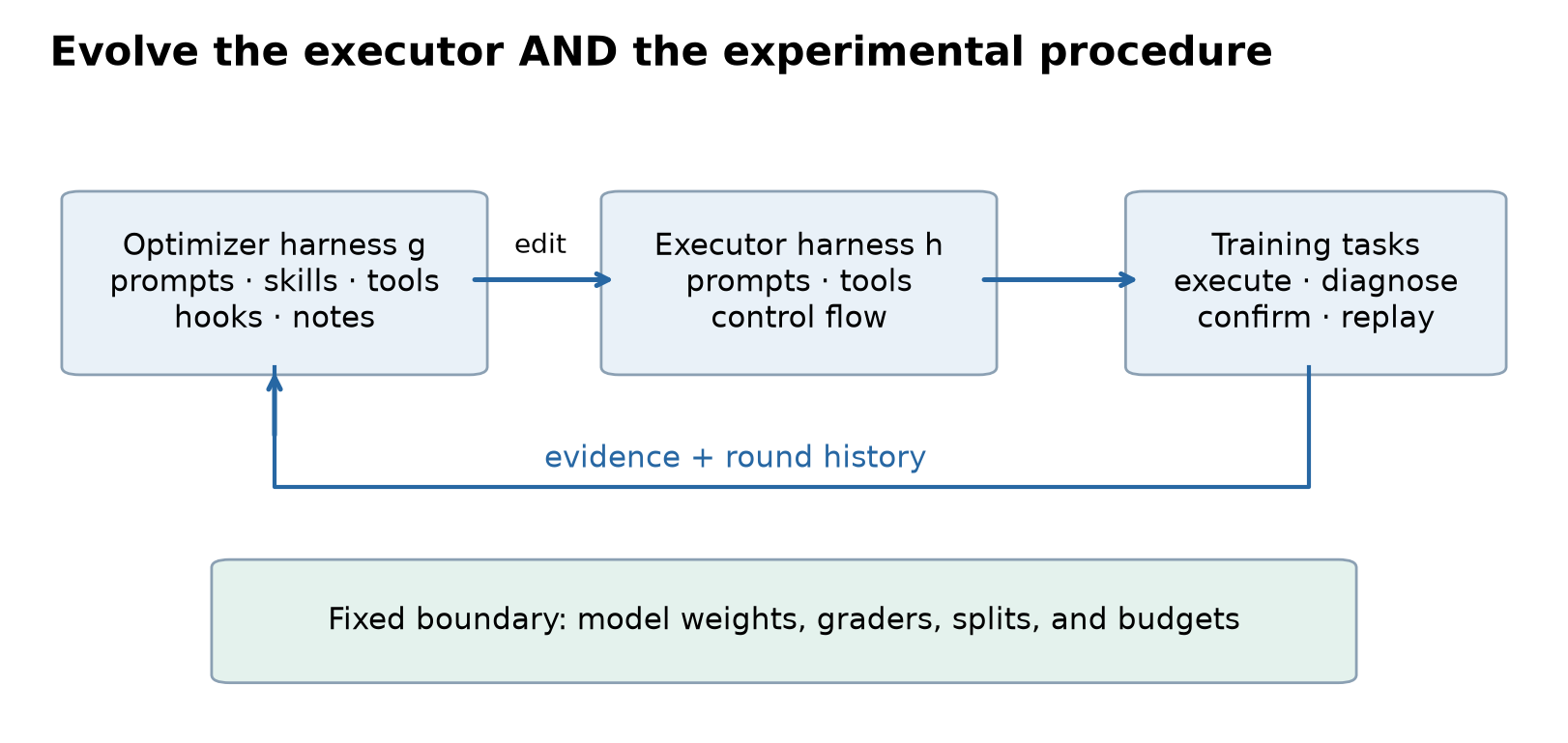
Figure 1. Original schematic based on paper Sections 2–3 and Appendix B. The executor harness h and optimizer harness g change at different points. Model weights, grading rules, and resource limits remain fixed.
2. Prerequisites: execution, search, and selection are different objects
2.1 What a harness controls
A harness is the executable configuration around a model: instructions, tools, state, and the rules that decide what happens before and after a model or tool call. An executor hook may rewrite a command or add a reminder. An optimizer hook may instead reserve experiment budget or ask for evidence before submission. Identical file types can have completely different roles depending on which agent consumes them.
Let the executor weights be , its harness be , and a task be . A complete trajectory includes actions and environment responses. The paper writes execution as . A binary loss is zero for success and one for failure. The population objective is
Changing changes the distribution of trajectories, not . Even with greedy decoding, infrastructure and execution can produce variation in observed task outcomes. A single observed pass should not silently be treated as a deterministic property of the harness.
2.2 Why the optimizer is also a learned object
The optimizer has frozen weights and a separate harness . Its job is to generate candidates for under a finite budget. The object being learned in the outer loop is thus an algorithm encoded in files and procedures. There is no differentiable update through a simulator and no policy-gradient estimator in the method described here.
For round , let be the candidates the optimizer produces. The conceptual objectives are
The expectation is over candidate generation and evaluation with the task sets fixed. It does not imply an exact global optimizer for . In practice an LLM revises its own working procedure using round reports. The notation helps separate what is being improved from how the revision is actually proposed.
2.3 Three kinds of uncertainty
There is diagnostic uncertainty: did an agent fail because of invalid arguments, an unavailable dependency, or an incorrect solution? There is execution uncertainty: would the same candidate pass if rerun? There is selection uncertainty: among several noisy candidates, did the procedure retain the one that generalizes?
These uncertainties require different remedies. Replaying a trace can establish reproducibility, but does not automatically identify a cause. Perturbing one step can test a local causal hypothesis, but does not establish broad generalization. Evaluating on held-out tasks can test transfer, but repeated feedback from those tasks creates adaptivity. VERSE is interesting precisely because it exposes all three problems rather than reducing them to one final accuracy.
3. The data boundary and the actual learning protocol
The main SWE-rebench study uses 110 training tasks and 50 validation tasks drawn from a 593-task historical pool. The in-distribution test has 108 gradable March 2026 tasks, all Python. The July 2026 out-of-distribution set has 107 gradable tasks: 21 Go, 17 Java, 20 Python, 25 Rust, and 24 TypeScript. Four Java tasks and two in-distribution tasks are excluded because their reference solutions fail the authors’ grading environment. These denominators matter when translating percentages into task counts.
The optimizer can inspect training trajectories and run checks on training tasks. Validation sends back accuracy, identifiers of changed outcomes, confirmation information, and limited harness-error summaries. It does not send validation task statements, tests, or trajectories. Test tasks enter neither optimization loop. Appendix D also reports an overlap scan and notes that three OOD Python tasks come from a repository present in training and validation, whereas the in-distribution test shares no repositories with them.
This is a useful separation, but validation is not an untouched final holdout. Its feedback shapes later candidates as well as selecting the final round. A task identifier plus a pass/fail transition can transmit useful information even without source text. The paper acknowledges this and analyzes the information cost in Appendix C. The sealed test is consequently essential, not an optional ceremonial final step.
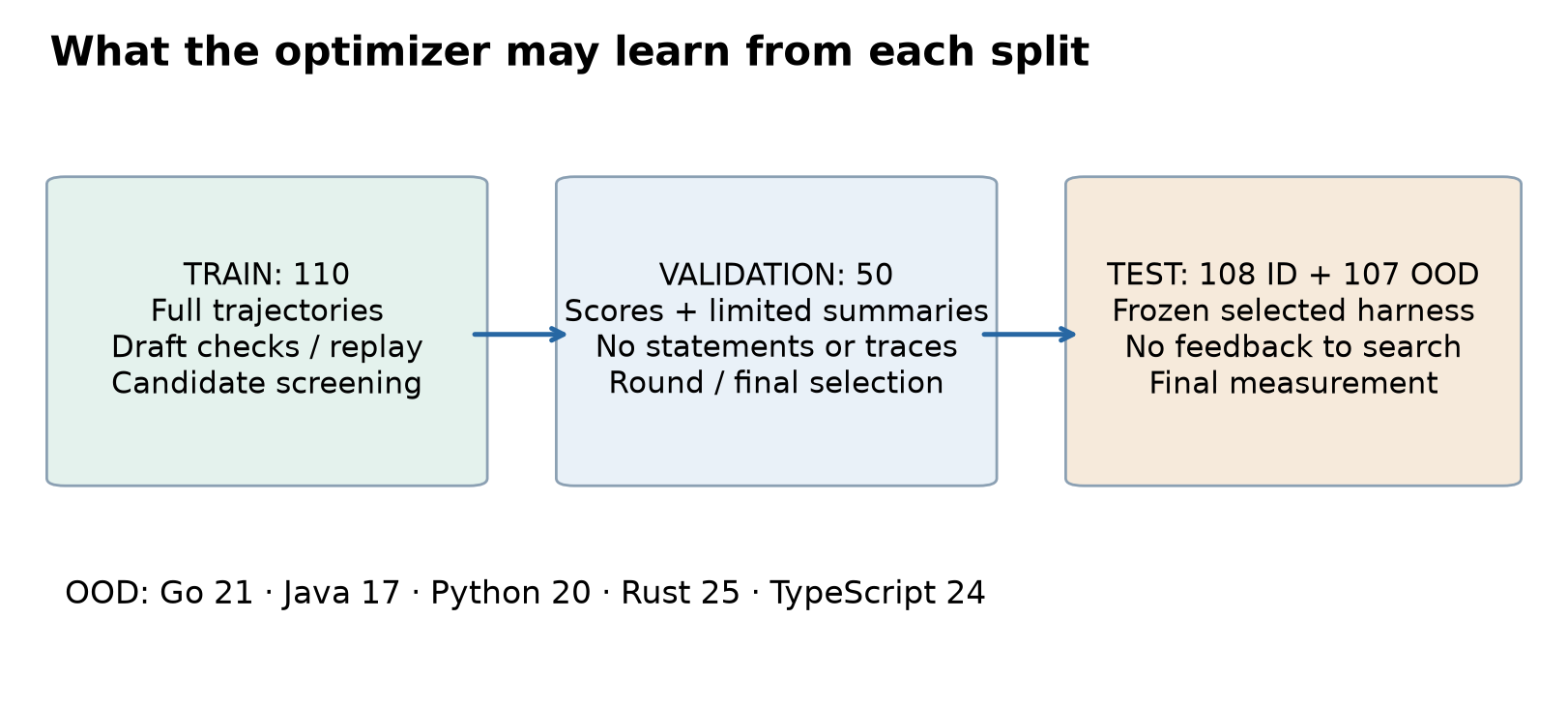
Figure 2. Original schematic using Sections 2.2 and Appendix D. Counts are tasks, not repeated runs. Only training supplies detailed trajectories and executable probes; validation supplies restricted feedback; the final harness is frozen before testing.
Algorithm 1. The two-loop search, simplified from Appendix B
The numbered procedure preserves selection and budget boundaries; it is explanatory pseudocode, not a software listing.
1  Freeze model weights, graders, task splits, and limits.
2  Evaluate initial h0 on validation; archive it.
3  For each round, fix optimizer harness g for candidate search.
4    Generate up to three candidate executor harnesses.
5    Let candidates request training checks from one shared pool.
6    Compare candidates on a common training subset (up to 12 tasks).
7    Keep the best candidate; use confirmed passes to break ties.
8    Smoke-check it; allow up to three repair attempts if needed.
9    Validate and archive the resulting harness when accepted.
10   Update g from round evidence and restricted validation feedback.
11 Re-evaluate the two leading archived harnesses; choose the better.
12 Freeze the selected h and evaluate it on the sealed test tasks.
There are important exceptions behind this compact presentation. If no candidate is submitted or no repair passes the smoke check, the round keeps the previous harness and skips validation, while the optimizer self-update still runs. A smoke-repaired candidate is validated without repeating the training screening. Training comparison therefore evaluates a potentially different version from the one eventually archived. The selection theory explicitly treats this as an assumption to be satisfied, not as a free consequence of the protocol.
Each main run has six rounds and three candidate slots per round. A candidate gets at most 60 optimizer turns; a self-update gets up to 30. Eight experiment units per candidate are pooled into 24 units per round, shared across candidates and the self-update. This is not three isolated budgets. A task verification costs one unit, including a confirmation if its first run passes; replay and perturbation cost one unit per call. Units count experiments, not identical quantities of physical execution.
The final selector re-evaluates the two best archived harnesses and compares their mean validation losses, breaking ties toward the later round. Reporting the last round alone would conflate the quality of exploration with the quality of selection. Conversely, selecting an apparently good checkpoint does not remove uncertainty introduced earlier when only one candidate per round enters the archive.
4. What the verification machinery actually establishes
VERSE augments a host optimizer rather than replacing its entire evidence interface. Meta-Harness reads raw traces; AHE supplies root-cause reports; Self-Harness groups weaknesses; HarnessX provides summaries on demand. The paper reimplements these interfaces under a shared experimental protocol. Results therefore compare controlled versions of the methods, not every original system operating with its original model, acceptance rules, and budget.
The first added component is trace minimization. It seeks a smaller sequence whose replay reproduces the same outcome. For a failure, merely producing any error is insufficient: the reduced trace must fail the same tests. In the appendix example, candidate subsets retaining 8 and 12 steps reproduced only 5 of the original 14 failures and were rejected. A different 12-step subset preserved all 14. This is a useful defense against replacing the original problem with a simpler but irrelevant failure.
The replay tool asks whether the recorded failure is reproducible. The perturbation tool removes or replaces a suspected step and replays the sequence to investigate dependence on that step. The verification tool executes a candidate on up to three target tasks, reporting failing tests and harness errors. A target is counted as passed only after two successful runs. A training history records which failure classes disappear, return, or persist across rounds.
The system does not impose a hard rule that every failed check blocks submission. The optimizer may revise, investigate further, or submit anyway. That distinction makes VERSE an interactive experimental interface rather than a universal acceptance certificate. Optimizer-written hooks may subsequently impose local submission reminders, but those are learned procedures, not the definition of the fixed verification tools.
Algorithm 2. A draft check and its interpretation
1  Choose a draft and up to three training targets.
2  Check applicability and remaining shared experiment budget.
3  For each permitted target, execute the draft harness.
4    On a first pass, run a confirmation execution.
5    Record confirmed pass, failure, or inconclusive outcome.
6  Separate targets previously failing from regression canaries.
7  Return outcomes, errors, and costs to the optimizer.
8  Let the optimizer revise, investigate, or submit within limits.
A passing canary checks preservation; it does not count as a newly repaired task. Conversely, a failure to repair one task does not prove that every aspect of the edit is useless. The edit may fix an interface problem while a second semantic bug still prevents success. The useful record is therefore richer than a single “good/bad edit” bit: which hypothesis was tested, which code path executed, what changed, and what remains unresolved.
There is also a subtle difference between the paper’s replay study and the tools used during evolution. In the study, after retained recorded actions are replayed, an agent may continue until termination. The VERSE replay tools stop after recorded commands and do not call a model. A repair rate measured in the former setting should not be advertised as the guaranteed efficacy of the latter tool. Their evidence supports the feasibility of localized diagnosis, not interchangeable runtime behavior.
5. Deriving the repair-choice argument
The theory starts with two possible causes and their corresponding repairs . Let and be the distributions of available evidence under these causes, with prior probabilities and . At evidence value , the optimal decision chooses the larger posterior mass. The smaller mass is unavoidable error, so
Define the Bhattacharyya affinity . Identical evidence distributions have affinity one; disjoint evidence supports have affinity zero. Using immediately gives the upper bound. For the lower bound, write and apply Cauchy–Schwarz across evidence values:
These bounds describe ambiguity in the information, not the intelligence of a particular language model. A stronger reasoner may make better use of existing information, but cannot extract a distinction absent from the complete evidence itself. This is why repeated reflection and new experimentation should not be treated as interchangeable.
5.1 Why adaptive experiments can help
At check , the optimizer chooses query from history , then receives environment feedback . The query policy cannot directly observe the hidden cause. The environment feedback can depend on it. Expanding the joint probabilities factors the next affinity into the previous evidence overlap times the overlap of the new observation, averaged over chosen queries.
If bounds that conditional overlap for all shared histories, the recursion and repair bound become
Here is the optimizer’s excess error above the best decision rule using the available evidence. A useful check lowers overlap; a better decision procedure lowers excess error. The distinction gives self-evolution two plausible roles: learn which experiment to ask for and learn how to respond to its result.
If the feedback distribution is identical under both causes, affinity does not decrease. Reformatting a transcript may make it easier for the actual optimizer to use, lowering , but it does not lower the information-theoretic Bayes error of the complete transcript. This qualification is crucial. The theorem is not an argument that summarization, static analysis, or more careful reasoning can never improve an imperfect optimizer.
5.2 Why two passes help, and when that argument breaks
Suppose a draft passes with probability under the correct cause and under the alternative. A single binary check has affinity
If a first pass triggers an independent confirmation, the possible outcomes are fail, pass-then-fail, and pass-twice. Summing their overlaps yields
For an illustrative calculation, take and . Then and confirmation reduces it to . A wrong repair’s double-pass probability falls from to , but a correct repair’s double-pass probability also falls from to . Confirmation improves specificity while potentially discarding useful noisy repairs. These are hypothetical probabilities, not measured VERSE success rates.
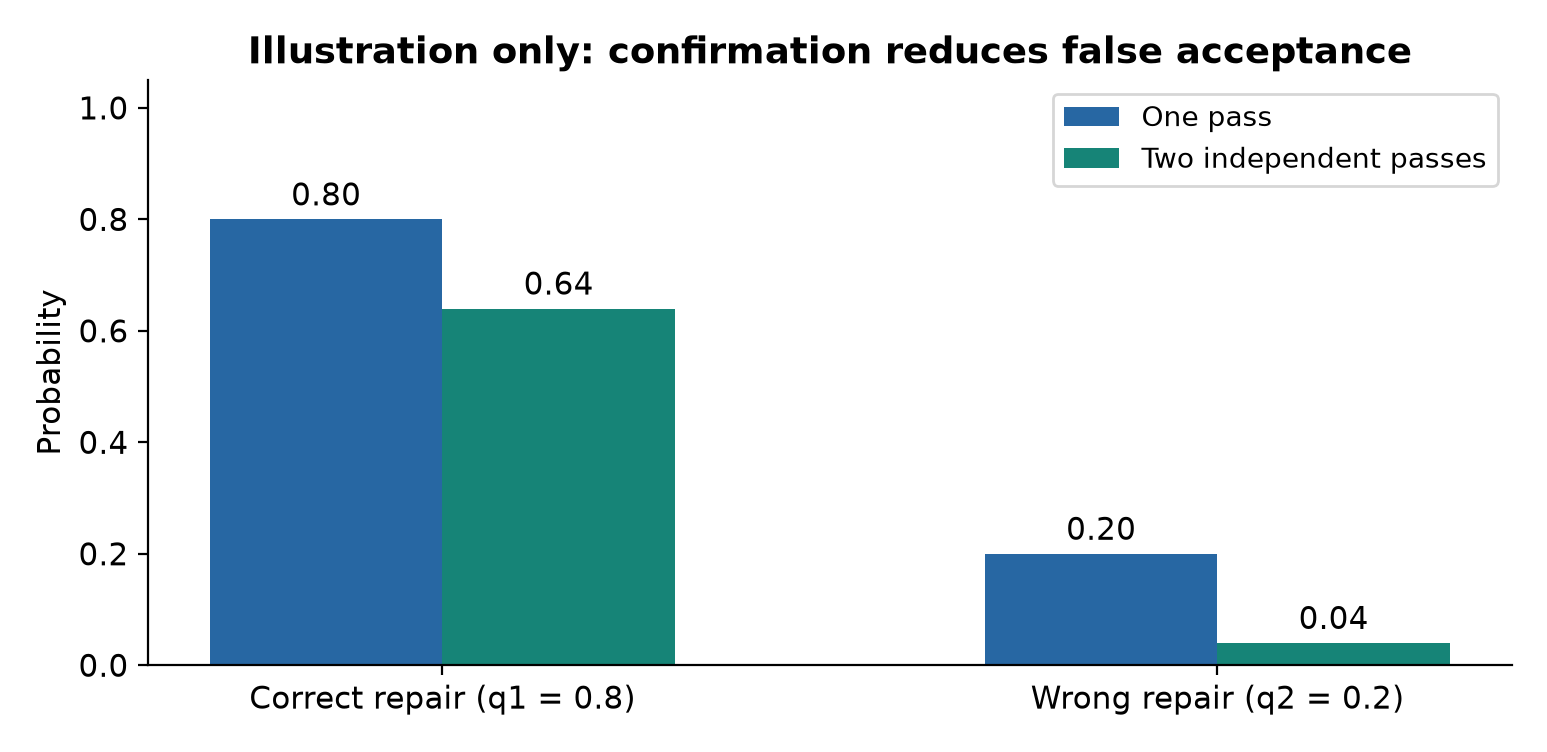
Figure 3. Original explanatory calculation with q1 = 0.8 and q2 = 0.2, assuming independent reruns. Bars show pass probability, not benchmark accuracy. Derived from Appendix C.1; no empirical data are implied.
Independence is a substantive assumption. Reusing a corrupted environment, cached output, or a systematic grader blind spot can make repeated outcomes highly correlated. Two passes then provide less new information than the calculation suggests. Fresh environments and faithful task grading support the interpretation; repeating the same defective observation does not.
6. From a correct repair to a good final harness
A local repair may solve the selected training task while damaging performance elsewhere. The paper’s second theorem therefore defines a good harness by population loss . For proposal , lower-bounds the conditional probability of targeting a failure whose correct repair produces such a harness. Given that target, upper-bounds the probability of submitting the wrong repair. The condition is stronger than “we can fix one observed bug.”
Let mean no good harness has appeared through proposal . Conditional on , a good proposal occurs with probability at least . Consequently,
Independence between proposals is unnecessary because the bounds are conditional on the preceding unsuccessful search. The best candidate has loss at most when search succeeds and at most one otherwise. Adding the expected gap from selecting a worse candidate gives
This decomposition distinguishes target choice, repair reliability, and final selection. Raising by improves the per-proposal success lower bound by only . If most attempted repairs are wrong, better target prioritization has limited payoff. Conversely, perfect local repair is insufficient if the targeted failures do not yield generalizable improvements.
Selection adds two more estimation problems. If every training estimate is within of the corresponding population loss and every validation estimate within , comparing empirical minimizers twice costs at most on that event. But candidates were constructed from training traces. A small is an assumption about that comparison, not a standard independent-sampling guarantee.
For validation, the paper bounds adaptive reuse through the possible feedback transcripts . With validation tasks, at most estimates per harness, rounds, and failure probability , one bound is
The proof conditions on training-side randomness, counts the statistics reachable through feedback, applies Hoeffding’s inequality to each fixed statistic, and takes a union bound. More informative feedback can improve search while increasing this generalization allowance. With only 50 validation tasks, identifiers and error messages can make the bound loose or vacuous. The result identifies a tradeoff; it does not certify the reported accuracy numerically.
Finally, retaining only validation outcome changes that reproduce alters the estimator’s target. Appendix C bounds its mean shift by , where is the task failure probability. Confirmation can suppress transient flips while biasing estimates toward the parent. Noise reduction and unbiasedness are different properties, and the paper deserves credit for separating them.
7. Main results: read the host dependence before the headline
The main experiment uses Qwen3.8-Flash-Next as optimizer and Qwen3.8-27B as executor, with both frozen. Table 2 reports avg@3: average resolved-task accuracy over three evaluations of a fixed harness. It is not pass@3, not majority voting, and not the probability that at least one of three attempts succeeds. Its error bars are standard errors across test evaluations of a single evolution run.
The following values are validation-selected results, transcribed from Table 2. “Tools” means VERSE without optimizer self-evolution; “Full” includes it.
| Host | ID baseline / tools / full (%) | OOD baseline / tools / full (%) |
|---|---|---|
| Meta-Harness | 39.20 / 34.57 / 42.28 | 28.66 / 28.35 / 37.69 |
| AHE | 33.95 / 37.96 / 35.19 | 26.17 / 35.51 / 30.22 |
| Self-Harness | 29.63 / 40.12 / 34.88 | 29.28 / 31.78 / 30.22 |
| HarnessX | 32.72 / 38.89 / 35.80 | 27.41 / 27.10 / 37.69 |
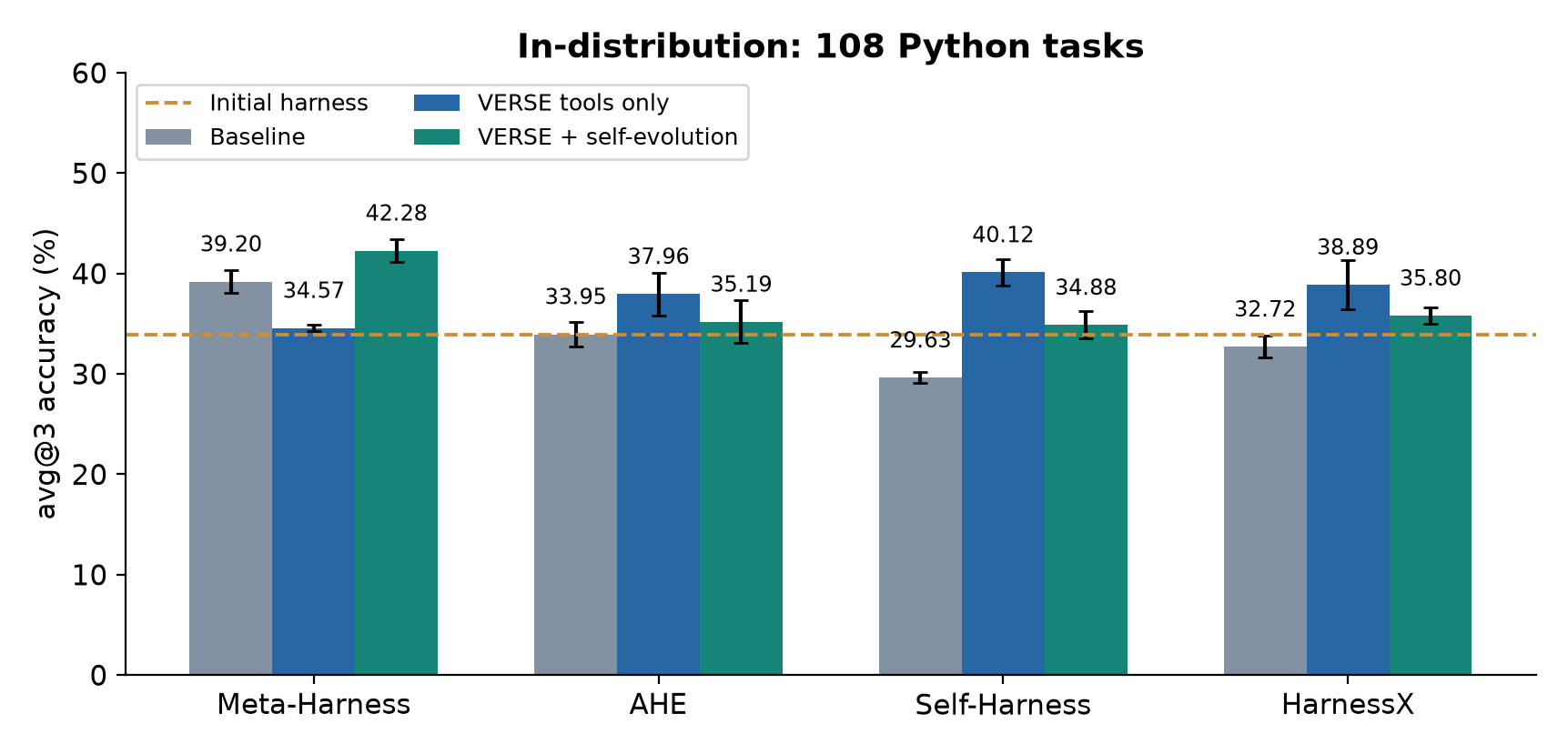
Figure 4. Redrawn from Table 2. Error bars are SEM across three test evaluations, with one evolution run per configuration. The initial harness is 33.95%; this is an ID comparison only.
Full VERSE beats each unequipped host on both test sets at the selected round. Including final-round results, it beats the corresponding baseline mean in all 16 comparisons. This supports robustness relative to those particular controlled baselines. It does not mean self-evolution improves on the tools-only configuration in every setting. At the selected round it improves three of eight host-by-distribution comparisons and worsens the other five.
On AHE, for example, tools-only reaches 37.96% ID and 35.51% OOD, while full VERSE reaches 35.19% and 30.22%. On Self-Harness, the analogous ID comparison is 40.12% versus 34.88%. These differences are too central to hide in a footnote. The value of the outer loop depends on the host’s existing evidence processing, on which lessons it learns, and on noisy search trajectories.
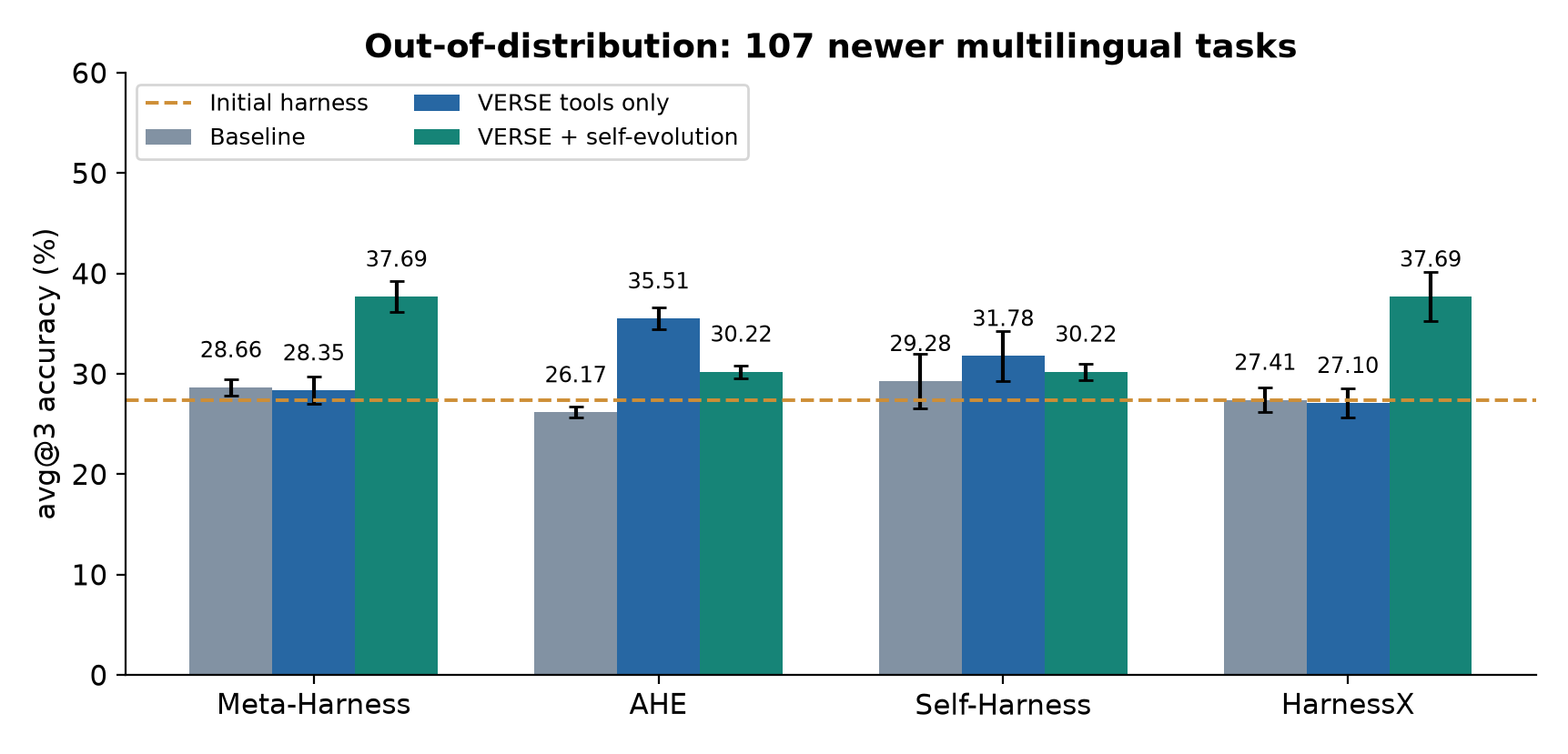
Figure 5. Redrawn from Table 2 on 107 newer tasks in five languages. The initial harness scores 27.41%. This figure uses the same selected harnesses as Figure 4; no OOD-based checkpoint selection is performed.
The strongest full result, 37.69% OOD, is 8.41 percentage points above the strongest selected baseline mean, 29.28%, which belongs to Self-Harness. The Meta-Harness-hosted comparison instead improves from 28.66% to 37.69%, a 9.03-point gain. “Best versus best” and “same host versus same host” answer different questions. The corresponding ID best-versus-best difference is 42.28−39.20 = 3.08 points.
The rounded abstract comparison of 42.3/37.7 against 39.2/29.3 is therefore accurate but compresses these distinctions. The useful practical takeaway is not to pick a host by looking at the sealed test maximum. A deployment procedure needs an independently specified host-selection rule or another development split if host choice is itself tuned.
8. Evidence about how the optimizer changes
The evolution logs show why execution is useful even when it frequently returns bad news. Among 170 draft evaluations, 17 repaired a failing target, 30 passed only already-passing regression tasks, 112 passed none of their targets, and 11 were inconclusive. Repeated evaluation of the same draft counts again. These are evaluations, not 170 unique proposed mechanisms or 170 independent tasks.
Only 28 of 286 predicted failing-task fixes actually passed in the next training run. Separately, 275 of 557 validation outcome changes did not reproduce on a rerun. These denominators refer to different events. The first is calibration of predictions; the second is reproducibility of changes. Neither directly estimates the error rate of the final selected harness.
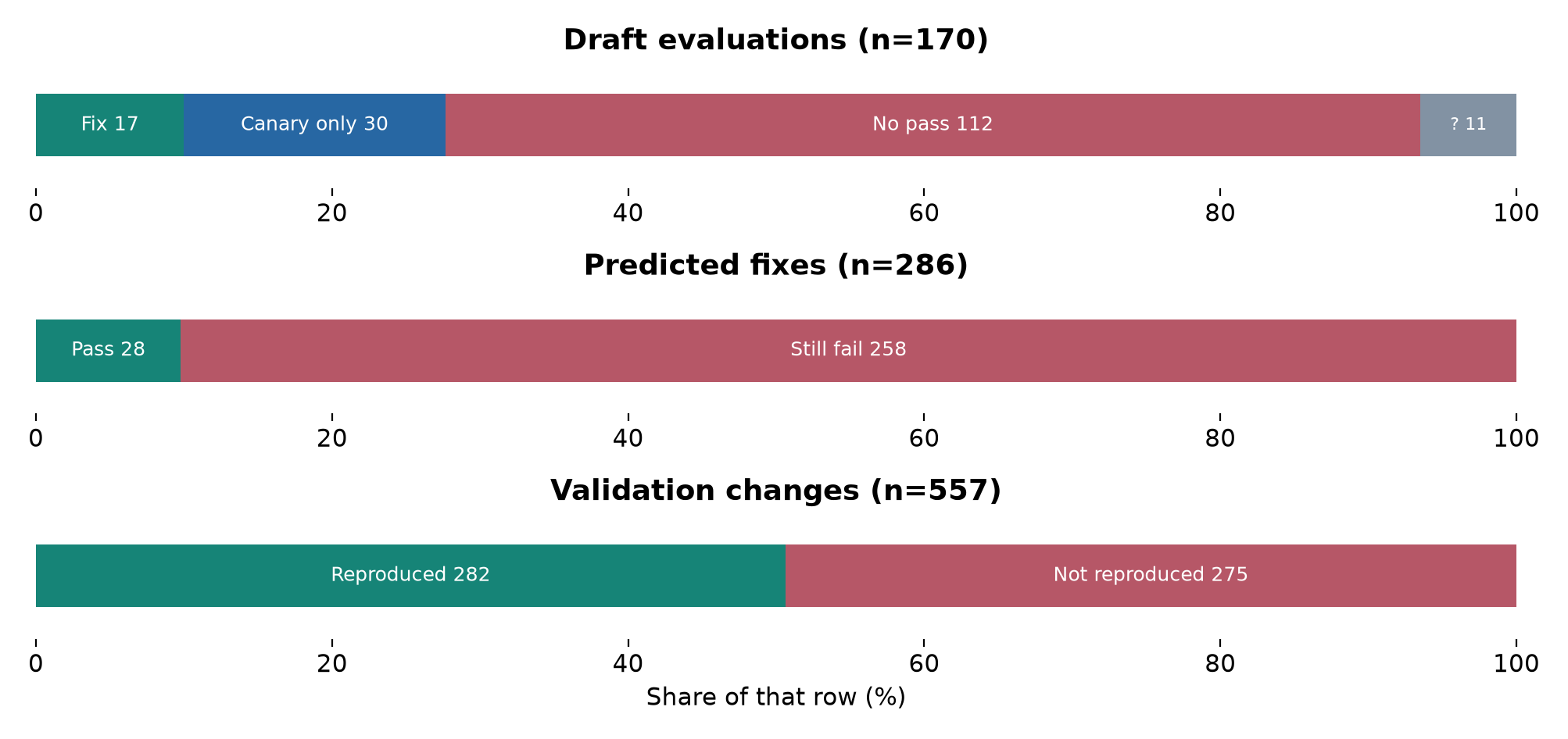
Figure 6. Counts redrawn from Figure 5 and Sections 4.3–4.4. The three rows summarize draft evaluations, predicted fixes, and validation changes respectively. They should not be pooled into one success statistic.
Self-evolving optimizers included an already-passing training task in 34 of 81 draft evaluations, versus 2 of 89 for fixed optimizers. After a check found no repaired target, they changed the draft before submission in 30 of 38 cases, versus 42 of 74. The calculated proportions are about 42.0% versus 2.2% for canary inclusion, and 78.9% versus 56.8% for revision after refutation. Their draft-fix frequencies were much closer: 9/81 versus 8/89.
The clearest behavioral change is thus not “self-evolution immediately makes each draft much better.” It changes what is tested and how negative evidence is used. A negative result can prevent a speculative lesson from becoming a permanent rule, but only if the optimizer treats that result as a reason to reconsider. This is the methodological connection between the log analysis and the theoretical excess-error term.
Appendix L provides a concrete sequence. After the first round, a strong run observed that testing only predicted fixes had missed regressions. It added passing canaries to its prompt, skill, and notes. In round 2 all three verification calls included a passing task, while none of the earlier three had. It also narrowed a broad interpreter rewrite to respect projects with their own environment managers. This turns one observed failure into a more discriminating experiment and a narrower mechanism.
The same appendix warns against treating generated memory as ground truth. Its notes incorrectly attribute the initial training score to a later harness and mention a nonexistent second candidate session. Artifact presence also does not establish utility: Appendix K reports broken self-written tools and rejected versions. These details are valuable counterweights to the seductive narrative that a growing library necessarily represents accumulating knowledge.
Algorithm 3. A regression-aware reading of one proposed mechanism
This is my operational abstraction of the paper’s evidence loop, not an additional algorithm claimed by the authors.
1  State the failure class and predicted effect of one edit.
2  Choose a failing target and a previously passing canary.
3  Distinguish replayable failure from an inconclusive environment.
4  Probe the candidate and confirm promising outcomes.
5  Check whether the intended branch was actually exercised.
6  Record repaired targets, regressions, costs, and uncertainty.
7  Retain a lesson only at the scope supported by that evidence.
8  Revisit the lesson when later rounds contradict it.
The last step matters: an early environmental workaround can become harmful after another component changes. Recording a rule without its supporting conditions makes later composition brittle. A useful memory should preserve the reason for a rule, its counterexamples, and the tasks on which it was tested.
9. Ablations, costs, and the boundary of transfer
9.1 The component ablation is not a universal ranking
On AHE without self-evolution, full tools reach 37.96% selected ID accuracy. Removing verification during evolution, while retaining minimization, gives 37.65%. Removing attribution and minimization, which also removes the training history, gives 35.80%. Removing only the training history gives 36.73%; plain AHE gives 33.95%.
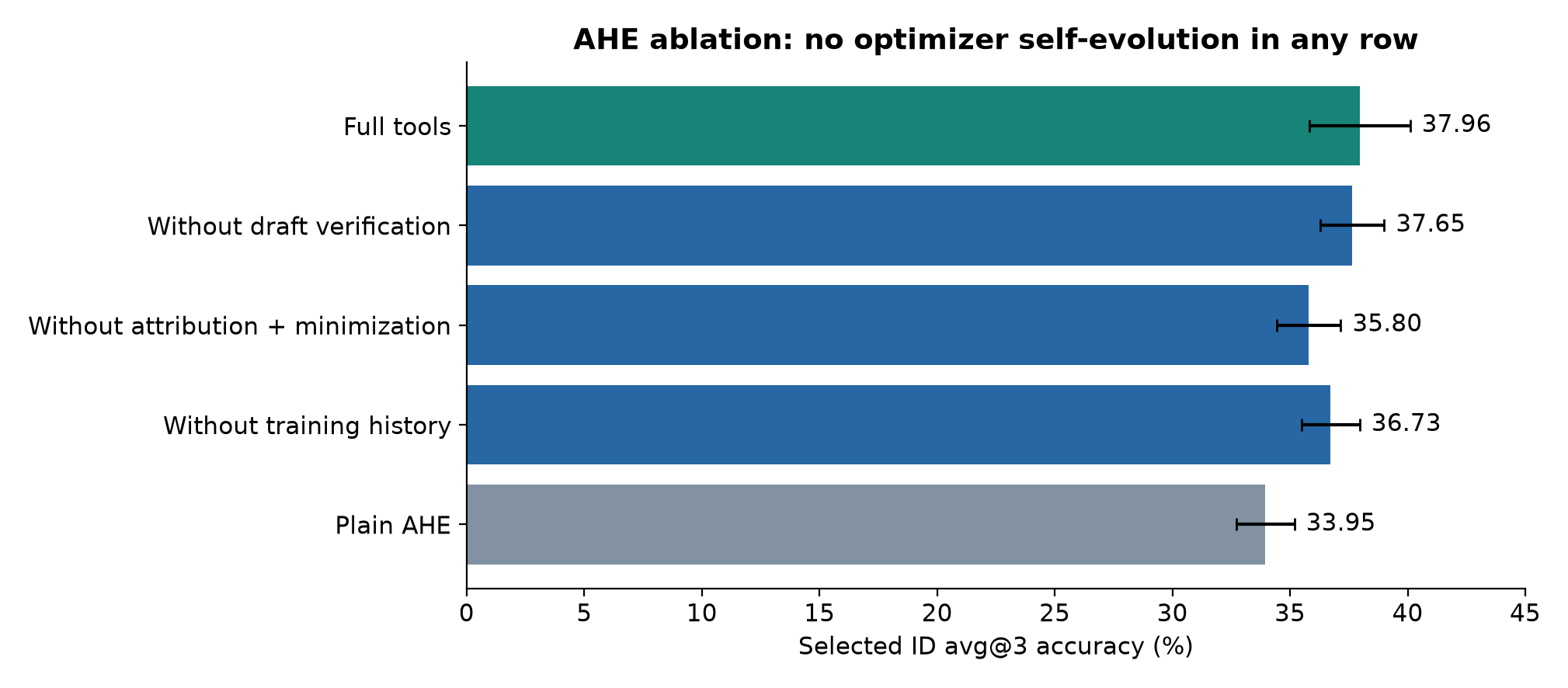
Figure 7. Redrawn from Table 3. Every row uses AHE without optimizer self-evolution. Error bars are evaluation SEM, not uncertainty across independent evolution runs.
The near tie after removing draft verification does not establish that verification is useless. In this run the fixed optimizer’s first nine checks refuted its drafts, and it stopped calling the tool after round 2. Availability and effective use are different treatments. But the result also prevents a strong claim that every component independently contributes a clear gain on every host.
Appendix H studies different models. At the same probe allowance, random scheduling gives 30.86% and a fixed schedule 26.85%, compared with 32.71% when the optimizer chooses probes. Restricting self-written artifacts to prompts, notes/skills, or tools lowers selected accuracy relative to the unrestricted run. These are useful design clues, but each ablation is a single evolution run. They motivate replication and do not precisely identify average causal effects.
9.2 “A small fraction of executions” is not “almost free”
Table 4 reports verification as 2–7% of agent runs, but end-to-end evolution takes 1.3–2.5 times the baseline wall time. On Meta-Harness, baseline versus full VERSE uses 1,326 versus 1,453 agent runs, 550 versus 634 million executor tokens, and 21.6 versus 38.0 hours. The calculated overheads are roughly 9.6%, 15.3%, and 75.9%, respectively. They measure different resources and should remain separate.
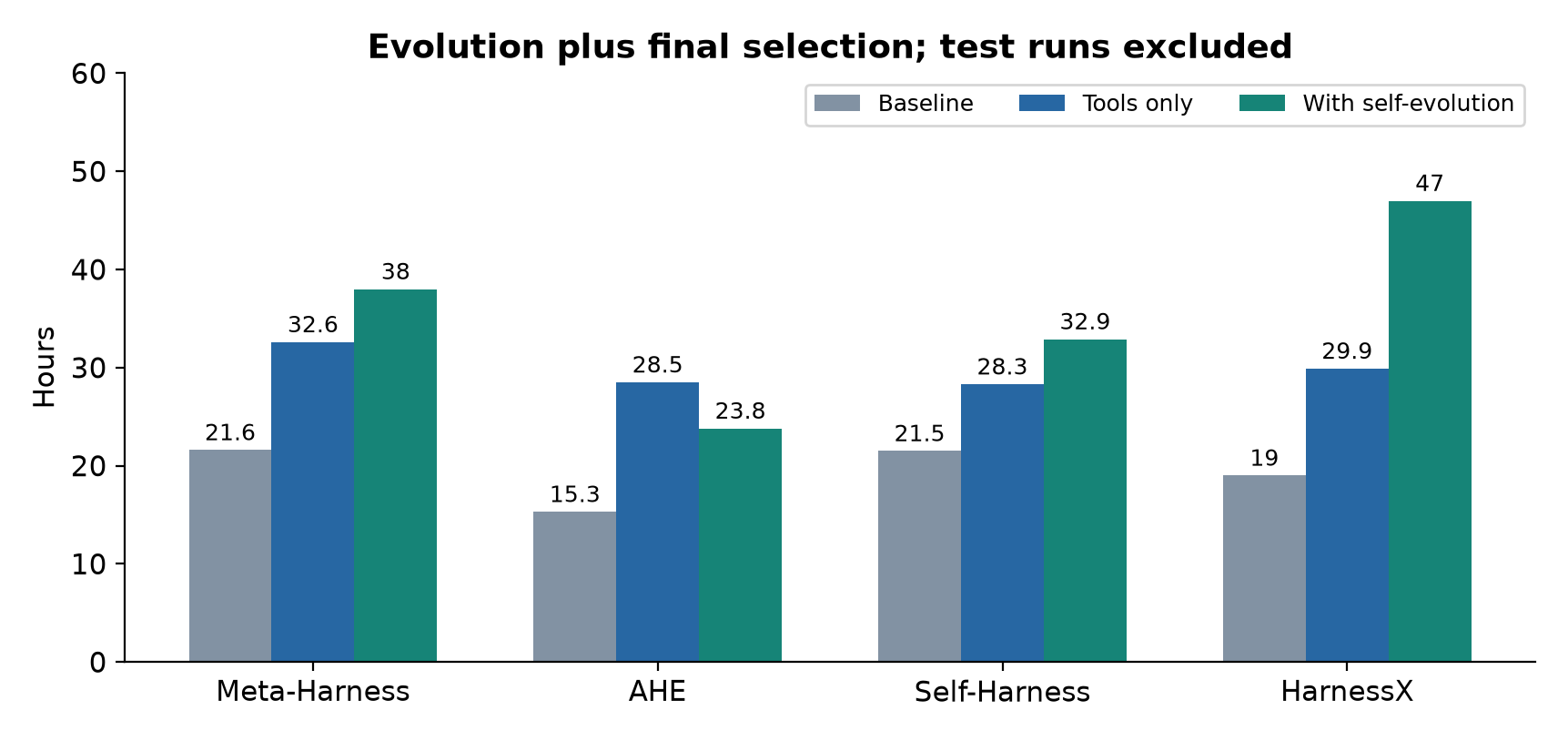
Figure 8. Hours redrawn from Table 4. Costs include evolution and final harness selection, excluding test evaluation. Shared-server load differed, so these are reported run costs rather than a clean latency microbenchmark.
The extra wall time includes waiting for checks, longer executor trajectories, screening and validation that a failed baseline round might have skipped, and variable server load. Optimizer token counts were not logged; model turns are reported instead. Therefore a complete dollar-cost or energy comparison cannot be reconstructed from the paper’s table. Equal candidate slots and turn caps are a meaningful control, but not equal total compute.
The economic question depends on reuse. A costly search can be worthwhile if one frozen harness serves many future tasks. The paper does not provide enough deployment-cost information to compute a break-even workload. Such a calculation would need the search cost, the per-task inference cost difference, and the value of a successful task, all under the intended task distribution.
9.3 Language transfer is stronger than arbitrary portability
The OOD test changes both time and language mix. Full VERSE raises the host mean in 16 of 20 host-by-language pairs. This supports transfer beyond the Python training setting, although each language has only 17–25 tasks and the result combines several forms of shift.
Cross-domain and cross-model experiments are less uniformly positive. Appendix G separates transferring the executor harness from transferring the optimizer procedure. A harness specialized for repository patches can lose accuracy on terminal tasks. An inherited optimizer may still adapt effectively, especially when the executor harness is reset. Yet changing the executor model often removes gains, and two adaptation rounds do not consistently restore them.
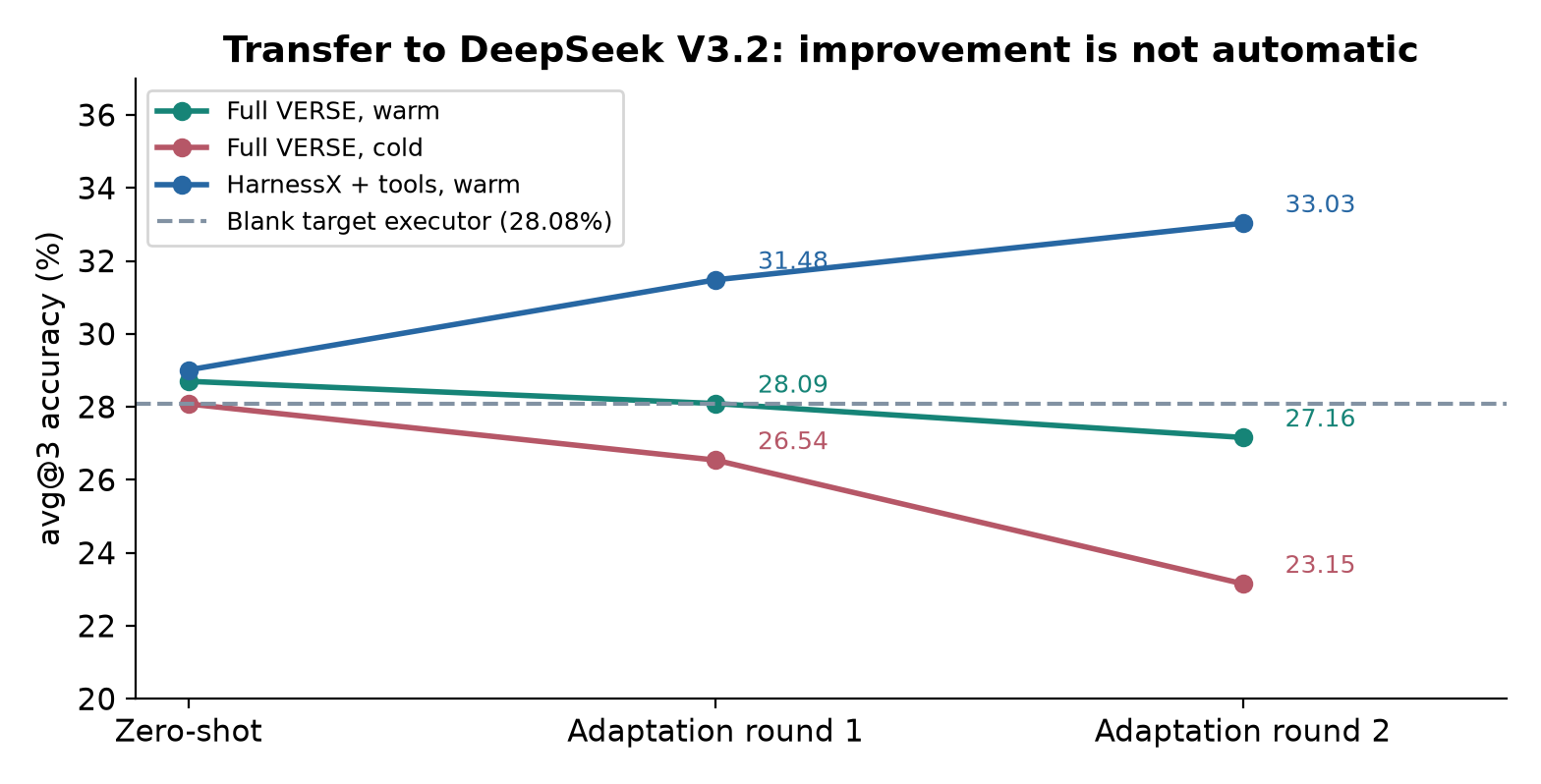
Figure 9. Selected examples from Table 10, SWE-rebench with DeepSeek V3.2 as target executor. “Full VERSE, warm” inherits both harnesses; “full VERSE, cold” resets the executor harness. The dashed line is the target model’s blank harness. These are examples, not an aggregate transfer score.
The reported shell-editing example helps explain this difference. An editor tool avoiding heredoc quoting can correct a shared interface problem across models. A behavioral reminder tuned to one model’s habits may not transfer. The mechanism’s level of abstraction matters: portability is more plausible for a reusable interface repair than for an idiosyncratic sequence of instructions.
10. Limitations
Evolution variability is incompletely measured. Main Tables 1–3 use one evolution run per row. Three test evaluations measure variability conditional on a produced harness, not variability of the learning process. Appendix F adds three evolution runs for baselines and HarnessX-hosted VERSE with a different, anonymized model pair. Its means are encouraging, but cannot replace replication of every main configuration with the main models.
Compute is not matched end to end. VERSE receives extra probes and self-update calls; some baselines also skip screening and validation when candidates fail. The experiments show what the complete systems accomplished under matched proposal controls. They do not isolate the entire gain from an equally expensive baseline search with more candidates, more careful selection, or an expanded fixed workflow.
Validation is adaptive and small. Restricted feedback is better than exposing full trajectories, yet 50 tasks and repeated outcome identifiers still permit adaptation. The theoretical bound explicitly depends on feedback information. Its usefulness requires quantities that are not empirically estimated here. Moreover, confirmed outcomes need not be unbiased estimates of fresh-run accuracy.
The theoretical repair model is deliberately narrow. Two causes with corresponding correct repairs are analytically tractable. Real failures may have several interacting causes, and an intervention may change the environment or future actions rather than isolate one mechanism. The existence of a population-improving repair behind each productive target is an assumption, not an empirical guarantee derived from the observed pass rate.
Transfer is conditional. New-language gains do not imply that the same harness works with another executor or another task family. The paper’s negative transfer results should be retained alongside the headline. A deployment with a different tool API, model, context window, or grader needs a fresh evaluation, even if the nominal task category sounds similar.
Generated artifacts can preserve wrong beliefs. A self-written hook or note is an optimizer action, not independently verified knowledge. The appendix’s inaccurate notes and broken tools show why a count of generated artifacts cannot stand in for a count of reliable improvements. The fixed evaluation boundary limits the consequences, but does not make the internal narrative infallible.
11. Critical analysis
11.1 The most convincing claim is about process, not recursion depth
The strongest evidence links an observed regression to a changed experimental habit: passing tasks are added to checks, failed drafts are revised more often, and previously repeated analysis becomes a reusable operation. This makes a plausible mechanism for improvement visible. The theory’s split between information overlap and excess decision error sharpens that story without pretending to predict an exact benchmark score.
The weakest interpretation would be that self-evolution is intrinsically beneficial whenever it is allowed. Main Table 2 argues against that reading. Full VERSE is consistently above the unequipped hosts, yet often below their tools-only variants. I would frame the result as evidence for a promising combined design whose optimizer policy remains imperfect, rather than as a settled rule to turn on self-modification in every harness.
11.2 “Verified” describes observations under a protocol
The word should be read operationally. A draft can be run, a failure can be replayed, and a change can be confirmed twice on specified tasks. None of these observations proves universal correctness, absence of regressions, or validity of an unrestricted causal explanation. The system even permits submission after unsuccessful checks. Precision about this meaning helps preserve the actual contribution instead of inflating it.
There is a useful analogy to scientific experimentation, but it should be kept local. An experiment can falsify a proposed explanation only if the tested intervention distinguishes it from alternatives. Running an unchanged draft on another easy task may consume budget without reducing diagnostic ambiguity. The important resource is informative evidence per unit of cost, not the raw number of verification calls.
11.3 The next experiment should separate three competing explanations
First, a cost-matched comparison should give a fixed optimizer the same total executor and optimizer budget as the self-evolving one, allowing it additional proposals or repeated checks. Second, a frozen procedure distilled from an evolved optimizer could be tested on new independent evolution runs. Third, the complete self-evolving optimizer could start from that same distilled procedure. These comparisons would help distinguish extra compute, reusable procedural knowledge, and continued online adaptation.
A second axis is validation feedback. One could compare a scalar score, score plus reproducible change counts, and the current identifier-bearing summary under the same search budget. An independent final test would reveal whether richer feedback improves transfer enough to offset its greater opportunity for overfitting. This is a proposed study, not an experiment reported in VERSE.
Finally, the unit of replication should be the entire search trajectory. Report the distribution across fresh workspaces and seeds, the chance of beating the initial harness, the magnitude of worst regressions, and the resource distribution. A system intended to improve agents autonomously needs tail behavior, not only the best checkpoint from one favorable search.
11.4 What I would carry into an engineering design
I would preserve the separation of executor and optimizer state; immutable task-grading rules; distinct records for diagnoses, predictions, observations, and lessons; and explicit budgets shared across concurrent candidates. I would also make a lesson’s supporting evidence and scope easy to inspect. These choices follow from the paper’s failures as much as its successes.
I would not equate a passing smoke check with an effective behavioral intervention, nor a larger skill library with better generalization. The observable target is sustained improvement on fresh tasks after freezing a specific harness. That target keeps the engineering discussion anchored when the optimizer’s own explanations become elaborate or persuasive.
12. Conclusion
VERSE studies a useful escalation of harness optimization: improve not only the executor configuration, but also the procedure that proposes, tests, and revises configurations. Its contribution is clearest when a noisy success or a persuasive diagnosis is replaced by an informative experiment and a regression-aware memory.
The paper reports meaningful held-out gains and offers unusually candid evidence about failed checks, unreliable predictions, extra cost, and weak transfer across models. Those limitations make the result more useful. They show where an apparently intelligent improvement loop still needs experimental discipline. The practical lesson is to treat self-improvement as a search-and-selection problem with uncertain evidence, not as a property conferred by allowing an agent to edit itself.
References and figure provenance
- Zekai Wang et al. VERSE: Verified Self-Evolving Optimizer for Agent Harnesses, v1, October 2, 2026. Main Sections 2–4 and Appendices B–L are the source for the method, theory, and reported measurements in this review.
- Figures 1–2 are original explanatory schematics. Figure 3 is an explicitly hypothetical calculation. Figures 4–5 redraw Table 2; Figure 6 redraws the counts in Figure 5; Figure 7 redraws Table 3; Figure 8 redraws Table 4; Figure 9 selects labeled examples from Table 10. Redrawing preserves the stated metric, population, and uncertainty convention.
- The authors’ repository entry is supplied as a resource link. This note explains and critiques the paper’s evidence; it does not claim independent benchmark reproduction.