Review date: 2026-09-08 · Author: Zhongzhu Zhou Paper reviewed: Cliff: Learning Process Rewards from the First Mistake Paper authors: Peixuan Han, Runhui Wang, Ketan Ramaneti, Jie Hao, Gerald Friedland, Chris Kong (Amazon Web Services; University of Illinois Urbana-Champaign) arXiv: 2609.02817 · Venue/Status: arXiv preprint, submitted 2 September 2026
Why This Paper, and Why You Should Care
If you have trained an LLM with GRPO or PPO on math or coding tasks, you already know the single most annoying property of outcome-only reward: a rollout that gets 19 out of 20 reasoning steps right, then flips a sign in the last line, is scored exactly the same — zero — as a rollout that is wrong from the first token. Both get the same negative advantage, which means every single token in both trajectories, correct or not, is pushed down by the same amount. The policy gradient cannot tell the difference between “this model is bad at arithmetic” and “this model is bad at everything.” That is a huge amount of wasted signal, and it is the entry point for this paper.
Cliff’s answer is disarmingly simple: use a teacher LLM to find the first place a rollout goes wrong (the “Pitfall Step”), and give the tokens before that point a less punishing (or slightly positive) advantage than the tokens after it. No new reward model to train, no per-step scalar scores, just one binary cut point per rollout. The paper’s central claim is that this single cut is enough — you do not need dense, per-token process rewards to get most of the benefit of process supervision.
Why should you care about yet another RLVR reward-shaping paper? Because the framing here is unusually clean. Most process-supervision work either (a) trains a whole separate model just to score reasoning steps, which is expensive and fragile, or (b) requires the teacher and student to be close cousins (same tokenizer, similar reasoning style), which rules out the most obvious use case of “cheap open model learns from an expensive frontier model.” Cliff sidesteps both constraints by asking the teacher for the cheapest possible piece of information it can reliably provide — not a score, not a distribution, just “where did this go wrong” — and shows that this minimal signal, correctly converted into an advantage, captures most of what denser process supervision would have given you anyway.
Prerequisites
Before diving into the method, let’s make sure the background is solid, because Cliff is built directly on top of it.
RLVR and GRPO in one page
Reinforcement Learning with Verifiable Rewards (RLVR) is the current default recipe for teaching LLMs to reason: sample a rollout from the policy, check the final answer against a ground-truth verifier (does the boxed number match? does the code pass all test cases?), and use that binary or near-binary reward to update the policy. It scales because you don’t need human raters — but it also means every intermediate reasoning step is invisible to the reward function. The paper spends its introduction on exactly this problem, and gives a memorable example: a solution that is “nearly complete” but has “only a minor error” is “penalized identically to a completely incorrect attempt.”
Group Relative Policy Optimization (GRPO) solves the “we need a value function” problem of PPO by exploiting structure that RLVR gives us for free: sample rollouts for the same question , then use the empirical mean and standard deviation of their rewards as the baseline and scale, instead of learning a critic. This is what the paper’s Equation (2) computes:
Notice the crucial detail: does not depend on (the token position) — every token in rollout gets the same advantage. GRPO’s full objective (their Equation 1) is:
where is the usual PPO-style importance ratio. If you have read our earlier posts on DAPO or GSPO you’ll recognize this immediately — Cliff literally reuses DAPO’s token-level loss aggregation (the normalizer instead of per-sequence averaging) as its base loss, and only changes how is computed.
Why process supervision is hard, and what people have tried
Two prior directions try to get beyond this coarse signal:
- Process Reward Models (PRMs). Train a separate model to score each reasoning step. Works, but needs its own training data, is prone to reward hacking (the policy learns to satisfy the PRM’s quirks rather than actually reason correctly), and needs re-training whenever the domain shifts.
- On-Policy Distillation (OPD). Instead of an outcome reward, use a teacher model’s token-level log-probabilities on the student’s own rollouts as a dense supervision signal (basically, “how surprised is the teacher by each token the student produced”). This only works well when teacher and student share a tokenizer and similar reasoning style — which rules out using, say, a much bigger frontier model as the teacher for a small open-weight student unless you do extra cross-tokenizer alignment work.
Cliff’s pitch is to sidestep both constraints: no reward model to train (just prompt an off-the-shelf LLM as a judge), and no dependence on shared tokenizers or reasoning patterns (the teacher’s verdict, not its logits, is what matters).
The “vacuous implication” intuition
The paper motivates its design with a nice piece of formal-logic flavor: in the material conditional “A → B,” if A is false, the whole statement is true regardless of B — this is the textbook example of “vacuous truth.” Translated to reasoning traces: once a chain-of-thought has already gone wrong, whatever comes after is conditioned on a false premise, so evaluating it in fine detail “provides limited additional information.” The authors are explicit that this is not a rigorous proof, just an intuition pump — but it is the right intuition to have in your head before reading Section 3.
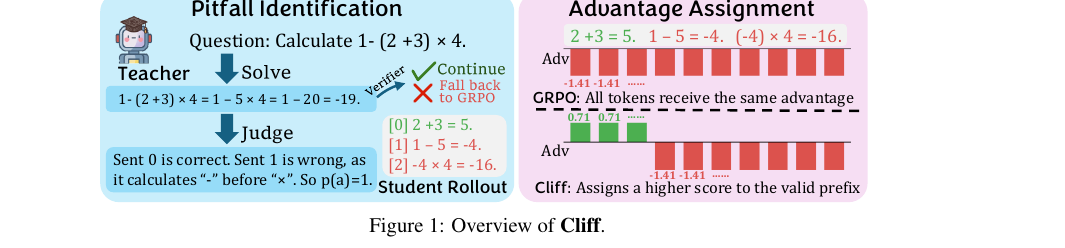
3. Method: How Cliff Actually Computes Its Advantages
3.1 Step 1 — recovering GRPO’s two advantage values in closed form
Before Cliff can modify anything, we need the baseline GRPO advantages in a form we can manipulate. The paper makes a simplifying (and for RLVR, realistic) assumption: rewards are binary, . If a group of rollouts has empirical success rate , then every rollout’s reward is either or , so the whole group’s rewards have only two distinct values, meaning Equation (2) collapses to just two possible advantage values: one for every correct rollout, one for every incorrect rollout. Because reward is Bernoulli(), its standard deviation across the group has the closed form (this is just the standard formula for the standard deviation of a Bernoulli random variable — variance , so ). Plugging and into Equation (2) with this gives the paper’s Equation (3):
Intuitively: if almost every rollout in the group succeeds (), shrinks toward 0 (a correct rollout isn’t very informative when everyone succeeds) while grows large (the rare failure stands out and gets punished hard). Symmetrically, if almost every rollout fails (), grows large (a rare success is highly rewarded) while shrinks toward 0. This is exactly the GRPO baseline behavior everyone already knows, just written out in closed form so we can build on top of it.
3.2 Step 2 — splitting an incorrect rollout at the Pitfall Step
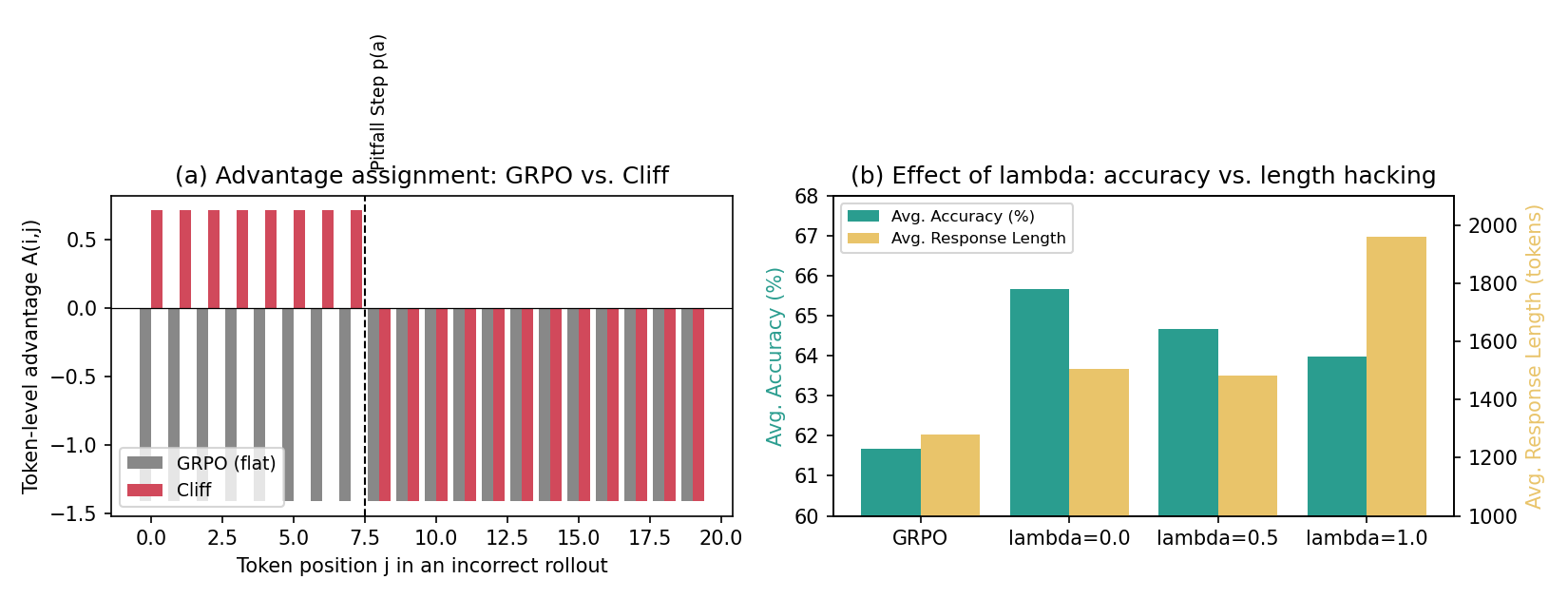
Here is Cliff’s actual modification, the paper’s Equation (4). For a correct rollout, nothing changes — every token still gets (minus a recentering offset , explained next). For an incorrect rollout, instead of every token getting the same , tokens are split at the Pitfall Step :
Read this line by line: the first case is unchanged GRPO for correct rollouts. The second case is the entire contribution of Cliff — tokens in the valid prefix of a wrong rollout get instead of , where is a tunable dial on how much credit that valid reasoning gets. The third case says the erroneous suffix keeps the ordinary (harsh) GRPO-style incorrect-rollout advantage, unchanged. The paper’s own headline empirical result (Section 6.2, discussed below) is that the best setting is — meaning the valid prefix gets zero advantage (before recentering), rather than positive reinforcement. This is a genuinely important and slightly counterintuitive design choice we’ll come back to in Section 3.4.
3.3 Step 3 — the recentering offset , and why it has to exist
GRPO’s advantages are, by construction, zero-mean within a group (this is baked into the -subtraction in Equation 2). Cliff’s per-token split in Equation (4) breaks that property, because now the average advantage across all tokens in the group depends on how far into each incorrect rollout the Pitfall Step happens to land — some groups will have long valid prefixes, some short ones, purely by chance. If left uncorrected, this would silently shift the effective learning rate/scale of the policy gradient update in an uncontrolled, data-dependent way. The fix is Equation (5): compute the unrecentered group-mean advantage exactly, then subtract it from every token so the group mean returns to exactly zero, matching GRPO’s own normalization convention:
This looks intimidating but is just a weighted average: the numerator sums, over every rollout, (advantage value) × (number of tokens that get that value), and the denominator is the total token count across the group — an ordinary weighted mean, computed separately for the three cases in Equation (4) and then summed. Token positions are indexed from 0, so a valid prefix contains exactly tokens and the erroneous suffix contains the remaining tokens, which is why those exact counts appear as multipliers.
3.4 Design choice: why , and what the alternative gets wrong
It would be natural to assume that rewarding the valid prefix of a wrong rollout (i.e., ) should always help — after all, that prefix genuinely is good reasoning, so why not reinforce it positively rather than giving it zero credit? The paper’s Section 6.2 experiment (Table 4, discussed in Section 5 below) shows this intuition is wrong in practice: gives the best accuracy, is close behind, and is measurably worse, with response length ballooning from 1506 tokens () to 1959 tokens (). The mechanism, formalized in the paper’s Appendix C (and reproduced with derivation in Section 4 of this review below), is that positively rewarding a valid-but-incomplete prefix creates exactly the wrong incentive: the policy learns it can get partial credit just by producing more tokens of valid-looking reasoning before eventually messing up, rather than being pushed to actually finish reasoning correctly. This is a textbook length-hacking failure mode, and the paper’s choice to default to — i.e., no positive credit at all for the valid prefix, just less negative credit than the fully-wrong case — is a specific, evidence-backed answer to “how generous should partial credit be,” not an arbitrary default.
4. A Worked Numerical Example (Grounding Equations 3-5)
Abstract formulas are easiest to trust once you’ve pushed real numbers through them. Take a group of rollouts for one question, with rewards (one correct, three incorrect), so . Then . Plugging into Equation (3): , and . Under vanilla GRPO, the one correct rollout’s tokens all get , and every token in all three incorrect rollouts gets , regardless of how much of each incorrect rollout was actually valid reasoning.
Now suppose the three incorrect rollouts have lengths tokens, with Pitfall Steps at (i.e., rollout 4 is wrong from the very first token — perhaps it misread the question). With (the paper’s chosen default), Cliff’s unrecentered per-token advantages are: rollout 1 (correct): for all its tokens. Rollout 2: for tokens – (the valid prefix, since ), then for tokens –. Rollout 3: for tokens –, then for tokens –. Rollout 4: for every one of its 10 tokens (since means there is no valid prefix at all).
To find the recentering offset via Equation (5), suppose rollout 1 has 15 tokens. The numerator is (rollout 1’s correct-rollout contribution) (rollout 2) (rollout 3) (rollout 4). With every term vanishes, leaving numerator . The denominator is the total token count . So . Every advantage computed above then gets this same subtracted: rollout 1’s tokens end up at ; rollout 2’s valid prefix ends up at (mildly negative, not zero — this is the recentering side-effect, and it’s expected); rollout 2’s erroneous suffix ends up at ; and so on for rollouts 3 and 4.
The qualitative takeaway from this concrete example: even a fully-wrong rollout’s valid prefix (rollout 2’s first 12 tokens, or rollout 3’s first 4 tokens) ends up with an advantage around — mildly negative, but far less punishing than the their own erroneous suffixes get, and dramatically less punishing than the flat (unrecentered) or (recentered) that vanilla GRPO would assign to every single token in these same rollouts. That gap — a small negative number for good-but-incomplete reasoning versus a much larger negative number for the actual mistake — is the entire mechanism by which Cliff is supposed to teach a model to distinguish “I reasoned correctly but ran out of ideas” from “I reasoned incorrectly starting here.”
5. The Full Training Pipeline as Pseudocode
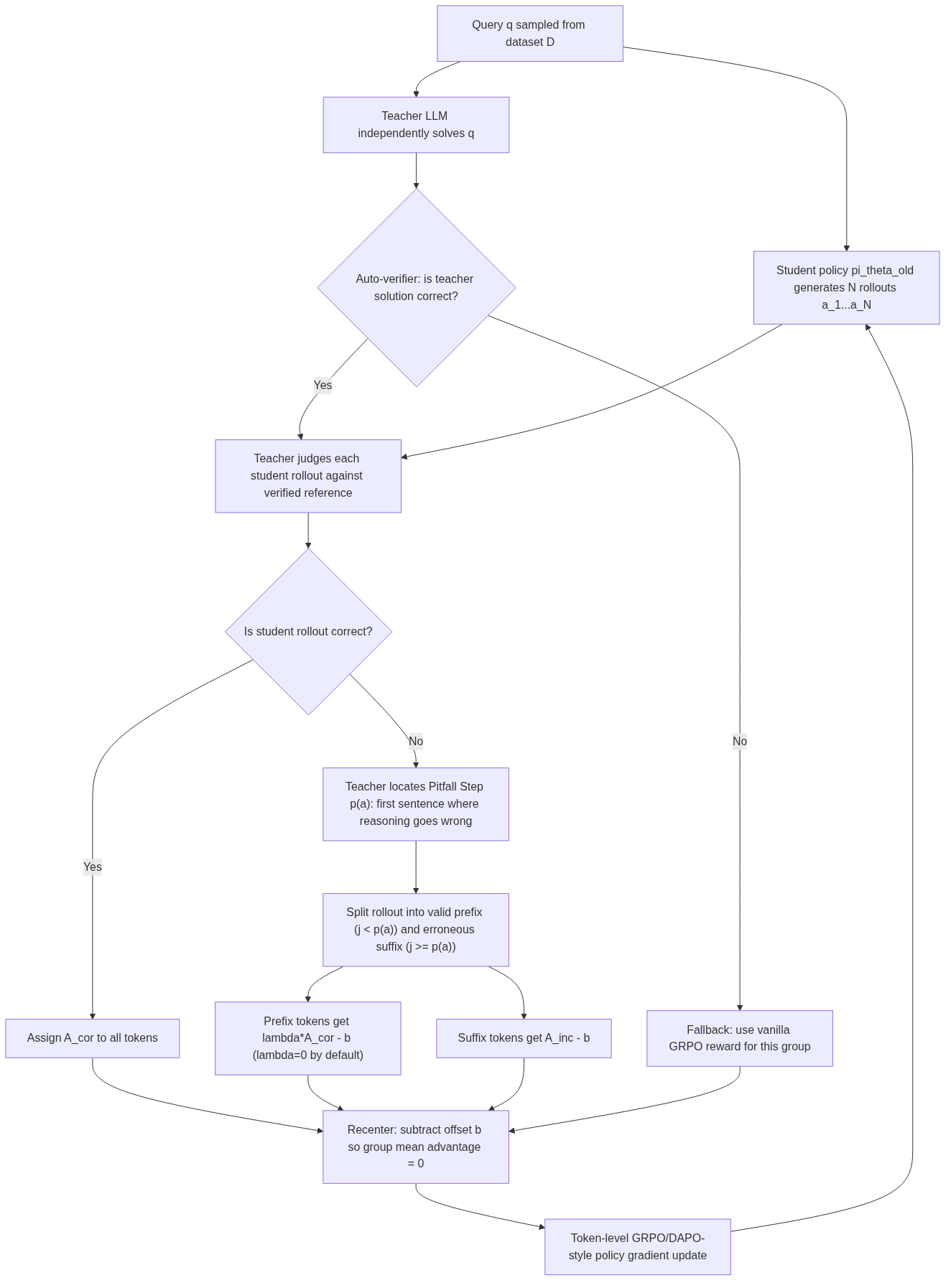
Putting Sections 3.1-3.3 together, here is the complete per-training-step procedure Cliff runs, as numbered pseudocode:
Algorithm 1: Cliff Training Step
Input: policy pi_theta_old, query q ~ D, teacher model T, verifier V, lambda
1.  Sample N rollouts a_1, ..., a_N ~ pi_theta_old(q)
2.  Teacher T generates its own reference solution ref for q
3.  IF V(ref) is incorrect:
4.      Fall back to vanilla GRPO for this group (compute A_i via Eq. 2, done)
5.  ELSE:
6.      FOR each rollout a_i:
7.          IF V(a_i) unanimous with all other rollouts in the group (all correct or all incorrect):
8.              Skip teacher judging (zero reward variance -> zero advantage anyway)
9.          ELSE:
10.             Ask teacher T to judge a_i against ref, sentence by sentence
11.             IF T judges a_i correct: R(q, a_i) = 1
12.             ELSE:
13.                 R(q, a_i) = 0
14.                 p(a_i) = index of first sentence T flags as wrong
15.                 IF a_i was truncated at Lmax (overlength): p(a_i) = 0  // hard cap, Section 3.4/Appendix C
16.     Compute mu, sigma, A_cor, A_inc via Eq. (3) using the R(q, a_i) values from steps 7-15
17.     Compute offset b via Eq. (5)
18.     FOR each rollout a_i and each token position j:
19.         Assign A_{i,j} via Eq. (4), then subtract b (Eq. 5)
20. Update pi_theta using the token-level GRPO/DAPO loss (Eq. 1) with these A_{i,j} values
A few implementation-level details worth flagging because they matter for reproducing the method exactly: step 7-8 (skipping unanimous groups) is a pure compute-saving optimization — the paper notes these groups carry zero reward variance and therefore zero advantage under GRPO’s own normalization regardless of what the teacher would have said, so skipping the judge call for them loses no real signal except in the rare case where the teacher would have disagreed with the automatic verifier on every single rollout in the group. Step 15 (the overlength hard cap) is not an optimization at all but a correctness requirement — Section 3.4 above already previewed why: without it, an overlength (truncated) rollout could receive a long “valid-looking” prefix from the teacher (since it genuinely didn’t do anything wrong, it just ran out of budget), and the paper’s own Appendix C math (reproduced in Section 8 below) shows this specific case is exactly where length-hacking would otherwise sneak back in.
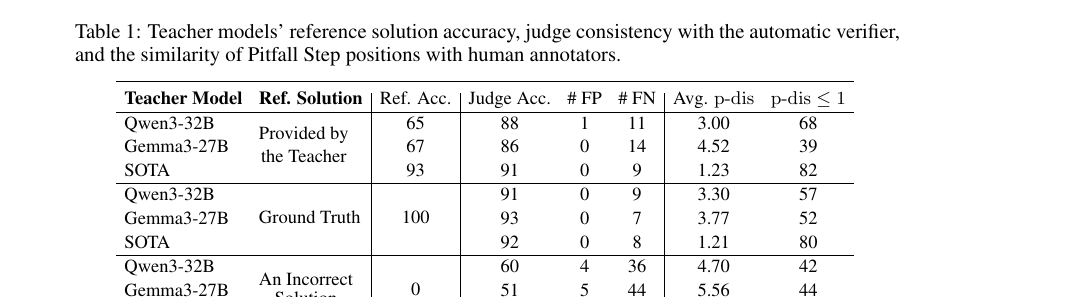
6. Can the Teacher Actually Find the Pitfall Step? (Judge Quality)
Everything above assumes the teacher’s judgment of “where did this rollout first go wrong” is trustworthy. Section 4 of the paper tests this directly, before ever touching RL training, using a hand-annotated dataset: 50 correct and 50 incorrect rollouts from DAPO-Math, with human experts independently marking each incorrect rollout’s Pitfall Step using the exact same instructions given to the LLM judge (so the comparison is apples-to-apples). The paper defines agreement via
the absolute difference in sentence index between the human’s and the LLM’s flagged Pitfall Step — zero means perfect agreement, larger numbers mean the LLM flagged a different sentence than the human did.
| Teacher Model | Ref. Solution | Ref. Acc. | Judge Acc. | # FP | # FN | Avg. p-dis | p-dis ≤ 1 |
|---|---|---|---|---|---|---|---|
| Qwen3-32B | Provided by Teacher | 65 | 88 | 1 | 11 | 3.00 | 68 |
| Gemma3-27B | Provided by Teacher | 67 | 86 | 0 | 14 | 4.52 | 39 |
| SOTA | Provided by Teacher | 93 | 91 | 0 | 9 | 1.23 | 82 |
| Qwen3-32B | Ground Truth | 100 | 91 | 0 | 9 | 3.30 | 57 |
| Gemma3-27B | Ground Truth | 100 | 93 | 0 | 7 | 3.77 | 52 |
| SOTA | Ground Truth | 100 | 92 | 0 | 8 | 1.21 | 80 |
(Table 1, condensed to the two most important rows-groups: teacher’s own reference solution vs. a verified ground-truth reference. “Ref. Acc.” is how often the teacher’s own independently-generated solution is itself correct; “Judge Acc.” is how often the teacher’s correct/incorrect verdict on the student rollout matches the automatic verifier; “p-dis ≤ 1” is the percentage of judged-incorrect cases where the LLM’s flagged Pitfall Step is within one sentence of the human’s.)
Three findings matter for trusting the method: (1) judging is easier than solving. Even Qwen3-32B and Gemma3-27B, whose own problem-solving accuracy (65-67% when generating their own reference) trails the SOTA teacher badly, still achieve judge accuracy in the high 80s-90s once given a verified ground-truth reference — correctly identifying someone else’s mistake turns out to be a meaningfully easier task than solving the problem from scratch, which is good news for using cheap teachers. (2) Reference quality matters a lot. Comparing the “Provided by Teacher” rows (using the teacher’s own, possibly-wrong solution as reference) against “Ground Truth” rows (a verified-correct reference), judge accuracy and p-dis both improve when the reference is verified — this is exactly why Cliff’s pipeline (Section 3, Algorithm 1 step 3-4) discards groups where the teacher’s own reference solution fails verification, rather than trying to judge against a reference that might itself be wrong. (3) most disagreements are false negatives, not false positives — the teacher almost never wrongly rejects a genuinely correct student solution (FP columns are 0-1 across the board), but does miss roughly 10% of cases it should flag as wrong (FN columns are 7-14) — and the paper notes some of these apparent misses may actually be cases where the automatic verifier itself was fooled by a lucky guess, not genuine judge failures.
7. Main Experimental Results
With judge quality established, Section 5 runs the actual RL experiments: two student models (Qwen3-4B-Base, SFT-warmed on OpenThoughts for instruction-following before RL; and Phi-4-mini-Instruct), three teachers (a frontier SOTA model, plus open-source Qwen3-32B and Gemma3-27B), two domains (math: GSM8k/MATH-500/DAPO-math/AIME; coding: CodeContests/LiveCodeBench/DeepCoder), and four baselines: plain GRPO, GRPO-with-Teacher (teacher judges correct/incorrect but the whole rollout still gets one flat advantage — this isolates whether Cliff’s gain comes from the teacher signal alone or from the prefix/suffix split specifically), SFT-style Distillation, and On-Policy Distillation (OPD, only run for open-source teachers since it needs access to token-level log-probabilities that a closed frontier model typically won’t expose).
| Setting | Teacher | GSM8k | MATH-500 | DAPO | AIME | Math Avg. | CodeContests | LiveCode | DeepCoder | Code Avg. |
|---|---|---|---|---|---|---|---|---|---|---|
| Qwen3-4B (base) | N/A | 84.53 | 71.00 | 29.40 | 17.69 | 50.66 | 14.25 | 20.29 | 10.60 | 15.05 |
| + GRPO | N/A | 92.80 | 79.00 | 42.90 | 32.01 | 61.68 | 23.75 | 27.66 | 21.20 | 24.20 |
| + GRPO | SOTA | 92.04 | 80.00 | 44.00 | 33.44 | 62.37 | 23.25 | 28.64 | 22.60 | 24.83 |
| + Cliff | SOTA | 93.17 | 83.20 | 49.30 | 36.98 | 65.66 | 26.25 | 27.82 | 23.80 | 25.96 |
| + GRPO | Qwen3-32B | 92.12 | 78.40 | 44.90 | 29.37 | 61.20 | 25.50 | 27.66 | 23.40 | 25.52 |
| + OPD | Qwen3-32B | 91.21 | 77.20 | 37.90 | 26.37 | 58.17 | 19.25 | 25.70 | 16.20 | 20.38 |
| + Cliff | Qwen3-32B | 92.12 | 80.80 | 48.90 | 36.65 | 64.62 | 26.50 | 28.15 | 23.40 | 26.02 |
(Table 2, condensed to Qwen3-4B rows for space — Phi-4-Mini shows the same qualitative pattern across all teacher/domain combinations; full 28-row table in the paper’s Section 5.2. Bold marks Cliff’s improvement over the corresponding GRPO baseline at each math-avg./code-avg. column.)
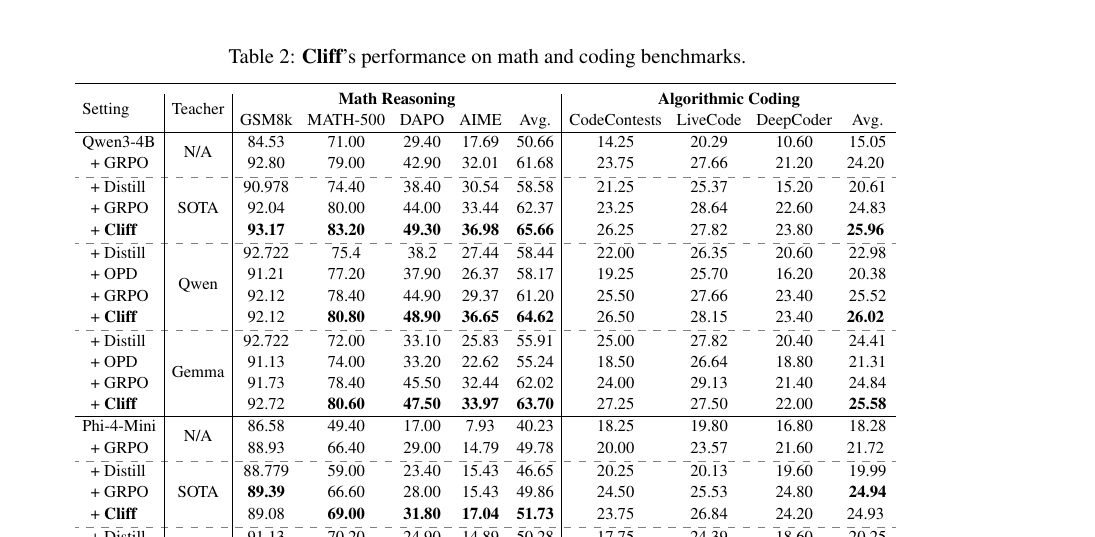
Four findings from this table matter beyond just “Cliff wins”:
(1) The gain is not just from having a teacher — it’s from the prefix/suffix split specifically. This is the paper’s most important ablation and the one most likely to be skipped by a fast reader. GRPO-with-Teacher (teacher judges correct/incorrect, but the whole rollout still gets one flat advantage, exactly like plain GRPO’s outcome reward just recomputed by an LLM instead of a rule-based verifier) only improves marginally over plain GRPO (e.g., 62.37 vs. 61.68 math avg. with the SOTA teacher — a 0.69-point gain). Cliff, using the same teacher and the same judgments, but additionally splitting the token-level advantage at the Pitfall Step, reaches 65.66 — a further 3.29-point gain on top of GRPO-with-Teacher’s already-modest 0.69. This cleanly isolates that the win comes specifically from where the credit gets assigned within a rollout, not merely from having an LLM re-verify correctness.
(2) Cliff does not require a near-frontier teacher. Comparing the SOTA-teacher row (65.66 math avg.) against the open-source Qwen3-32B-teacher row (64.62), the gap is real but modest (about 1 point), even though Qwen3-32B’s own problem-solving accuracy trails SOTA substantially (recall Table 1: 65% vs. 93% reference-solution accuracy). This matches the Section 4 judge-quality finding that judging is meaningfully easier than solving — a mediocre-at-solving teacher can still be a good-enough judge to drive most of Cliff’s benefit.
(3) OPD underperforms both GRPO and Cliff here, despite being a legitimate, actively-researched alternative — 58.17 math avg. vs. GRPO’s 61.20 and Cliff’s 64.62 under the same Qwen3-32B teacher. The paper attributes this to OPD’s core requirement (shared tokenizer/reasoning style between teacher and student) being only partially satisfied here, which is exactly the constraint Cliff was designed to avoid depending on in the first place.
(4) The pattern holds across both math and code, which matters because code rewards in this paper are unit-test pass/fail (not partial credit for passing some tests) — the same binary-reward assumption from Section 3.1 applies unmodified, and the Pitfall Step concept (“first sentence where the reasoning goes wrong,” as judged by a teacher reading the whole chain-of-thought, not just checking final code output) transfers to a domain where success is checked by running code rather than checking a boxed number.
8. Design Choice Deep-Dive: The Length-Hacking Math (Why Is Provably Safe)
Section 3.4 already described what happens empirically as increases (longer responses, worse accuracy). The paper’s Appendix C derives why, and it’s worth walking through because it’s a genuinely elegant piece of reward-hacking analysis that generalizes beyond this one paper.
The general question. Autoregressive generation length is entirely controlled by when the model chooses to emit the EOS token. If a training signal makes non-EOS tokens look relatively more attractive than EOS at a position where the model could have stopped, responses get longer; if it does the opposite, they get shorter. So the right way to ask “does this method incentivize length-hacking” is: does the average per-rollout advantage correlate with rollout length in a way that’s separable from whether the rollout is actually correct?
GRPO’s baseline case. The paper defines a group’s “length mass” (roughly: total advantage mass carried by all non-final tokens, since the final EOS token’s own advantage doesn’t drive lengthening the same way interior tokens do). Because GRPO’s advantages are constant within a rollout, this telescopes down to using the zero-mean-across-group property, and after substituting from Equation (3) and simplifying, the paper arrives at where are the average lengths of correct and incorrect rollouts respectively. The conclusion (Equation 7-8 in the paper): ‘s sign exactly tracks whether correct rollouts happen to be longer than incorrect ones in the policy’s own current samples — GRPO is a faithful amplifier of whatever length-correctness correlation already exists in the data, not an independent source of length pressure. If longer responses aren’t actually more often correct, GRPO gives the model no incentive to lengthen just for its own sake. This is the safety property Cliff needs to preserve.
Cliff’s case. Because Cliff also recenters to zero mean (Equation 5), the same telescoping trick applies, but now (the last token’s advantage) is always exactly or (never the valid-prefix value , since the very last token of an incorrect rollout is by definition part of the erroneous suffix, not the valid prefix). Working through the algebra (paper’s Equation 9-10) with denoting the average fraction of an incorrect rollout’s length that lies in the valid prefix, the paper derives the lengthening condition:
Read this as: when (no valid prefix ever, i.e., every incorrect rollout is wrong from token zero), Cliff’s lengthening condition reduces to exactly GRPO’s () — Cliff degenerates safely back to GRPO’s behavior when there’s nothing to split. But when (incorrect rollouts typically do have some valid prefix, which is the normal, expected case), the right-hand side shrinks below 1, meaning Cliff’s threshold for “lengthening becomes advantageous” is easier to cross than GRPO’s — and, crucially, that threshold gets easier to cross the larger is, since appears with a positive coefficient inside the term being subtracted. This is the formal version of the empirical Table 4 result: keeps the lengthening threshold as close to GRPO’s safe baseline as Cliff’s design allows, while larger actively lowers the bar for reward-hacking-via-length.
Why the overlength hard cap ( when truncated) is a correctness requirement, not just an optimization. One more subtlety: the whole derivation above assumes every rollout actually emits an EOS token. If a rollout is truncated at the maximum length before finishing, GRPO’s outcome verifier almost always scores it as failed (correctly — an unfinished answer usually can’t be verified as correct), so GRPO naturally suppresses the lengthening trend for truncated rollouts. But Cliff’s teacher judges reasoning validity, not task completion — a truncated rollout that was reasoning perfectly correctly right up until it ran out of budget would get a long valid-looking prefix from the teacher, with no erroneous suffix at all to punish it. Without intervention, this would hand the policy a free, safe way to get long valid-prefix credit simply by generating right up to the length limit without ever finishing. This is exactly why Section 3.2’s Algorithm 1 (step 15) hard-codes for any overlength rollout — treating the entire truncated rollout as if it were wrong from the start, closing this specific loophole by fiat rather than relying on the general argument to cover it (the general argument doesn’t cover this edge case, since a truncated rollout’s would otherwise be pushed close to 1).
The paper actually derives two separate sufficient conditions for full safety against length hacking (its Equations 12-13): (C1) a correct rollout’s total advantage must always exceed an incorrect rollout’s, even in the worst case where the incorrect rollout is stretched to the maximum length — working through the algebra gives , and since empirically, satisfies this. (C2) an incorrect rollout must never be able to increase its own total advantage purely by extending its valid prefix — this reduces to , and with empirically, this forces to be very small. Setting trivially satisfies both conditions regardless of what the empirical constants happen to be in any given run, which is a cleaner guarantee than picking some small positive that only works for the specific and values measured in this paper’s experiments. One genuinely interesting nuance the paper adds: condition (C2) is not actually required for safe training in the fully general sense — extending a valid prefix is only “hacking” if the extra tokens are padding, repetition, or otherwise non-substantive; if a longer prefix reflects genuinely more correct reasoning before the eventual mistake, rewarding it is exactly what Cliff is supposed to do. What ultimately separates legitimate reward from hacking is the teacher’s judgment of whether the tokens are real reasoning, not the mathematical shape of the advantage function itself — the math derivation guarantees the worst case is safe, it doesn’t imply every positive is automatically bad.
9. Implementation Details Worth Knowing
A few concrete engineering choices from the paper’s Appendix B/D are worth calling out because they affect how faithfully this could be reproduced: training is built on veRL, using DAPO’s token-level loss aggregation (footnote 1 in the paper, already mentioned in Section 3) rather than per-sequence-averaged GRPO. Cliff and GRPO share hyperparameters (batch size 64, 12 rollouts per group, 200 training steps, actor LR 1e-6, rollout temperature 1.0, advantage clip 0.2, zero KL penalty) so the comparison in Table 2 isolates the advantage-computation change specifically, not confounded by different optimization settings. Teacher rollout temperature is fixed at 0.6 (lower than the student’s own 1.0, favoring a more deterministic/reliable teacher judgment). The judge prompts (Appendix D, one for math, one for coding) are carefully engineered with explicit anti-over-penalization rules — e.g., “if the student’s final answer matches the reference, mark it correct unless a step contains a concrete, undeniable error,” and an explicit list of things to never flag: different-but-valid approaches, algebraically equivalent restatements, verbose-but-correct steps, or minor slips that don’t change the final outcome. This prompt engineering detail matters more than it might look: a judge that’s too eager to flag stylistic differences as “mistakes” would inject noise into the Pitfall Step signal and could plausibly reproduce exactly the reward-hacking risks the paper is trying to avoid by not using a trained PRM. The coding-domain judge prompt additionally instructs the teacher to trace a buggy code line back to the reasoning step that decided on it (“a buggy code line is often the faithful implementation of a decision the student already stated in the reasoning above it … report that reasoning line instead”) — a specific, non-obvious design choice for keeping the Pitfall Step at the true source of the error rather than at its downstream symptom.
The paper’s Appendix E case studies are also worth a beginner-friendly mention because they show the judge isn’t infallible in an instructive way. In one case, a student’s solution to a periodicity problem gets a wrong final answer, and the teacher correctly (per human review) locates the Pitfall Step at the exact sentence where the student wrongly assumes a period of 20 is sufficient without checking compatibility with the full circular arrangement of 268 positions. But in a different case (a genuinely tricky one, involving numbers arranged in a circle where period-20 within a linear sequence does not imply period-20 on a circle unless 20 divides the circle size), the human annotator explicitly disagrees with the teacher’s chosen Pitfall Step: the teacher flagged an early sentence as wrong, but the human points out that sentence was actually a true (if incomplete) statement, and the real mistake happened several sentences later. This is a genuinely honest inclusion by the authors — it shows that even a capable teacher can misattribute which sentence is the actual first mistake in subtle multi-step derivations, which is exactly the kind of noise Table 1’s non-zero average p-dis (Section 6 above) is measuring in aggregate, not eliminating.
10. Limitations (As Stated by the Authors, Expanded)
The paper’s own Future Work line is brief but points at real, unresolved scope limits worth expanding on: (1) Cliff is currently validated only on math and single-turn code generation, both domains with a clean, automatically-checkable final answer. The paper explicitly states plans to “extend the method to agentic settings” — meaning multi-turn tool use, environments with delayed or partial feedback, or tasks where “correctness” isn’t a clean binary at all, are all untested. It’s a real open question whether a teacher LLM can reliably locate a single “first mistake” in a long, branching agentic trajectory the same way it can in a linear chain-of-thought. (2) The method depends on an LLM judge being available and affordable to call for every training rollout that isn’t part of a unanimous group — for large-scale RL runs with millions of rollouts, this is a real, ongoing inference cost on top of the RL training compute itself, distinct from (though smaller than) training a dedicated PRM once. (3) The paper explicitly notes plans to “explore rule-based Pitfall Step detectors” as future work — an implicit admission that the current LLM-judge approach, while shown to work well in Sections 4-5, is not the only or necessarily final design, and a cheaper non-LLM detector for at least some domains (e.g., code, where syntax/type errors are mechanically checkable) might be a viable complement or alternative.
11. Critical Analysis
(a) Weaknesses and flaws specific to this paper. The main results in Table 2 report only single numbers per cell with no visible variance/confidence intervals across seeds, despite RL training being notoriously noisy run-to-run — a reader cannot tell from the table alone whether Cliff’s typically 1-4 point improvement over GRPO-with-Teacher would hold up against seed variance, especially for the smaller gaps (e.g., 92.12 vs. 92.04 on GSM8k in one row, which is within plausible noise for RL training). The judge-quality study in Section 4 (Table 1) also uses a fairly small hand-annotated set (50 correct + 50 incorrect rollouts), which is reasonable for a preliminary calibration check but is a thin evidentiary base for the strong claim that judging generalizes reliably across the much larger and more diverse rollout population actually used in RL training (thousands of rollouts across 200 training steps).
(b) Limitations the authors understate or omit. The paper is transparent that its own Appendix E case studies include an example where the teacher’s chosen Pitfall Step disagrees with the human expert’s (Case 3, Section 9 above) — but it doesn’t discuss how often this specific failure mode (correctly identifying that something is wrong, but attributing it to the wrong sentence) occurs relative to outright missed mistakes, nor whether it has a measurably different effect on training than a false negative does. A Pitfall Step that’s “wrong but present” (splits the rollout at the wrong point) seems like it could inject a different, and possibly more insidious, kind of noise than a missed mistake (which just falls back to treating the whole rollout as one flat block, i.e., ordinary GRPO behavior) — yet the paper’s judge-quality metrics (Table 1) only report an aggregate distance (p-dis), not a breakdown of how frequently a wrong-but-confident judgment like the circle-periodicity case actually occurs. Also under-examined: Section 6.1 shows that ground-truth filtering only clearly helps the weaker open-source teachers, with SOTA showing near-identical performance with and without it — but this raises a natural follow-up question the paper doesn’t address: for the (unfiltered) fraction of cases where even the SOTA teacher’s own reference solution would fail verification, what fraction of training signal is being silently discarded, and does that fraction vary meaningfully by problem difficulty in a way that could bias what the model ends up learning to solve well?
(c) Concrete, specific improvement suggestions. First, report variance across at least 2-3 seeds for the headline Table 2 results, particularly for the smaller reported gains, so readers can distinguish a real effect from RL training noise — this is a standard and relatively cheap addition given the paper already runs many (teacher, student, domain) combinations. Second, expand the judge-quality evaluation (Section 4) with a breakdown of wrong-Pitfall-Step-but-flagged-as-incorrect cases specifically (not just overall p-dis), since this failure mode plausibly has different training dynamics than a simple miss, and Appendix E’s own case studies suggest it’s not rare. Third, given the paper’s own stated interest in agentic settings, a natural and relatively low-cost next experiment would be to test Cliff on a multi-turn but still single-outcome-verifiable setting (e.g., a tool-augmented math or code task with a few tool calls) as an intermediate step before jumping to fully open-ended agentic environments — this would validate whether the core “find the first mistake, split into two segments” idea survives the jump from a single linear chain-of-thought to a trajectory that includes external tool outputs interleaved with reasoning, which is a meaningfully different structure for a teacher to judge.
11b. A Closer Look at the Coding-Domain Results
Math and coding are treated somewhat symmetrically in Table 2, but they differ in a way worth flagging for readers who work primarily on code: the reward function for coding is strictly binary and strictly pass/fail against a held-out test suite (10 test cases per problem, 5-second time limit, full credit only if every single case passes), executed in a sandboxed environment (VolcEngine’s sandbox, per Appendix A). This is a harsher reward than the math domain in one specific sense — there’s no partial credit for “almost correct” code the way a human grader might give partial credit for a math proof that’s 90% right, which makes the coding domain a genuinely stringent test of whether Cliff’s process-level signal can compensate for outcome-level reward being maximally unforgiving. The results (Code Avg. columns in Table 2) show Cliff’s margin over GRPO is real but generally smaller in absolute percentage-point terms than in math (roughly 1-2 points on Code Avg. versus 3-4 points on Math Avg. in several rows) — plausibly because reasoning errors in code are often more “local” (a single off-by-one bug can invalidate an otherwise-correct algorithm) than errors in a multi-step math proof, making the notion of a single clean “Pitfall Step” a slightly less natural fit for code than for prose-style mathematical reasoning. The paper doesn’t discuss this domain asymmetry explicitly, but it’s visible directly in the numbers and is a reasonable thing to keep in mind when judging how well Cliff’s core idea should be expected to transfer to your own domain if it isn’t math-proof-shaped.
11c. Reading the Training Dynamics Figure
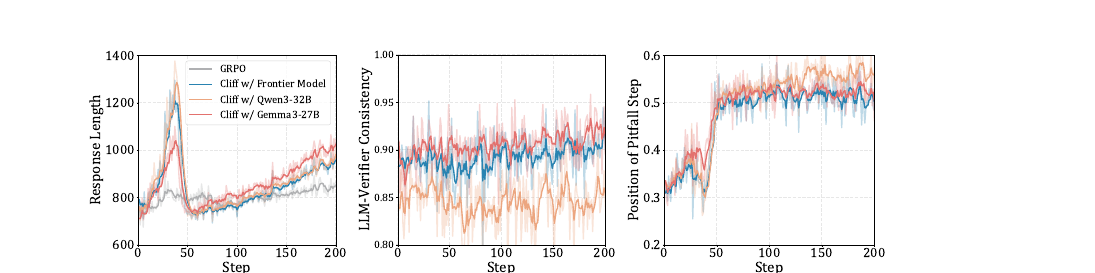
Section 6.3 of the paper (Figure 2, shown just above) tracks three metrics over the course of training rather than just reporting a final number, which is a genuinely useful addition for anyone trying to debug their own Cliff implementation. First, response length grows steadily under both GRPO and Cliff as training progresses (both are learning to reason more before answering), but Cliff shows a distinctive early-training spike in length before stabilizing — the paper reads this as the model initially exploring longer reasoning trajectories before settling into a stable pattern, rather than a sign of runaway length hacking (which the Section 8 math analysis already rules out at ). Second, the paper tracks agreement between the teacher’s judgment and the automatic verifier over training (85-90% typically), noting that Gemma’s lower consistency reflects its comparatively weaker judging reliability relative to the SOTA and Qwen3-32B teachers — a useful sanity check that judge quality (Section 6 of this review) doesn’t silently degrade as the policy being judged evolves during training. Third, and most interesting: the paper tracks the relative position of the Pitfall Step within incorrect rollouts (i.e., from Section 8’s math) over the course of training, finding it rises sharply over roughly the first 50 steps toward about 0.5, then stabilizes. The authors read this as the model first learning to get early reasoning steps right even on hard problems (lengthening the average valid prefix), then settling into a consistent reasoning process rather than continuing to game the judge indefinitely — an empirical, training-curve-level piece of evidence that complements the static worst-case safety argument from Section 8, since it shows the actual trained models don’t drift toward degenerate long-valid-prefix behavior over the full 200-step training run.
11d. A Note on the DAPO-Math Judge Consistency Numbers
One more quantitative detail worth unpacking, since it directly bears on how much to trust Cliff’s teacher-judgment pipeline at scale rather than just in the small 100-example calibration study of Section 4/6 of this review. Section 6.3’s training-dynamics tracking reports 85-90% consistency between the teacher’s correct/incorrect verdict and the automatic verifier’s own binary correctness check, measured continuously across the full 200-step training run rather than on a fixed held-out calibration set. This is a meaningfully different, and arguably more relevant, measurement than the Table 1 judge-quality numbers: Table 1 asks “does the teacher agree with a human on where exactly the mistake is,” a fairly demanding bar, whereas the 85-90% training-time consistency asks the coarser but more directly load-bearing question “does the teacher’s binary correct/incorrect call match what the automatic verifier would say.” The gap between these two numbers (some judge-verifier disagreement is expected and, per Section 6’s discussion of false negatives, partially attributable to the automatic verifier itself occasionally accepting lucky guesses) is a useful sanity check that the pipeline’s core correctness classification remains reasonably stable throughout an entire training run, not just at a single calibration snapshot before training begins.
One more thing worth spelling out for readers less familiar with RLVR pipelines: the reason a 10-15% judge-verifier disagreement rate is tolerable at all, rather than being a fatal flaw, comes back to the skip-if-unanimous optimization from Algorithm 1 (step 7-8 in Section 5’s pseudocode above). Disagreement only matters for groups where the verifier and teacher would route to different Pitfall Step computations — for the (likely large) fraction of groups where the automatic verifier’s binary correct/incorrect split already matches what the teacher would say, any residual disagreement about intermediate reasoning steps is moot, because Cliff’s own optimization means the teacher isn’t even consulted for the outcome-level correctness call on unanimous groups in the first place. This is a subtle but important point: the 85-90% consistency figure describes agreement on the harder-to-avoid cases (mixed groups, where some rollouts succeed and others fail), which is exactly the population where getting the Pitfall Step right actually matters for the resulting policy gradient.
11e. Why Binary Rewards, Specifically
One small but easy-to-miss modeling choice deserves its own callout: the paper’s footnote to Equation (3) notes that even for domains with non-binary rewards (like coding with partial-credit test suites), the paper’s own design recommendation is to either threshold the reward or compare against the group average again, and cites recent work suggesting binary rewards are “more stable and less noisy” for verifiable tasks generally, not just as a Cliff-specific convenience. This matters for the closed-form derivation in Section 3.1 above: everything from Equation (3) onward (the two-value structure, the clean recentering offset in Equation 5, and critically the entire length-hacking safety proof in Section 8) depends on rewards taking only two distinct values within a group. If you tried to apply Cliff’s exact algebra to a genuinely continuous, multi-valued reward (e.g., a graded partial-credit score), the whole closed-form derivation would need to be redone from scratch with a different, messier expression for , since the reward distribution would no longer collapse into just two buckets. This is a real, if narrow, scope boundary on how directly Cliff’s math generalizes beyond binary-reward RLVR settings, distinct from the broader agentic/multi-turn scope limitation already discussed in Section 10.
11f. What “Same Family” Actually Buys OPD, and Why Cliff Doesn’t Need It
It’s worth being concrete about exactly what breaks in OPD when teacher and student diverge, since “shared tokenizer and reasoning style” can sound like a minor caveat rather than the load-bearing constraint it actually is. OPD’s entire supervision signal is the teacher’s log-probability at each of the student’s own token positions — concretely, for token of the student’s rollout, OPD asks “what probability would the teacher have assigned to this exact token, at this exact position, given this exact prefix?” This requires the teacher and student to tokenize identically (so “this exact token” refers to the same sub-word unit for both models) and, more subtly, requires the teacher’s own learned distribution over next-tokens to be a meaningful reference point for judging the student’s choice — if the teacher would never naturally produce this kind of phrasing or notation even when reasoning correctly (a stylistic mismatch rather than a correctness one), its log-probability for the student’s token says more about stylistic distance than about reasoning quality. Cliff’s design deliberately discards all of this: the teacher never sees the student’s token-level generation process at all, only the final rendered text of each sentence, which it judges holistically for correctness. This is precisely why Cliff can pair a frontier closed-source teacher with an open-weight student of a completely different architecture and tokenizer family, a combination OPD structurally cannot support without extra cross-tokenizer alignment machinery (the paper cites specific prior work, e.g. Niu et al. 2026, aimed at exactly this cross-tokenizer OPD problem — machinery Cliff simply has no need for).
11g. A Note on Reward Hacking, More Generally
It’s worth stepping back and connecting Cliff’s specific length-hacking analysis (Section 8) to the broader reward-hacking literature this paper is implicitly responding to, since the framing clarifies why the paper spends an entire appendix on what might otherwise look like a narrow technical concern. Reward hacking, in the RLVR context, generally means: the policy finds some way to increase its measured reward that doesn’t correspond to genuinely better task performance — producing longer responses because length correlates (spuriously) with reward, exploiting a PRM’s blind spots by producing text that superficially resembles good reasoning without being correct, or (in the OPD case) drifting toward whatever surface style happens to minimize the teacher’s surprise regardless of whether that style helps solve problems. What makes Cliff’s specific hacking risk (length, via a too-generous ) tractable to analyze rigorously, where PRM reward hacking generally isn’t, is precisely the simplicity the paper insists on: because Cliff’s advantage function has only three possible per-token values per rollout (Equation 4), the entire space of possible hacking strategies reduces to a single scalar quantity (rollout length) with a closed-form safety condition (Equations 11-13), rather than requiring an empirical audit of an arbitrarily complex learned reward model’s failure modes. This is arguably the paper’s most transferable methodological lesson, independent of the RLVR-for-reasoning application: a reward-shaping mechanism that’s simple enough to admit a closed-form worst-case analysis is a genuinely different kind of artifact than one that requires post-hoc empirical hacking audits, and that difference in analyzability is itself a design goal worth optimizing for, not just a side benefit of choosing a simple mechanism.
12. Reproducibility Notes
The paper specifies its RL framework (veRL), exact hyperparameters for all four methods compared (Table 6, reproduced in Section 9 above), and exact benchmark dataset sources with license information (Table 5: GSM8k, MATH-500, DAPO-math, AIME, CodeContests, LiveCodeBench, DeepCoder, OpenThoughts, all MIT/Apache-2.0/CC-BY-4.0), which is a solid basis for independent replication. The full judge system prompts for both math and coding domains are reproduced verbatim in Appendix D, meaning the exact instructions given to the teacher — including the specific anti-over-penalization rules discussed in Section 9 — are available for anyone attempting to reproduce the judging pipeline rather than having to reverse-engineer them from behavior alone. One reproducibility caveat worth flagging: the paper’s “SOTA” teacher model is referred to only by that label throughout the main text, without specifying the exact model name/version in the body (the actual identity would need to be checked against any code release, which the paper does not link in the text extracted for this review) — reproducing the SOTA-teacher results specifically would require confirming exactly which frontier model was used, since “SOTA” as of the paper’s writing may not mean the same model to a reader six months later.
12b. How Cliff Relates to the Broader RLVR Literature
It’s worth placing Cliff explicitly against the two prior directions it positions itself against, since the comparison clarifies exactly what’s novel here versus what’s borrowed.
Versus Process Reward Models (PRMs). A PRM (e.g., Math-Shepherd, the various “let’s verify step by step” lineage) is a trained scoring function: you collect step-level correctness labels (often via expensive human annotation or automated MC rollouts), train a model to predict a scalar score per step, then use that score as a dense reward signal. This gives you genuinely fine-grained, per-step credit — potentially much richer than Cliff’s single binary cut. But it comes at real cost: the PRM itself needs enough training data to generalize to the exact distribution of student rollouts it will be asked to score during RL, and if it doesn’t generalize well, the policy can learn to exploit the PRM’s blind spots (classic reward hacking) rather than actually reasoning better. Cliff trades away the fine granularity for a scoring mechanism (an off-the-shelf LLM judge) that needs zero additional training data and is far harder to systematically exploit, precisely because its only two possible per-token advantage levels per rollout leave little room for a narrow, learnable exploit surface the way a differentiable, continuously-scored PRM does.
Versus On-Policy Distillation (OPD). OPD sidesteps training a separate reward model by directly using the teacher’s own token-level log-probabilities on the student’s rollouts as a dense signal — essentially asking “how surprised is the teacher by each token the student wrote?” This is elegant when it works, but it fundamentally requires token-level alignment between teacher and student: if they use different tokenizers, the teacher’s per-token log-probs simply don’t correspond to the student’s own token boundaries, and even same-tokenizer teacher-student pairs can differ enough in reasoning style (not just capability) that the teacher’s surprise doesn’t cleanly track the student’s correctness. Table 2 shows OPD’s weaker results are consistent with this: it’s evaluated only for the open-source, same-ish-family teachers (Qwen3-32B, Gemma3-27B), and even there it trails both plain GRPO and Cliff. Cliff needs none of this alignment because it only asks the teacher for a verdict about a whole sentence being right or wrong — a judgment that doesn’t require matching tokenizers or similar reasoning styles at all, just enough shared understanding of the problem domain to recognize a mistake when the teacher sees one.
Versus GRPO-with-Teacher, the paper’s own internal ablation. It’s worth being precise about why this baseline exists, because Section 7’s discussion of it is arguably the single most important result in the paper for understanding where Cliff’s improvement actually comes from. GRPO-with-Teacher replaces only the automatic verifier’s correct/incorrect judgment with the teacher LLM’s correct/incorrect judgment, while every token in a rollout still receives the same flat, unsplit advantage — Equation (2), unchanged. If Cliff’s gains came mainly from “a smarter, more nuanced judge deciding correctness” rather than from “decomposing credit within a rollout,” GRPO-with-Teacher should already capture most of that benefit, since it uses the identical teacher and the identical correctness verdicts Cliff uses. The fact that GRPO-with-Teacher only improves marginally over plain GRPO, while Cliff’s additional per-token split unlocks several more points on top, is the paper’s strongest single piece of evidence that the real contribution is the credit-assignment mechanism itself, not merely outsourcing verification to a stronger judge.
The throughline: PRMs buy fine granularity at the cost of a training pipeline and reward-hacking risk; OPD buys density at the cost of tokenizer/style alignment; Cliff buys neither fine granularity nor per-token density, but in exchange needs no training and no alignment constraint at all — a genuinely different point on the cost/richness tradeoff curve, not simply “OPD or PRM but cheaper.”
13. Conclusion
Cliff answers a genuinely well-posed question — “how fine-grained does process supervision actually need to be?” — with a refreshingly minimal answer: one binary split point per rollout, located by an off-the-shelf LLM teacher rather than a trained reward model, is enough to meaningfully outperform both plain outcome-only GRPO and on-policy distillation across 12 tested (student, teacher, domain) combinations. The method’s appeal is its simplicity: no new model to train, no dependence on shared tokenizers between teacher and student, and a length-hacking-robust default () backed by an actual worst-case safety proof rather than just an empirical default. The honest inclusion of a case where the teacher’s own judgment disagrees with a human expert (Appendix E, Case 3) is a good sign of scientific candor, and the paper is appropriately modest about where it hasn’t yet been tested — agentic, multi-turn settings remain future work. If the vacuous-implication intuition holds up as this method scales to harder, longer, and more open-ended reasoning tasks, “just find the first mistake” may turn out to be a surprisingly durable design principle for process supervision, at a fraction of the engineering cost of training a dedicated process reward model.